Off-Season Running Plan: How to Hold Fitness Between Training Blocks

An off-season running plan has a narrower job than a training plan. It does not need to make you fitter. It needs to let your body and mind recover from the season, keep most of the fitness you built, and hand you to the next block ready to train.
Some fitness will slip, and that is part of the design. Studies of trained runners show the drop stays small when volume comes down but some quality stays in the week. The lighter load is also what brings freshness back. So the next build starts from a body that has recovered and is still close to where it was.
That frees up room in the week. The off-season is when the work that race preparation tends to crowd out gets its turn: short hill sprints for leg speed and power, longer hill repeats for aerobic strength, and strength training with enough time to make real progress.
Every off-season running plan follows the same shape. First comes rest, sized to the season you just finished. Then comes a maintenance running plan that holds fitness without building fatigue. Finally, the next plan begins with its base block, sized to the weeks left before your next goal race. Coming off a quiet stretch rather than a hard season? In that case, skip the rest weeks and start at maintenance.
Key Takeaways
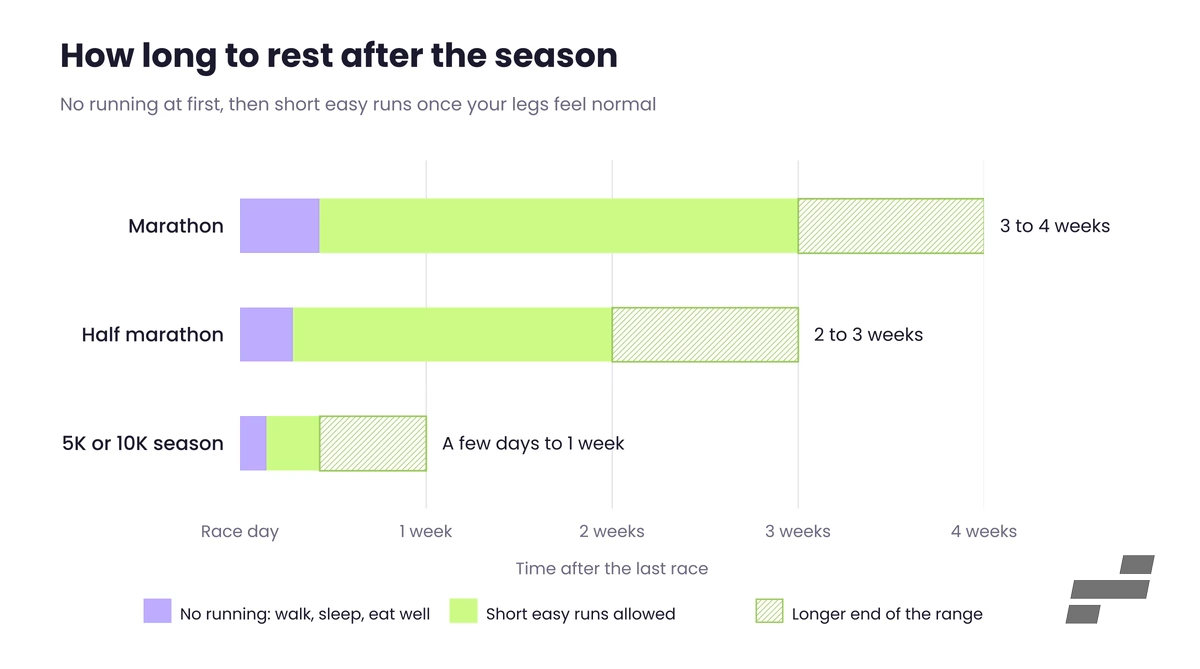
- Rest three to four weeks after a marathon, two to three after a half marathon, and a few days to a week after a 5K or 10K season, with short easy runs coming in once your legs feel normal.
- Some fitness slips in the off-season, but cutting volume while keeping some quality keeps the drop small, and the lighter load is what brings back freshness.
- A maintenance running plan runs for about four weeks at about a third of your peak weekly running time over three or four days, with a long run of about half your last build’s longest.
- An off-season running plan is the time for short hill sprints, longer hill repeats, sub-threshold work and strides, all kept well short of exhausting.
- Your off-season running plan ends after about four weeks of maintenance, when your next plan starts with its base block and runs for the weeks left before your goal race.
- You are ready to build when niggles have cleared, easy runs feel normal again and you want to train.
How Long Should a Runner’s Off-Season Be?
A runner’s off-season starts with rest sized to the season that just ended: three to four weeks after a marathon, two to three weeks after a half marathon, and a few days to a week after a 5K or 10K season. About four weeks of maintenance follow, and then the base block for your next goal race begins.
Sizing the Rest to the Season You Just Had
The marathon earns the longest rest because the damage runs deeper than the soreness. Warhol and colleagues (1985) took calf muscle biopsies from marathon runners at intervals after the race. The damaged muscle fibers took three to four weeks to repair. In other words, the legs usually feel fine within a week, well before the repair is done. That is why a marathon calls for three to four weeks of rest rather than one.
Rest does not have to mean zero running, though. Martínez-Navarro and colleagues (2021) had marathon finishers either rest or run 40 minutes at moderate effort every other day, starting two days after the race. The runners recovered from muscle damage just as well as the resting group, and their jump performance came back faster. So short, easy runs fit into the rest weeks once walking and stairs feel normal.
A half marathon is easier to absorb. In a simulated half marathon, most strength and movement measures were back within one to two days (Wang and colleagues, 2025). The two to three weeks covers what a single test does not: months of training load on tendons and bones, plus the mental break.
After a 5K or 10K season, the rest is mostly for the mind. A few days to a week is usually enough, unless the season ran long with frequent racing, in which case go toward the longer end.
Is It Okay to Take a Month Off From Running?
Yes. After a marathon, the recommended rest already comes close to a month. A month with no running at all costs some fitness and takes a few weeks to rebuild, but it does not erase years of training. It makes the most sense after a long season, an injury, or a stretch where motivation is gone. For a fuller picture, see how quickly an aerobic base fades when training stops and how long the return takes. For most runners, though, an off-season running plan with short easy runs in the rest weeks, followed by maintenance, is the easier way to maintain running fitness and makes the next block easier to start.
The Rest Weeks of an Off-Season Running Plan
The first days after a goal race are for walking, sleeping and eating well. Appetite often stays high for a few days, so eat to it, with enough protein at each meal to support muscle repair.
Once the legs feel normal on stairs, usually around day three or four after a marathon, add short recovery runs in the days after a race. Twenty to 30 minutes every other day is plenty. On sore days, an easy bike or elliptical session keeps blood moving without the impact. From the second week after a marathon, easy runs can gradually come most days, still with no structure and no pace targets.
Heavy lifting stays out for a week or two. Light mobility work fits well here instead, since a few minutes of hip and ankle range most days is easy to keep up.
The rest weeks are also when niggles show themselves. During a build, adrenaline and routine can mask a sore Achilles or a tight hip. With the racing gone, pay attention to anything that still hurts at the start of a run or the next morning. A niggle that lasts through the rest weeks needs attention before maintenance adds load.
Finally, give your head a break as well. Leave the watch at home for a few runs, choose routes for the scenery and run with friends. Motivation coming back on its own is one of the clearest signs the rest has worked.
How Much Fitness You Keep During an Off-Season Running Plan

Trying to maintain running fitness completely through the off-season would defeat the purpose of the break. The aim is a small, controlled drop. The body recovers from the season, stays close to where it was, and starts the next build from a higher floor.
What Happens When Trained Runners Cut Back
Two studies of well-trained runners show where the line sits. Houmard and colleagues (1990) had runners cut weekly volume by about 70% for three weeks while keeping their intervals and races. Their 5K times and VO2max did not change. Runners in a matching study from the same lab also reported better mood, less fatigue and lower perceived effort at a set pace (Witting and colleagues, 1989).
McConell and colleagues (1993) went further. For four weeks, runners cut volume by two-thirds, halved the number of runs and kept every run easy. VO2max held, but nine of the ten runners got slower, adding about 12 seconds to a 16:36 5K.
Twelve seconds is a small price for four easy weeks. It also shows what fades first when all the quality goes: speed at race effort slips before the aerobic engine does.
Reduced Training Versus a Full Stop
García-Pallarés and colleagues (2009) followed world-class kayakers for five weeks after their world championships. Half stopped training completely, and the other half kept training at a reduced load. Both groups lost fitness. However, the reduced-training group lost about half as much. VO2max fell 4.8% against 10.1%, and fitness at threshold fell 5.7% against 8.8%. Cortisol, a stress hormone, dropped by about 30% in both groups, a sign the season’s fatigue was clearing either way.
These were paddlers rather than runners, but the pattern matches the running studies. Rest happens with either approach, and the controlled version keeps more fitness to build from.
Why a Smaller Drop Means a Quicker Return
The smaller the drop, the less there is to rebuild. A detailed case study shows the cost of a long full stop (Lepers and colleagues, 2024). A highly trained master triathlete stopped training for 12 weeks and lost about 11% of his running VO2max. Twelve weeks of structured retraining brought VO2max back, but his running economy and lean muscle mass had still not fully returned.
It is a single athlete, so treat the numbers as an illustration. Still, it points to what maintenance needs to protect beyond the aerobic engine: running economy and muscle. That is the reason for the hills, strides and strength work in the maintenance weeks of an off-season running plan.
How Much Running the Maintenance Weeks Need
For the maintenance block of an off-season running plan, about a third of your peak weekly running time is enough. That matches what the trained runners in both studies kept, about 30% of their usual volume in one and a third in the other. A runner who peaked at six to seven hours a week would run about two to two and a half hours. The hours stay low on purpose, since this is the part of the year set aside for rest and a mental break. They come back in the base block. Measuring in minutes rather than miles keeps the plan fair across paces, since a slower runner covers less ground in the same time.
Most of those minutes stay easy. For the reasoning behind that balance, see how to split easy and hard running across the week.
Your Maintenance Running Plan: A Sample Week
The maintenance weeks are the longest part of an off-season running plan. Each one holds three or four runs, two short doses of quality, one longer run and two strength sessions. The off-season running schedule below sets a first rest week after a marathon beside a typical maintenance week. The maintenance week fits a runner who peaked at six to seven hours a week, so scale the minutes to your own peak, and keep every easy run at how easy an easy run should feel: conversational and relaxed.
| Day | Sample rest week | Sample maintenance week |
| Mon | Rest | Rest |
| Tue | Walk, 20 to 30 min | Easy 25 min, then 6 to 8 × 8 to 12 sec hill sprints; strength |
| Wed | Rest, or easy bike or elliptical, 20 to 30 min | Rest, or easy cross-training, 30 to 45 min |
| Thu | Recovery run, 20 to 30 min, if legs feel normal | Longer hills or sub-threshold, alternating weeks; strength |
| Fri | Rest, light mobility | Rest or mobility |
| Sat | Recovery run, 20 to 30 min, or an easy hike | Optional easy 20 min, then 6 × 20 sec strides |
| Sun | Easy bike, swim or hike, 30 to 45 min | Long run, about half your last build’s longest |
After a half marathon or a shorter season, the rest week can start with easy running a day or two sooner. If you skip the optional Saturday run, add the strides to Tuesday.
Hills, Sub-Threshold Work and Strides
Race preparation pushes the week toward race-specific sessions, and neuromuscular work tends to get left behind. An off-season running plan is a good time to bring it back.
Short hill sprints build power and leg stiffness with very little fatigue. Run 6 to 8 efforts of 8 to 12 seconds up a steep hill, close to full effort. Walk back down for full recovery, about two minutes. Each sprint should feel as crisp as the first.
Longer hill repeats build aerobic strength. On a moderate grade, choose one of two versions: 10 to 12 repeats of 25 to 30 seconds, or 5 or 6 repeats of 1 minute. Run them at a strong but controlled effort and jog back down between each. On alternate weeks, swap them for sub-threshold work, such as 2 × 10 minutes just under threshold effort with two minutes easy between. Your breathing should be deep and steady, never ragged.
On top of that, add a few strides after easy runs twice a week.
💡 Coaching tip: Finish every maintenance session feeling you could have done two more reps. Hold back from time trials or chasing paces here. The goal is to keep these systems working without adding fatigue.
The Long Run in Maintenance
The maintenance long run scales with the long run you built up to. About half of your last build’s longest run, by time, is a sensible target. A runner who peaked at 2.5 hours runs about 75 minutes. One who peaked at 90 minutes runs about 45. In a smaller week, the long run takes a bigger share of the time.
This is the run that protects endurance for longer efforts. In an early reduced-training study, cutting every session to 13 minutes held VO2max but cost endurance on a long test of about two hours (Hickson and colleagues, 1982). Keep it easy and steady; long-run effort and pacing covers how that should feel.
Strength and Cross-Training in an Off-Season Running Plan
Once the week or two off heavy lifting is over, two strength sessions a week fit easily. With running load down, there is room to make progress rather than just hold on. Strength work also raises how much load the legs can tolerate when the next build adds miles.
Keep the basics: split squats, single-leg Romanian deadlifts, step-ups and calf raises, starting with bodyweight and then adding load. For progression, see strength work in the transition phase. An off-season running plan also suits fixing weak links, such as with a hip and glute routine.
Cross-training adds variety without impact. Cycling, swimming and hiking all count, and trail running or hiking on rolling ground brings natural hill work into easy days.
When Your Off-Season Running Plan Ends
After the rest weeks and about four weeks of maintenance, your off-season running plan ends and the next plan begins with its base block. Next season’s main race decides how long that plan runs, so choose it before the off-season ends. A framework for ranking races as A, B or C priorities helps when the calendar holds several options.
Fitting the Next Plan to Your Race Date
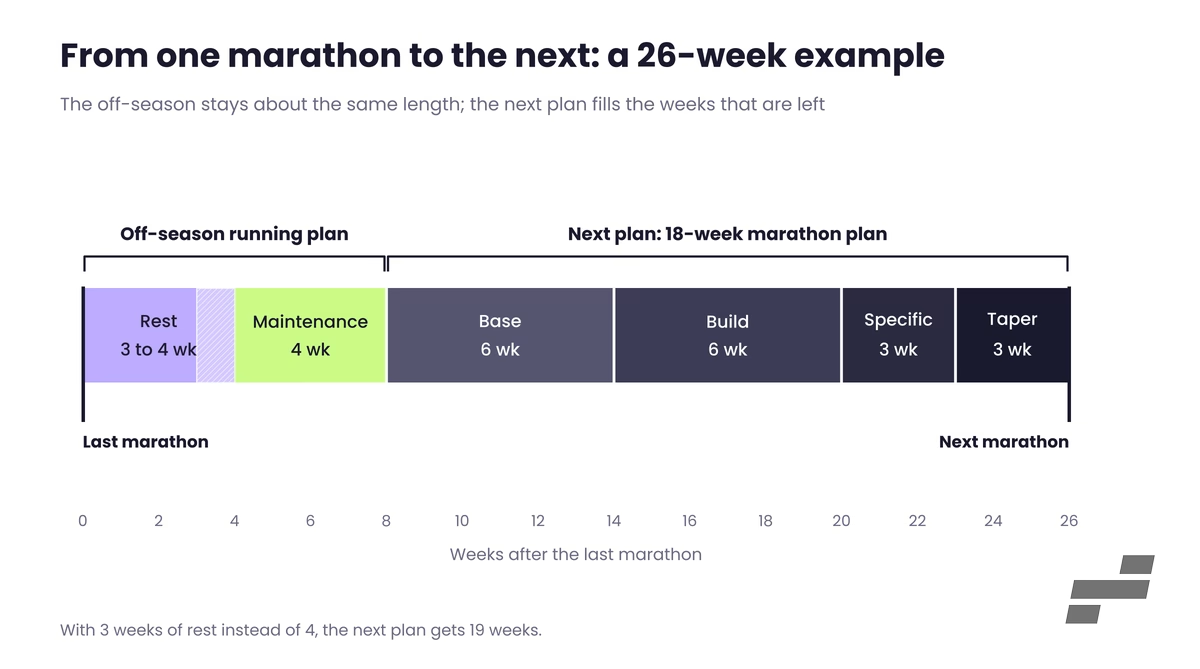
Count the weeks from the end of maintenance to race day. That number sets the length of your next plan, with the base block as its opening phase. The off-season stays about the same length each time, and the plan is what stretches or shortens to fit.
For example, an 18-week marathon training plan opens with its own base phase. Say the next marathon falls about 26 weeks after the last one. Three to four weeks of rest and four weeks of maintenance leave 18 to 19 weeks, which fits that plan. A first-time marathoner would do the same sum with a first-timer plan.
When the next race is further away, the plan can run longer, with more time in base. When it is closer, maintenance shrinks first. The rest weeks are the part to protect, since starting a build on legs that have not repaired costs more than a few weeks of base.
The base block itself rebuilds volume before the plan adds race-specific work. For how that block differs from what follows, see what each training block should emphasize.
Rebuilding volume means returning to your usual training hours, not going past them. Many runners have a fixed amount of time to train each week. For them, the base block brings the week back to those hours. The build then changes what fills them, with harder and more race-specific sessions inside the same time.
Signs You Are Ready to Build
The calendar sets the target date, but the body confirms it. In practice, four signs show you are ready:
- Niggles from the season have cleared, with no pain at the start of runs or the next morning.
- Easy runs feel normal again at your usual effort and heart rate.
- The maintenance long run feels routine rather than draining.
- You want to train, and look forward to structure rather than putting it off.
When the date arrives and the signs are not there yet, add one more week of maintenance to your off-season running plan. Starting a build a week late costs far less than starting it tired.
Building an Off-Season Running Plan for Each Athlete
For coaches, the off-season rarely lines up across a roster. One athlete finishes a fall marathon while another has a spring half on the calendar and a third has no race planned at all. Each off-season running schedule therefore starts from that athlete’s own race dates: rest sized to the season they just had, and a next plan sized to the weeks left before their next A race.
The maintenance weeks are also a good time to address what the last build exposed. An athlete who struggled on hilly courses gets more of the longer hill work. One who faded late in races gets a steady long run and an extra strength session. The structure stays light, but the emphasis is chosen per athlete.
Readiness is where the coach adds most. Athletes often report feeling ready before their easy runs say so, and some hold back longer than they need to. Comparing how easy runs feel against their usual effort and heart rate, alongside their own feedback on niggles and motivation, gives a clearer answer than either alone.
With an off-season running plan built this way, the athlete starts the next block rested, still fit, and working on the parts of their running that race preparation left behind.

Every Athlete’s Off-Season, on Their Own Dates
Suggested References
- Houmard, J.A., Costill, D.L., Mitchell, J.B., Park, S.H., Hickner, R.C., and Roemmich, J.N. (1990). Reduced training maintains performance in distance runners. International Journal of Sports Medicine, 11(1), 46–52.
- Witting, A.F., Houmard, J.A., and Costill, D.L. (1989). Psychological effects during reduced training in distance runners. International Journal of Sports Medicine, 10(2), 97–100.
- McConell, G.K., Costill, D.L., Widrick, J.J., Hickey, M.S., Tanaka, H., and Gastin, P.B. (1993). Reduced training volume and intensity maintain aerobic capacity but not performance in distance runners. International Journal of Sports Medicine, 14(1), 33–37.
- García-Pallarés, J., Carrasco, L., Díaz, A., and Sánchez-Medina, L. (2009). Post-season detraining effects on physiological and performance parameters in top-level kayakers: comparison of two recovery strategies. Journal of Sports Science and Medicine, 8(4), 622–628.
- Lepers, R., Mater, A., Assadi, H., Zanou, N., Grémeaux, V., and Place, N. (2024). Effect of 12 weeks of detraining and retraining on the cardiorespiratory fitness in a competitive master athlete: a case study. Frontiers in Physiology, 15, 1508642.
- Hickson, R.C., Kanakis, C., Davis, J.R., Moore, A.M., and Rich, S. (1982). Reduced training duration effects on aerobic power, endurance, and cardiac growth. Journal of Applied Physiology, 53(1), 225–229.
- Warhol, M.J., Siegel, A.J., Evans, W.J., and Silverman, L.M. (1985). Skeletal muscle injury and repair in marathon runners after competition. American Journal of Pathology, 118(2), 331–339.
- Martínez-Navarro, I., Montoya-Vieco, A., Hernando, C., Hernando, B., Panizo, N., and Collado, E. (2021). The week after running a marathon: effects of running vs elliptical training vs resting on neuromuscular performance and muscle damage recovery. European Journal of Sport Science, 21(12), 1668–1674.
- Wang, W., Xu, S., Komnik, I., Viellehner, J., Zedler, M., and Potthast, W. (2025). Biomechanical changes and the time course of recovery in lower extremities of recreational runners following a simulated treadmill half-marathon. Sports Medicine – Open, 11, 22.