Strength Training for Runners: The Exercises and How to Program Them
Most runners already know strength training helps. The harder questions are practical. Which exercises are worth the time? How heavy should the weights be? Which days should you lift on, and what happens to the lifting when race-specific training picks up?
Strength training for runners works on progressive overload, the same principle that drives the running itself. The body adapts to what it is asked to do, so the demand has to keep rising for the adaptation to continue. A first set of bodyweight lunges is genuinely hard; by the fourth week, the same set asks nothing new of the legs, and progress stalls. Keeping it going takes load that rises over time, sessions placed where they don’t cost the runs that matter, and a dose that changes as the race gets closer.
This guide to strength training for runners covers all of it. It starts with what to do and how heavy to lift, then walks through the exercises worth doing, each with an easier and a harder version. After that come how to start from zero, where sessions sit in a running week, and how the plan shifts from base training to race day.
Key Takeaways
- Two sessions a week of heavy lower-body lifting, calf work, a few jumps and some trunk and upper-body work cover what most runners need.
- Lift a weight you could manage about six times, do four or five reps with it, and add weight once the last rep stops feeling hard.
- Heavy, low-rep lifting makes runners stronger without making them heavier, because most of the early gain comes from the nervous system rather than muscle size.
- Lift on the same day as a hard run, after it, so easy days stay easy and the day before the long run stays free.
- Build strength in base training, hold it with one shorter session through the build and taper, and finish loaded work about a week before the race.
- Runners over 50 have the most to gain, since muscle and bone decline faster with age and heavy lifting slows both.
What Strength Training Should Runners Do?
Runners should do two strength sessions a week built around heavy lower-body lifts such as squats, deadlifts and split squats, plus calf raises, a few jumps, and some trunk and upper-body work. Lift heavy for few reps, about four to six per set, and add weight over time. Place sessions after hard runs, keep them to 30 to 45 minutes, and drop to one shorter session as a race approaches.
The payoff shows up in two places. The first is running economy, the oxygen cost of holding a given pace. In a study by Støren and colleagues (2008), well-trained runners who added heavy half squats three times a week for eight weeks improved their economy by about 5%. They also ran about 21% longer at their maximal aerobic speed before reaching exhaustion, with no change in body weight. In practice, the same race pace costs less, and that saving matters most in the final third of a race, when everything else is starting to fade.
The second is durability. Every step loads the calves, the Achilles and the knees, and stronger muscles and tendons tolerate that load across more weeks of training. Strength work doesn’t make a runner injury-proof, since how quickly training load rises matters at least as much. Still, the tissue capacity it builds is what lets a runner string together consistent weeks. For more on the research on why distance runners need strength work, including the link between leg stiffness and economy, see our earlier summary.
How Heavy to Lift
In strength training for runners, heavy means a weight you could lift about six times with good form, done for four or five reps. The last rep should feel slow and effortful, yet still clean. If every rep moves at the same speed, the weight is too light. If your form breaks on the last rep, it’s too heavy.
The reason is what each kind of lifting trains. Light weights for 15 or 20 reps build muscular endurance, which running already supplies in large amounts. Heavy weights train something running doesn’t: the nervous system’s ability to recruit more of the muscle at once and produce force quickly. That quality shows up as a stiffer, more elastic stride, and it is the one linked to better economy.
Heavy is also relative. A runner new to lifting who can goblet squat a 12 kg kettlebell six times is lifting heavy for them. In practice, progressive overload means adding weight once every rep of every set looks like the first one. For most lower-body lifts, that means 2.5 to 5 kg at a time; for single-leg moves, the next dumbbell up. Expect fast gains in the first two months as the movement becomes familiar, then slower, steadier ones.
Stop each set before you fail. Grinding out a rep you barely make adds soreness that carries into the next run, without adding strength.
Will Weight Training for Runners Make You Bulky?
No. Building muscle size takes lots of volume, a calorie surplus, and recovery that isn’t already going into running. A runner’s week works against all three. In a 40-week study by Beattie and colleagues (2017), competitive distance runners lifted twice a week in preseason and once a week in-season. They got stronger and more economical, with no change in body mass or lean leg mass. The gain comes from a better-wired nervous system, not bigger legs.
The Best Strength Exercises for Runners
The best strength exercises for runners build force through the hips, knees and ankles, often one leg at a time. For the legs and hips, that means squats, Romanian deadlifts, split squats, single-leg Romanian deadlifts, calf raises, hip thrusts and Copenhagen planks. Add side planks and Pallof presses for the trunk, push-ups and rows for the upper body, and hops that build up to bounds.
Each exercise below comes with an easier and a harder version, so you can start where you are and keep progressing. The rep ranges are for the heavy phase described above.
1. Squat
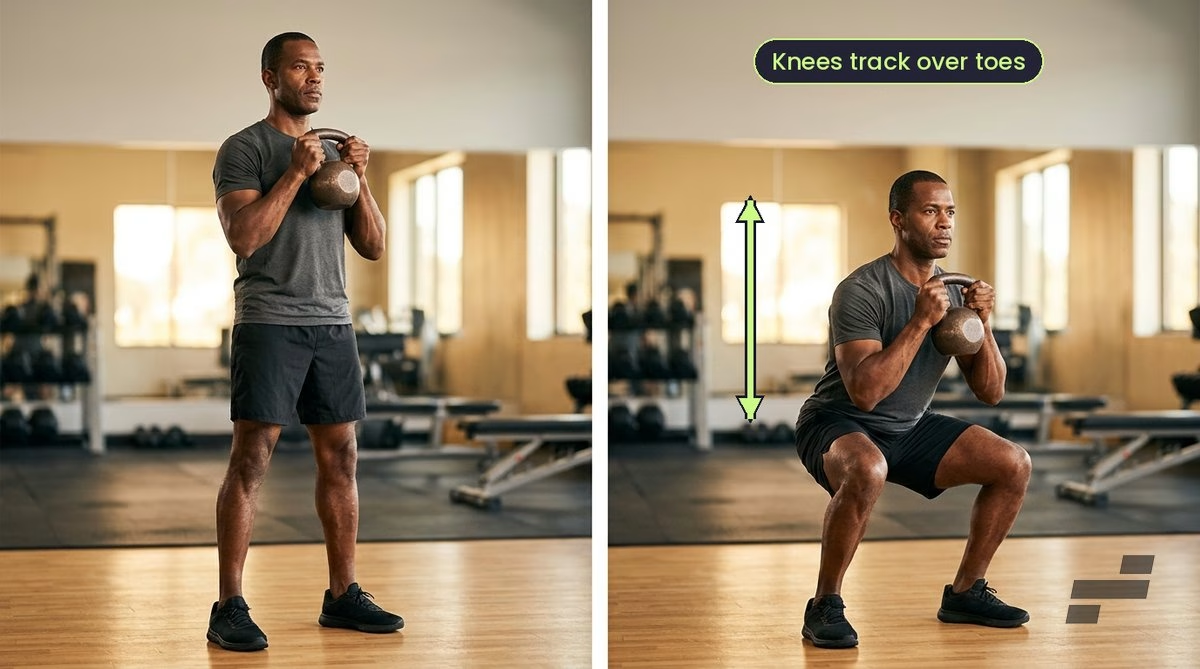
The squat builds the quads and glutes that control the knee every time you land. Stand with your feet about hip-width apart, sit down between your heels until your thighs are about parallel to the floor, and drive back up. It is the base for any quad strengthening a runner does.
- Easier: bodyweight squat to a box or bench.
- Harder: goblet squat with a kettlebell, then a barbell back squat.
- Heavy phase: 3 to 4 sets of 4 to 6.
2. Romanian Deadlift
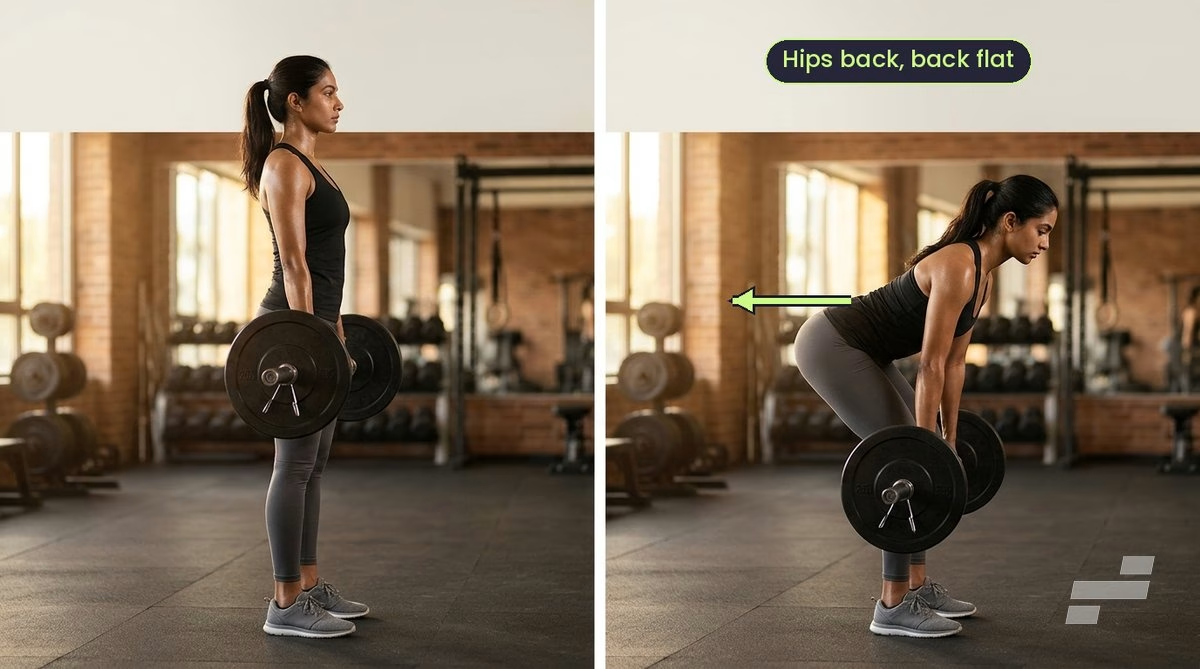
This lift trains the hamstrings and glutes through a hip hinge, the movement that drives you forward at push-off. Hold a bar or dumbbells, soften your knees, and push your hips back until you feel a strong stretch in the hamstrings, keeping your back flat. Stand up by driving the hips forward. The hamstrings work hardest at faster speeds, so this is the lift to keep when time is short.
- Easier: a broomstick or light kettlebell to learn the hinge.
- Harder: a loaded barbell, or a trap-bar deadlift from the floor.
- Heavy phase: 3 to 4 sets of 5.

3. Rear-Foot Elevated Split Squat
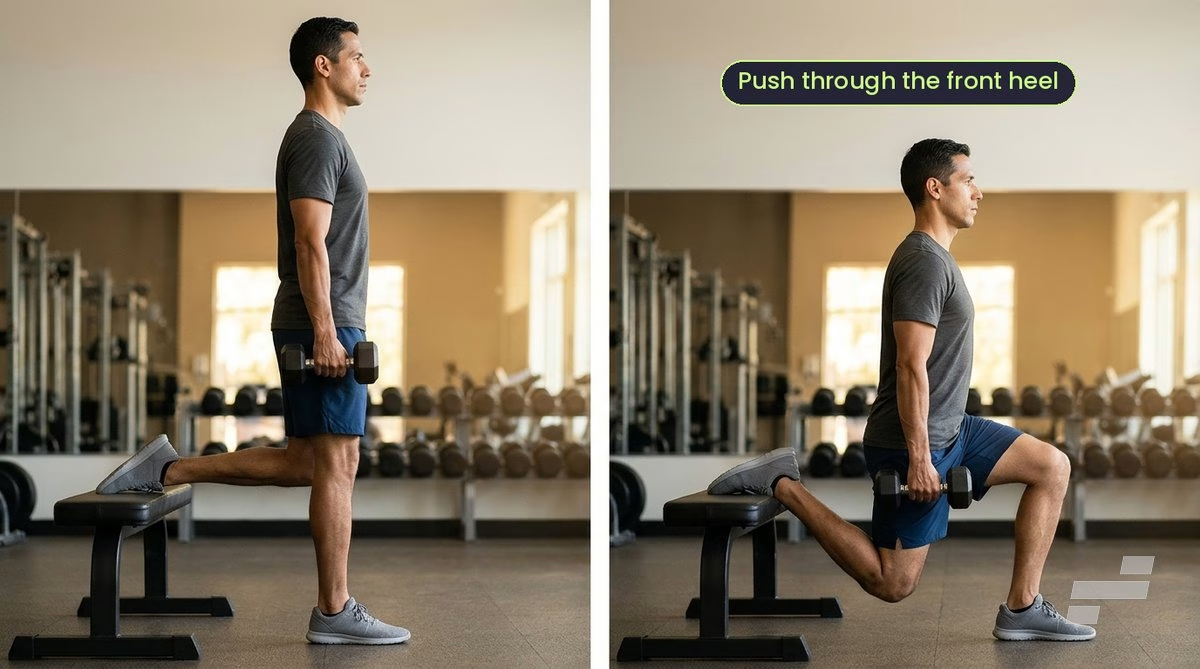
This is one of the most effective leg strength exercises for runners, because it loads one leg through a deep range while the other barely helps. Rest your back foot on a bench and step the front foot out far enough that the front knee tracks over the toes. Lower until the back knee nearly touches the floor, then push up through the front heel.
- Easier: a static split squat with both feet on the floor.
- Harder: a dumbbell in each hand, then a barbell.
- Heavy phase: 3 sets of 5 to 6 per leg.
4. Single-Leg Romanian Deadlift
The single-leg version adds balance on one foot to the hamstring and glute work, which is close to what every stance phase asks. Hinge forward on one leg while the other extends behind you, keep your hips square to the floor, then stand tall. It also builds the single-leg balance and ankle stability that keep a foot steady on uneven ground.
- Easier: a fingertip on a wall, or the back toe resting on the floor.
- Harder: a heavy dumbbell in the opposite hand.
- Heavy phase: 3 sets of 6 per leg.
5. Calf Raises, Straight and Bent Knee
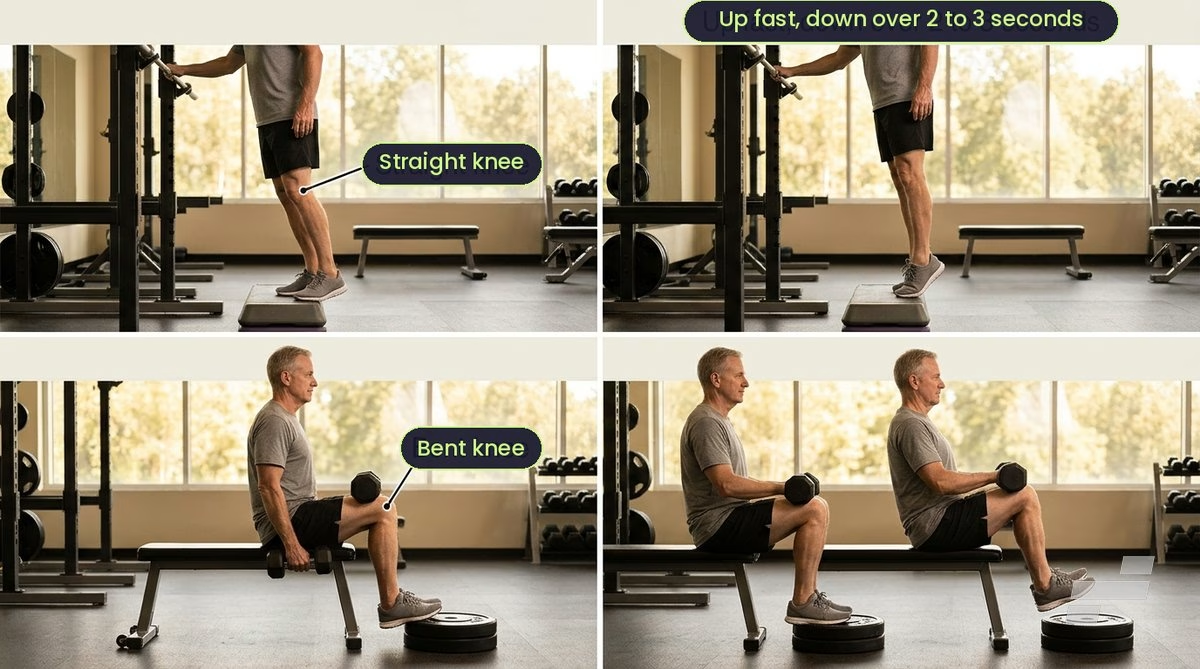
The calves absorb and return more force per step than any other muscle group, and the soleus, which works hardest with a bent knee, does a large share of it. Train both versions. Straight-knee raises off a step target the larger calf muscle; bent-knee or seated raises shift the work to the soleus. Rise quickly and lower over two to three seconds. Calf strengthening is also what the Achilles relies on as mileage rises.
- Easier: both legs at once, bodyweight only.
- Harder: one leg at a time holding a dumbbell, or a loaded seated raise.
- Dose: 3 sets of 8 to 12 of each version.
6. Hip Thrust
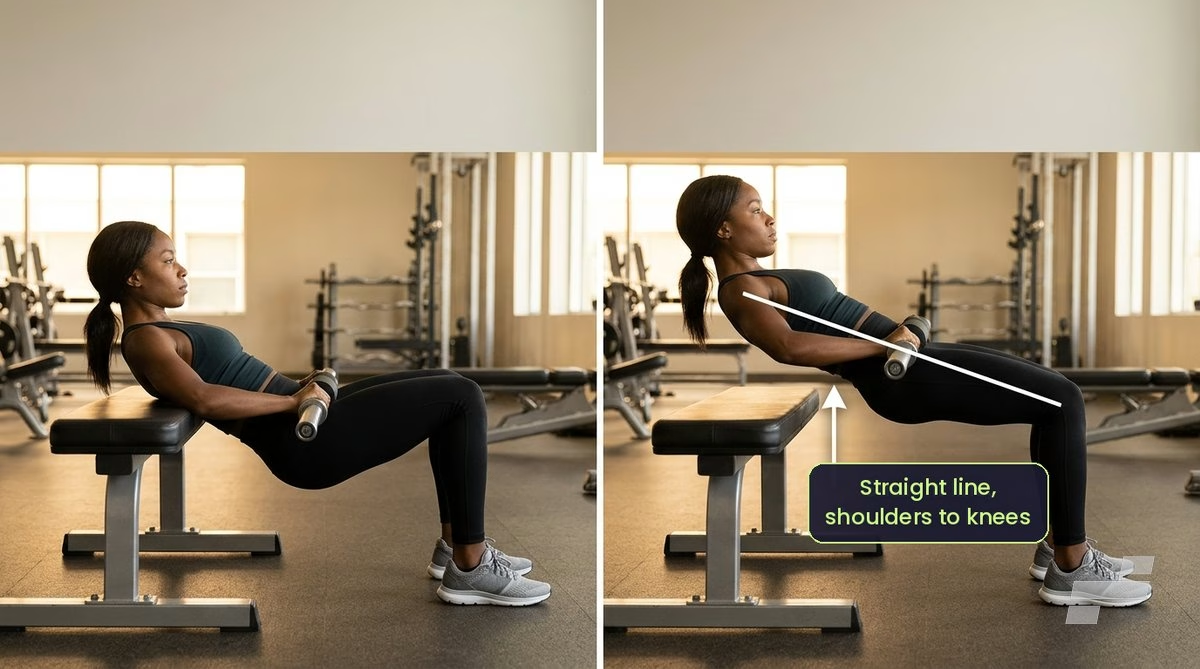
The hip thrust builds the glutes in the hip-extension position you reach at push-off. Sit with your upper back against a bench, feet flat, and a barbell or dumbbell across your hips. Drive your hips up until your body forms a straight line from shoulders to knees, pause, then lower. Side-lying leg raises and banded walks are useful hip and glute exercises for runners alongside it, since they train the side of the hip that keeps the pelvis level.
- Easier: a glute bridge from the floor.
- Harder: a loaded barbell, or a single-leg hip thrust.
- Heavy phase: 3 sets of 6 to 8.
7. Copenhagen Plank
The Copenhagen plank strengthens the adductors, the inner-thigh muscles that steady the pelvis on every landing. Lie on your side with your top leg resting on a bench, lift your hips until your body is straight, and hold.
- Easier: the top knee on the bench instead of the foot.
- Harder: the foot on the bench, then slowly lift and lower the bottom leg.
- Dose: 2 to 3 sets of 20 to 30 seconds per side.
8. Side Plank and Pallof Press
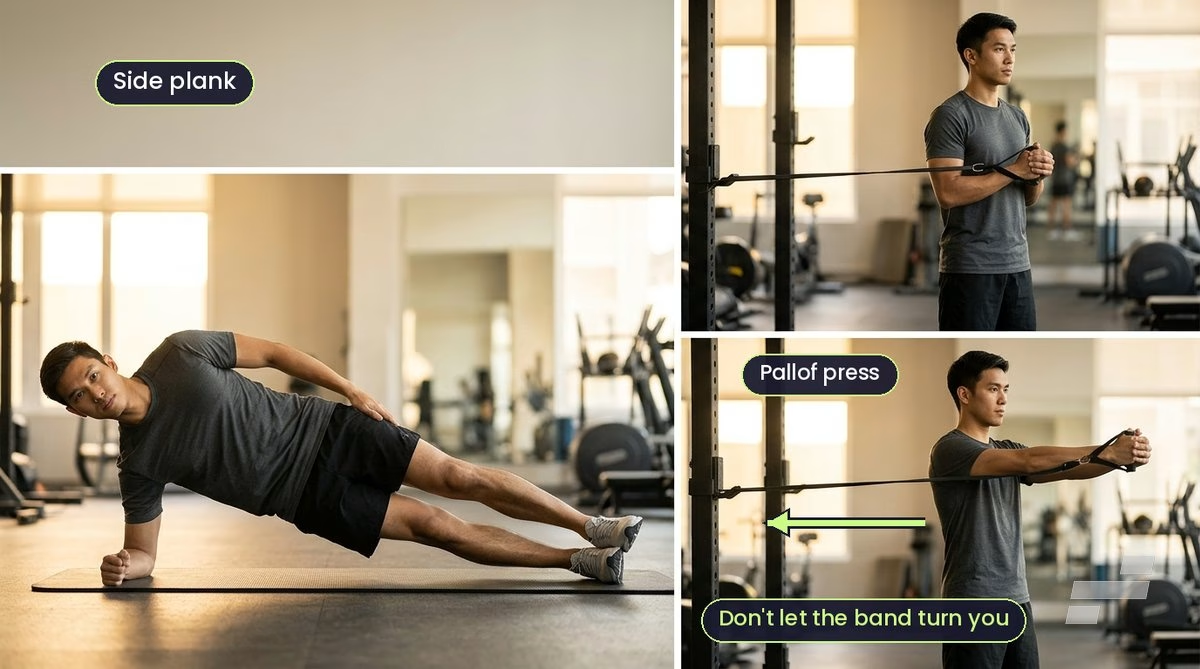
Running asks the trunk to resist twisting and side-bending far more than it asks it to curl. For the side plank, set your forearm under your shoulder, lift your hips and hold a straight line. For the Pallof press, anchor a band at chest height to your side, press it straight out from your chest, and hold without letting it pull you round. Core exercises for runners go well beyond these two, but these cover the patterns that matter most.
- Easier: side plank from the knees; a lighter band.
- Harder: side plank with the top leg raised; Pallof press in a split stance.
- Dose: 2 sets of 20 to 40 seconds, or 8 to 10 presses per side.
9. Push-Up and One-Arm Row
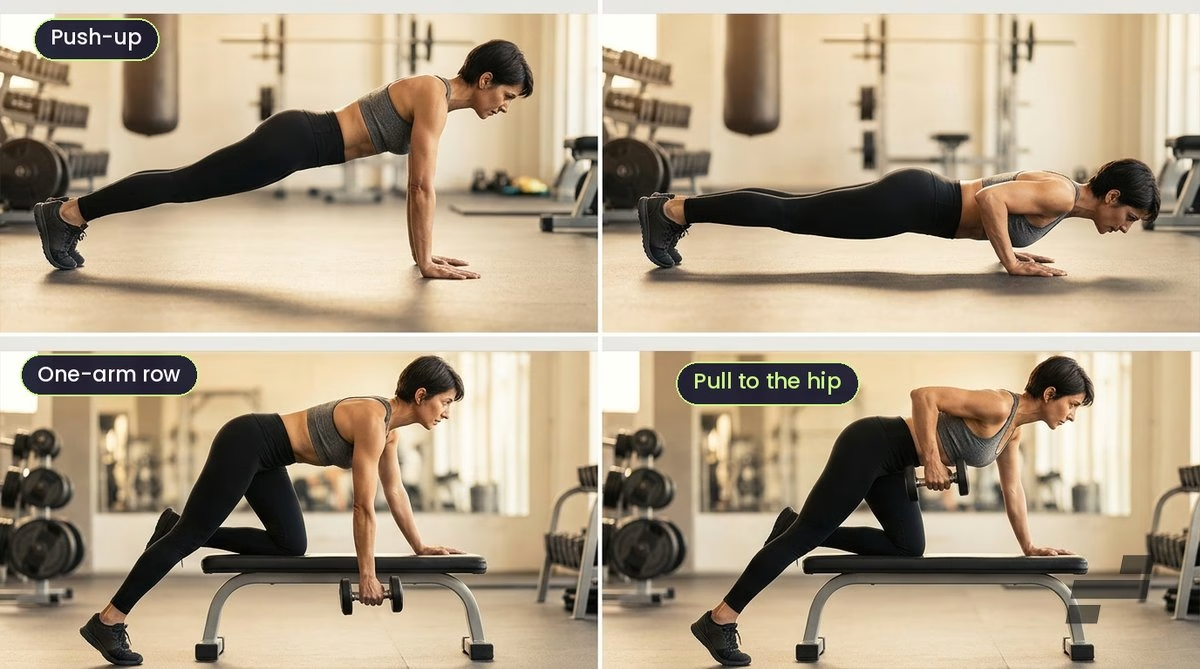
Arm swing balances the legs, and a strong upper back holds your posture late in a long run. For the push-up, place your hands under your shoulders, keep your body straight, and lower your chest to the floor. For the row, put one hand and knee on a bench and pull a dumbbell to your hip.
- Easier: push-ups with hands on a bench; a lighter dumbbell.
- Harder: feet raised or weighted push-ups; a heavier row.
- Dose: 2 to 3 sets of 8 to 10.
10. Pogo Hops to Bounds
Jumps train the tendons to store and return energy quickly. In a nine-week study by Paavolainen and colleagues (1999), well-trained runners who replaced about a third of their training with explosive work ran faster 5K times, with no change in VO2max. The gains came from economy and muscle power, which is why jumps earn a place even in a high-volume running week.
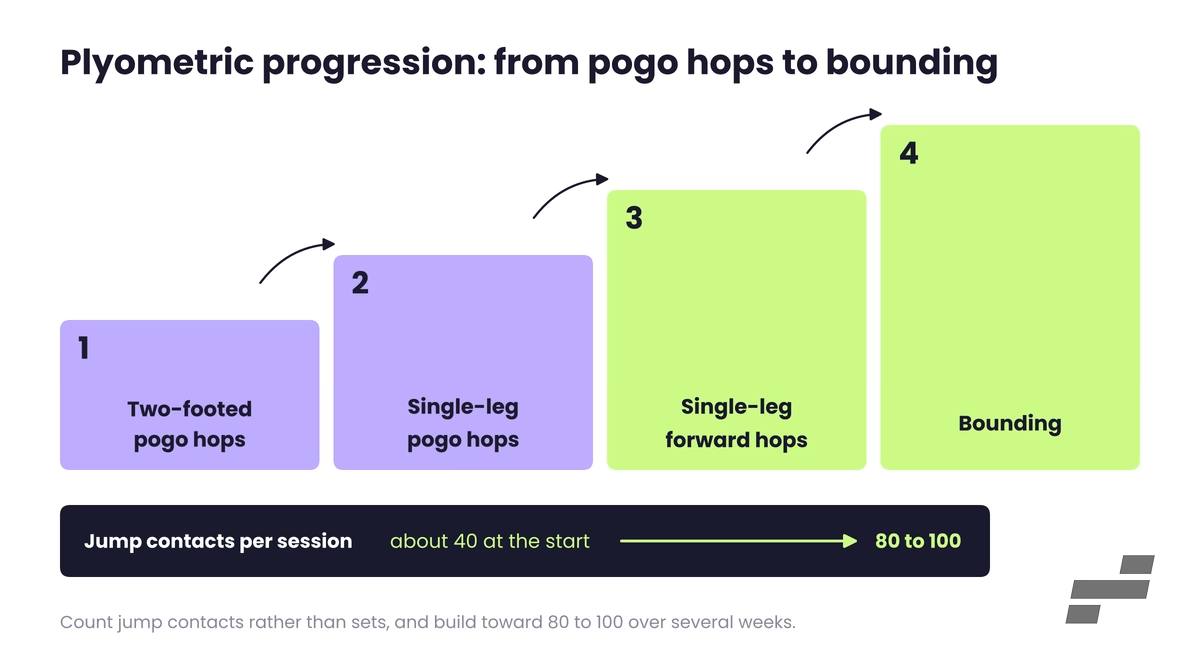
Start with pogo hops: quick, stiff-ankled bounces in place, landing on the balls of the feet. Progress to single-leg hops, then to bounding, which is an exaggerated running stride covering as much ground as possible. Count jump contacts rather than sets. Begin around 40 per session and build toward 80 to 100 over several weeks. Short steep hill sprints do a similar job on the run itself, and bounding technique sits naturally alongside other running drills.
- Easier: two-footed pogo hops, 2 sets of 10.
- Harder: single-leg hops, then bounds over 20 to 30 meters.
Strength Training for Runners at Home
Every exercise above has a bodyweight version, so the leg strength exercises for runners in this list work at home for the first few months. A home setup needs little: a sturdy bench or chair, a step, a resistance band, and an adjustable dumbbell or a kettlebell. Once bodyweight split squats and single-leg deadlifts stop being hard at 10 to 12 reps, they have done their job. From there, adding load (dumbbells, or a backpack with books) is what keeps the legs adapting. A few minutes of hip and ankle mobility before each session also makes the deeper positions easier to reach.
How to Program Strength Training for Runners
A runner’s strength session takes 30 to 45 minutes and follows the order the NSCA (National Strength and Conditioning Association) recommends: jumps first, then the heavy lifts, then the smaller exercises. Each part needs fresher legs than the one after it, so the order matters more than the exact exercise choice.
Start with a warm-up that raises your heart rate, wakes up the muscles you are about to use, and rehearses the first lift. That is the structure of the RAMP warm-up model used widely in strength and conditioning, and the same principles apply as for warming up for different session types. In practice, that means 5 minutes of easy cardio, a few glute bridges, bodyweight calf raises and a short side plank, all at an easy effort, then a light set of your first lift.
Jumps come next, while the tendons are fresh, because tired landings are sloppy landings. Then the heavy work: one squat or split-squat pattern and one hinge, 3 to 4 sets each, with 2 to 3 minutes of rest between sets. Short rests turn heavy lifting into conditioning, which running already provides. A set of rows or push-ups during those rest periods uses the time well, since the upper body works while the legs recover.
Finish with loaded calf raises and the harder trunk work, such as the Copenhagen plank and Pallof press, for 2 to 3 sets each. Challenging trunk work belongs after the heavy lifts, not before. In one small study, tiring the trunk muscles changed how the knees moved during squats, with less knee bend and more inward collapse.
Two Sessions a Week and Early Soreness
Two sessions a week can repeat the same exercises or split them between days. What matters is that each main pattern (squat, hinge, single leg, calf) gets trained at least once a week. When your running has a lighter week, let the lifting ease off too by dropping a set from each exercise.
Expect your legs to be sore after the first two or three sessions, especially from split squats and Romanian deadlifts, which load the muscle while it lengthens. Run easy through it. The soreness fades quickly as the body adapts, and later sessions at the same weight cause far less. If you can, start in a lighter running week.
How to Start Strength Training If You’ve Never Lifted
Use standards rather than a calendar, and move on when the work looks clean rather than when a set number of weeks has passed.
- Learn the movements. Do the bodyweight versions twice a week: box squat, static split squat, glute bridge, single-leg deadlift with the back toe down, two-legged calf raises and side plank from the knees, for 2 to 3 sets of 10 to 12. Move on when you can do 3 sets of 12 split squats per leg and 20 single-leg calf raises per side with control.
- Add load. Switch to goblet squats, dumbbell split squats and dumbbell Romanian deadlifts for 3 sets of 8 to 10, and introduce two-footed pogo hops. Move on once you have added weight for three or four sessions in a row and your form still holds at 8 reps.
- Go heavy. Drop to 4 to 6 reps on the main lifts and progress as described under how heavy to lift.
Most runners spend a few weeks in each stage, and some need longer in the first. If you’d rather follow a ready-made progression, a beginner half marathon plan with strength built in lays one out week by week.
Where Strength Fits in Your Running Week
Lift on the days you run hard, after the run, and keep the day before your most important session free of heavy leg work. Stacking hard work on the same day leaves room for easy days that are actually easy, and both kinds of training get the recovery they need. The same logic carries over to fitting strength into a multisport week, if you also swim or ride.
Same-Day Order by Session Type
Intervals or tempo. Run first and lift afterward, ideally later in the day rather than straight after. A combined hard day has a cost the next morning. Doma and Deakin (2013) found that runners who lifted and ran on the same day were less economical and performed worse in a running test the following day. So the day after should be rest or a recovery run, never a second quality session.
Hill sprints or fast strides. These already deliver high-force, springy loading. On those days, skip the jumps in your strength session and go straight to the lifts.
The long run. Nothing heavy for the legs the day before. A short upper-body and trunk session after the long run is fine if you have the time; lower-body work waits.
Easy days. If your schedule pushes lifting onto an easy day, keep the run short and genuinely relaxed, then lift. That protects the purpose of keeping easy days easy.
When the Week Doesn’t Cooperate
If the only gym slot falls the day before your long run, make it the lighter session: calves at moderate load, single-leg balance work, trunk and upper body. The heavy lifts move to the day of your quality session.
If you wake up sore before a key session, swap the days. Take the easy run now and run the key session tomorrow. Soreness that changes your stride is a reason to move a session, not to force it.
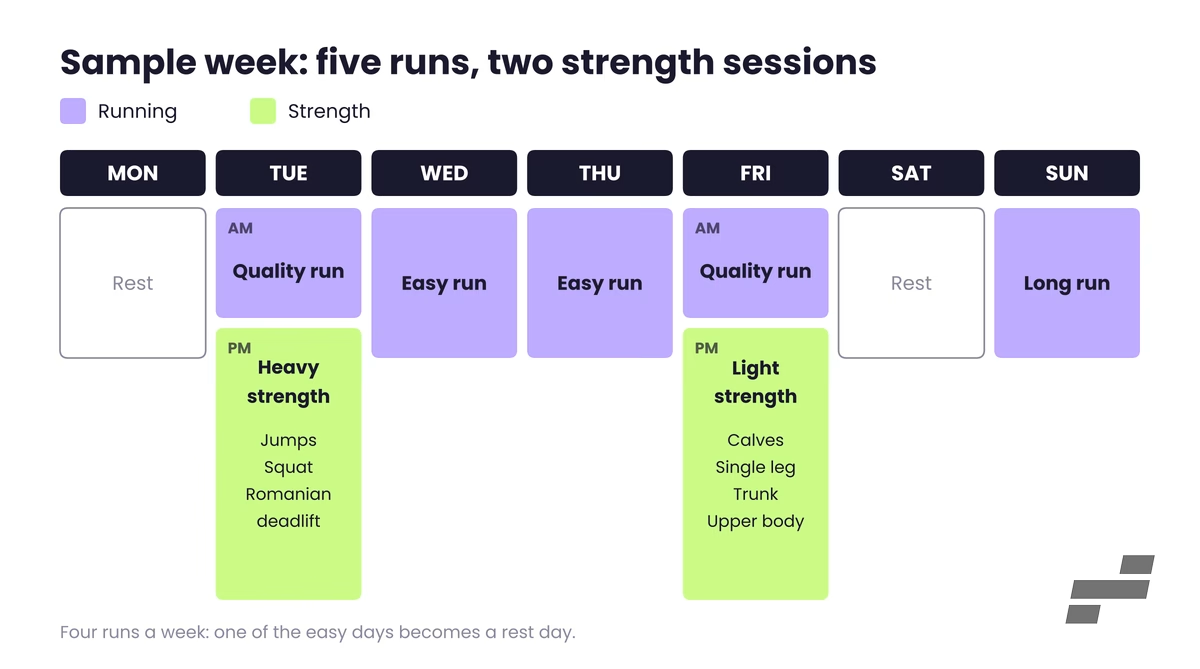
For a runner on five runs a week, the pieces fit together like this. Monday and Saturday are rest days. Tuesday and Friday are the quality days, each with a strength session later in the day. Tuesday gets the heavy session. Friday gets the lighter one (calves, single-leg balance work, trunk and upper body), so the legs arrive fresh for Sunday’s long run. Wednesday and Thursday are easy runs, and on four runs a week, one of them becomes a rest day.
Does Strength Training Hurt Your Running?
Not at these doses. The interference between the two mostly runs the other way: a large running load limits how much strength and muscle a person gains. In a meta-analysis of 21 studies, Wilson and colleagues (2012) found that running blunted strength and muscle gains more than cycling did, and that more frequent and longer endurance sessions blunted them further. Meanwhile, a review by Rønnestad and Mujika (2014) concluded that adding heavy strength work to endurance training improves running and cycling performance. The practical answer is to keep weight training for runners short and heavy, so it adds force without competing with the running for recovery.
Strength Training for Runners Across the Season
In strength training for runners, the lifting follows the running. When running intensity is low, the lifting can be at its most demanding; when race-specific work takes over, the lifting shifts from building strength to keeping it. Knowing how a season is divided into phases makes it easy to see where each change belongs.
| Phase | Strength sessions per week | What the lifting does | Jumps |
| Base | 2 | Builds strength: heavy main lifts plus full calf, trunk, upper-body work, and jumps | Introduced, building jump contacts week by week |
| Build | 1 to 2 | Holds strength: same weights, one fewer set per exercise | Shift toward single-leg hops and bounds |
| Peak | 1 | Short and heavy: main lifts only, 2 sets each | A few sets, low jump contacts |
| Taper | 1, short | Same weights, about half the sets; last loaded leg work about a week before the race | Pogo hops only |
| Race week | 0 to 1 | Optional 15 minutes early in the week: bodyweight, nothing that causes soreness | A few pogo hops if they feel good |
| Transition | 0 to 1 | Relearn the lifts at moderate weights before the next base phase | None |
The aerobic base phase is the best window for heavy lifting, because the running around it is mostly easy. That is where most of the strength gets built.
Build, Taper and After the Race
In the build, one session a week holds strength well, as long as the weights stay heavy. It’s the sets that drop, not the load. Beattie and colleagues used exactly this structure, with two sessions a week through preseason and one through the season, and their runners were still more economical at 40 weeks. Across a marathon build, that usually means two sessions a week in the early weeks and one from the point where long runs and marathon-pace work take over. Each block has its own priorities, so it helps to know what each training block should emphasize.
Strength fades slowly, so the taper cuts volume, not intensity. Keep the weights heavy, keep the sets few, and finish loaded leg work about a week before a half marathon or marathon. Race week itself is about feeling springy, and a few minutes of bodyweight work early in the week does that without leaving the legs heavy.
After the race, take a week or two off heavy lifting along with the running. The transition is then a good time to relearn the lifts at moderate weights. Between training blocks, one session a week keeps most of what you built, so the next base phase starts from a higher floor.
Strength Training for Masters Runners
Strength training for runners matters more with every decade. Muscle mass and strength decline with age, faster from the 50s onward, and the fast, forceful fibers go first. Bone density follows a similar path, and for women it drops more steeply after menopause. Running keeps the aerobic engine in good shape, but it does far less to hold on to force and bone.
Heavy lifting works for older runners too. Piacentini and colleagues (2013) compared two strength programs in masters marathon runners. Only the group lifting heavy loads improved running economy, while the group using lighter resistance did not, and the heavy lifters got stronger without adding muscle mass. For an older runner, heavy, low-rep work is the right tool rather than a risk to avoid.
The difference is recovery. Leave an extra day between the heavy session and the next quality run, add weight a little more slowly, and spend longer in the first two stages if you are new to lifting.
Strength That Lasts to Race Day
Three months in, the split squat that once needed a hand on the wall is done with dumbbells, the calf raises are on one leg, and the last kilometers of the long run feel steadier. None of it came from a single session. It came from adding a little weight at a time, in sessions placed where they didn’t cost the running, and that strength carries all the way to the start line.
For Coaches: Planning Strength Across an Athlete’s Season
Strength training for runners works best when it is planned at the season level, not week by week. In the base phase, decide which main lifts each athlete builds on. Then set the point where two sessions become one, and mark the last loaded session before each goal race. Because the heavy session belongs on the same day as the key run, strength placement follows the running calendar rather than competing with it.
It also helps to pay attention to how athletes feel going into quality sessions after lifting. A demanding strength week leaves fatigue that shows up in the next hard run, and the athlete’s own feedback is usually the first place it appears. An athlete who reports heavy legs on a tempo run the day after the gym may be carrying the lifting rather than the running, and the fix is in the strength plan.
Strength is also the part of a plan most likely to fade without anyone deciding to drop it, often around the point where the running gets more demanding. Scheduling strength sessions on the same calendar as the runs, as you can in EndoGusto, means the athlete sees the week as one plan rather than a running plan with a gym habit on the side.

Plan Strength and Running in One Calendar
Suggested References
- Beattie, K., Carson, B. P., Lyons, M., Rossiter, A., and Kenny, I. C. (2017). The effect of strength training on performance indicators in distance runners. Journal of Strength and Conditioning Research, 31(1), 9–23.
- Doma, K., and Deakin, G. B. (2013). The effects of combined strength and endurance training on running performance the following day. International Journal of Sport and Health Science, 11, 1–9.
- Haff, G. G., and Triplett, N. T. (Eds.). (2016). Essentials of Strength Training and Conditioning (4th ed.). National Strength and Conditioning Association. Human Kinetics.
- Jeffreys, I. (2007). Warm-up revisited: The ramp method of optimizing warm-ups. Professional Strength and Conditioning, 2(6), 12–18.
- Paavolainen, L., Häkkinen, K., Hämäläinen, I., Nummela, A., and Rusko, H. (1999). Explosive-strength training improves 5-km running time by improving running economy and muscle power. Journal of Applied Physiology, 86(5), 1527–1533.
- Piacentini, M. F., De Ioannon, G., Comotto, S., Spedicato, A., Vernillo, G., and La Torre, A. (2013). Concurrent strength and endurance training effects on running economy in master endurance runners. Journal of Strength and Conditioning Research, 27(8), 2295–2303.
- Robbins, D. W., Young, W. B., Behm, D. G., Payne, W. R., and Klimstra, M. D. (2010). Physical performance and electromyographic responses to an acute bout of paired set strength training versus traditional strength training. Journal of Strength and Conditioning Research, 24(5), 1237–1245.
- Rønnestad, B. R., and Mujika, I. (2014). Optimizing strength training for running and cycling endurance performance: A review. Scandinavian Journal of Medicine and Science in Sports, 24(4), 603–612.
- Seyedi, M., Torkaman, M., Soleiman-fallah, M., Khezri, D., and Ashroshtaghi, M. (2022). The effect of core fatigue on lower extremity kinematic variables during squats in female body builders. Physical Treatments, 12(4), 261–268.
- Støren, Ø., Helgerud, J., Støa, E. M., and Hoff, J. (2008). Maximal strength training improves running economy in distance runners. Medicine and Science in Sports and Exercise, 40(6), 1087–1092.
- Wilson, J. M., Marin, P. J., Rhea, M. R., Wilson, S. M. C., Loenneke, J. P., and Anderson, J. C. (2012). Concurrent training: A meta-analysis examining interference of aerobic and resistance exercises. Journal of Strength and Conditioning Research, 26(8), 2293–2307.