Marathon Training Plan: How to Train for a Marathon, Phase by Phase

If you have a marathon on the calendar, you already know the broad shape of a marathon training plan. Weekly mileage goes up, the long run gets longer, and the last few weeks ease off before race day. What decides how the race goes is the detail inside that shape: how long the longest run should get, when faster running enters the week, and how much recovery each big weekend needs.
The hardest miles of a marathon come in the last 10 km (6 miles), on legs that have already been running for hours. Most of a good plan is preparation for that fatigue. The aim is to practice it often enough to be ready, without runs so long they leave you flat for the rest of the week. For that reason, the framework below caps the long run at 2.5 hours and uses two back-to-back weekends to practice running on tired legs.
The 18 weeks split into four phases: base, build, specific and taper. Together they show how to train for a marathon: what each phase is for, what a typical week holds, and how to adjust it when your timeline or a week changes. A runner aiming for 3:10 is the worked example, alongside a time-based version for runners training five days a week. Distances are in miles, with kilometers in parentheses.
Key Takeaways
- Most runners need 16 to 20 weeks to train for a marathon, and 18 weeks leaves room for six weeks of base before the harder work starts.
- The long run is capped at 2.5 hours and built up to two or three times, because recovery between big runs is the real limit for most amateur runners.
- Back-to-back weekends, a long tempo one day and a medium-long run the next, train the feeling of the late race without a very long run.
- Most of the quality work sits just slower than marathon pace, while shorter reps faster than marathon pace arrive in the build phase.
- The last 2.5-hour run falls four weeks out and the last back-to-back three weeks out, followed by a three-week taper that cuts volume but keeps short, faster sessions.
How Long to Realistically Train for a Marathon
Most runners need 16 to 20 weeks to train for a marathon, and 18 weeks is a sound middle. Where you fall depends on your starting point. If you already run four or five days a week, cover 25 to 35 miles (40 to 55 km) a week and finish a 90-minute run comfortably, an 18-week marathon training plan is enough. With less running behind you, build that base first.
The 18 weeks are not arbitrary, and the reasons behind them explain most of how to train for a marathon. Six weeks of base come first, because the faster sessions later in a marathon training plan only pay off once the weekly mileage feels routine. Six weeks of build follow, then three weeks of race-specific work and a three-week taper. Shorter marathon training plans usually cut the base, which is fine for a runner who is already fit and risky for one who is not. Longer marathon running plans, on the other hand, mostly add easy weeks at the front, which suits runners coming back from a break.
The Base You Need Before Week 1
Week 1 of the 3:10 version already holds about 34 miles (55 km), including a 10-mile (16 km) long run. Starting there from 15 miles a week would mean more than doubling your running in a single week. A runner on five days a week starts lower, at around 20 to 25 miles (30 to 40 km) with a 75-minute long run.
If your recent weeks sit well below those numbers, spend a few weeks on easy running first. The base training article covers how long an aerobic base takes to build. First-timers who have never raced beyond 10 km often do better running a half marathon first and coming back to the marathon a season later. Run-walk intervals are also a valid way to build toward the distance, and to race it.
The 18-Week Marathon Training Plan at a Glance
The marathon training schedule below splits 18 weeks into four phases. The 3:10 column gives the long run as a distance. The five-day column sets it by time, which keeps the long run the same size of effort whatever your pace.
| Phase | Weeks | Main work | Effort (% of marathon pace) | Long run, 3:10 runner | Long run, five-day runner |
| Base | 1–6 | Easy running on hilly routes, strides, strength work, one progressive run a week | 70–80% easy; 80–100% on progressive runs | 10 → 15 mi (16 → 24 km) | 1:30 → 2:00 |
| Build | 7–12 | Reps faster than marathon pace, long steady runs just under it, first back-to-back in week 12 | 95–102% steady; 102–112% reps | 15 → 17.5 mi (24 → 28 km), 2.5 hours in weeks 9 and 11 | 2:00 → 2:30 |
| Specific | 13–15 | Longer work at and around marathon pace, last 2.5-hour run in week 14, second back-to-back in week 15 | 97–107% | 15 → 17.5 mi (24 → 28 km) | 2:15 → 2:30 |
| Taper | 16–18 | Volume drops, short faster sessions stay | 100–115% on short reps | 13.5 → 10 mi (22 → 16 km), then race day | 1:45 → 1:15, then race day |
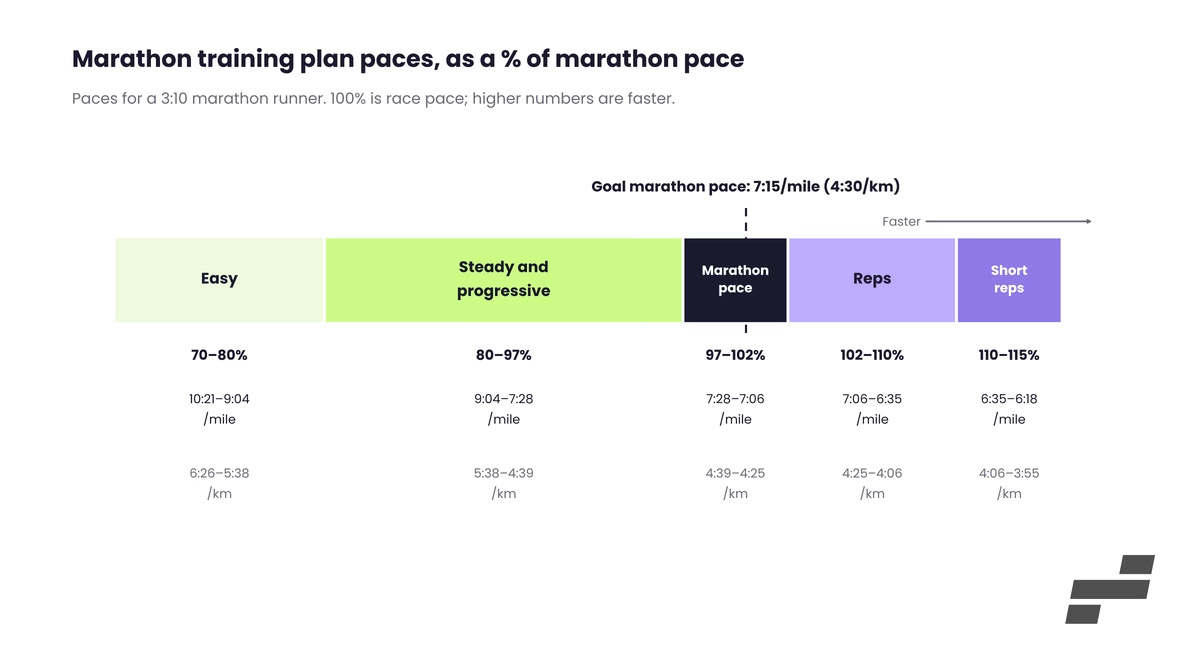
Every pace in this marathon training plan is a percentage of goal marathon pace, so 100% is race pace. Lower numbers are slower. For a 3:10 runner, easy running at 70 to 80% works out to about 8:40 to 9:20 per mile (5:24 to 5:50 per km), against a race pace of 7:15 (4:30). Anything above 100% is faster than race pace.
Weekly Mileage and Days per Week
The 3:10 version runs six days a week and peaks at about 50 to 55 miles (80 to 90 km). A runner aiming for 3:45 to 4:15 on five days a week peaks at around 30 to 40 miles (50 to 65 km). First-timers usually top out between 25 and 35 miles (40 to 55 km). In each case, one day a week is a full rest day or easy core work, and some weeks swap a run for 45 minutes on a bike, rower or elliptical.
The same phases sit underneath every level, so this framework works as a marathon running plan on its own or as a map for a more detailed one. First-timers have a separate day-by-day plan that covers each session from week 1. Intermediate runners chasing a sub-4 finish and advanced runners chasing sub-3 each have their own plan as well.
Base Phase (Weeks 1 to 6): Mileage Before Intensity
Easy running carries most of the base phase. Four of the six running days are easy at 70 to 80% of marathon pace. Easy running builds the mileage the rest of the marathon training plan stands on, and the hills add strength to the legs without the stress of fast running. Strides, short relaxed accelerations of about 20 seconds, follow most easy runs to keep some speed in the legs. The strides article covers how to program strides across a block.
One run a week is progressive. It starts at easy pace and finishes close to marathon pace, at 80 to 90% in week 1 and 90 to 100% by week 4. This is the first appearance of the steady running that carries the whole plan. It builds the ability to hold a strong pace for a long time, yet it costs far less recovery than a hard interval session. Short hill reps of about 100 m enter in week 4, and the first set of 1 km reps slightly faster than marathon pace closes the phase in week 6.
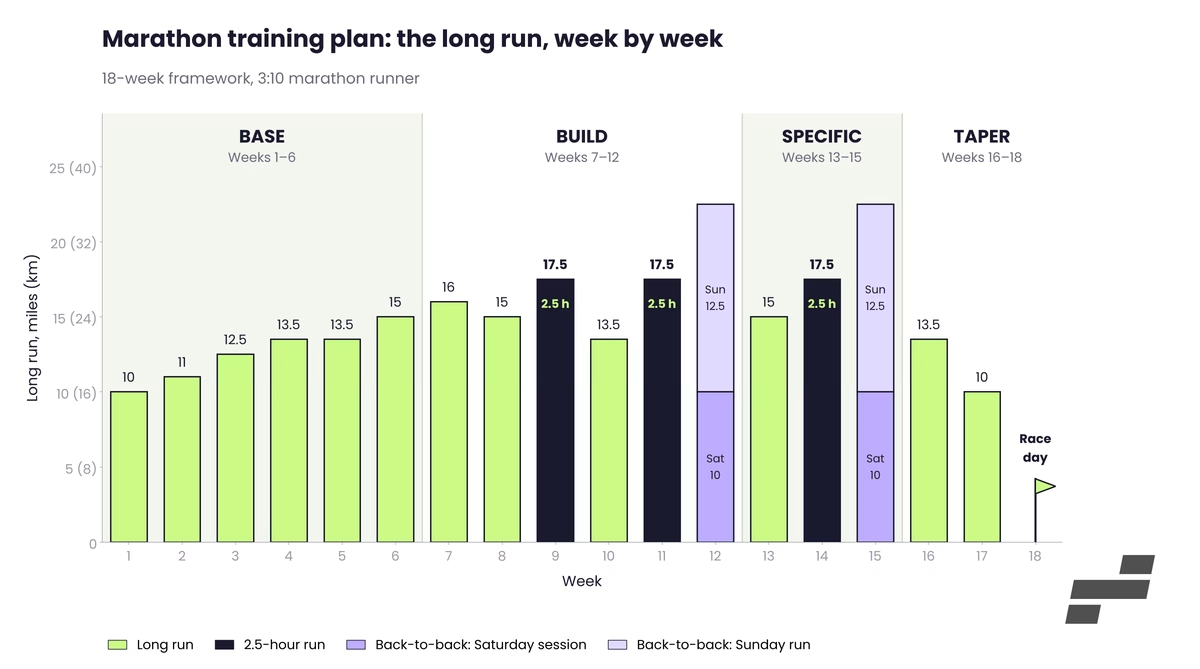
The long run grows from 10 miles (16 km) to 15 miles (24 km), preferably on hilly routes at easy effort. It holds at 13.5 miles (22 km) in weeks 4 and 5 before the next step, so the legs can catch up with the distance.
Sample Weeks: Base Phase
Week 1 opens the phase at about 34 miles (55 km). Week 6 closes it, with the progressive run reaching marathon pace and the first faster reps on Friday.
| Week | Monday | Tuesday | Wednesday | Thursday | Friday | Saturday | Sunday |
| 1 | 40 min easy, 6 strides, strength | 6 mi (10 km) progressive, from easy to 80–90% | 30 min easy, 6 strides | 40 min easy, 6 strides, strength | 45 min easy on a hilly route, or 45 min cross-training | Rest or easy core work | 10 mi (16 km) easy, hilly |
| 6 | 45–50 min easy, 6 strides, strength | 8 mi (13 km) progressive, finishing at 90–100% | 30 min easy, 10 x 100 m hills | 45–50 min easy, 6 strides, strength | 6 x 1 km slightly faster than marathon pace (102–105%), 1-min jog between reps | Rest or easy core work | 15 mi (24 km) easy, hilly |
On five days a week, drop Friday’s run, and run Sunday’s long run for 1:30 in week 1 and 2:00 by week 6.
Strength Work Through the Whole Build
Running loads the same tissues thousands of times a week. Calves, Achilles tendons, hips and the muscles around the knee take most of it, and stronger tissue tolerates the mileage better. Strength work also makes the same pace cheaper to run. A meta-analysis by Balsalobre-Fernández and colleagues (2016) found that adding strength training improved running economy in highly trained runners. In practice, that means less effort at the same speed, which counts most in the last hour of a marathon.
Two or three short sessions a week are enough, done after easy runs rather than on key session days. Twenty to thirty minutes covers it. A simple routine includes split squats, single-leg Romanian deadlifts, calf raises with a straight and a bent knee, step-ups and side planks. Start with body weight, then add dumbbells or a loaded backpack as the exercises get easy. The article on strength work for distance runners goes deeper on the reasoning.
Build Phase (Weeks 7 to 12): Faster Reps and Longer Long Runs
The build phase adds the faster work. Each week now holds two quality sessions. One is a set of reps a little faster than marathon pace, such as 16 x 500 m, 9 x 1 km or 15 x 300 m, at 102 to 112% with short recoveries. The other is a long steady run close to marathon pace, for example 4 x 2 miles (3.2 km) building from just under to just over race pace, or 9.5 miles (15 km) progressive at 97 to 102%.
Even so, most of the steady running still sits just slower than marathon pace. Tuesday’s progressive run in week 9 holds 95 to 97% for 8.5 miles (14 km). That is below the pace of classic threshold workouts, and deliberately so. Because it is a touch easier, it can be repeated every week, and the volume of it adds up. The faster reps, meanwhile, are short enough to sharpen the legs without leaving them tired for the weekend. Some long runs finish faster too, much like progression runs, which teaches the legs to lift the pace when they are already tired. By this stage, the goal pace needs to be a realistic one. A recent half marathon and the way the steady sessions feel are usually enough to judge it.
The long run reaches 2.5 hours for the first time in week 9, which is 17.5 miles (28 km) for the 3:10 runner. Week 10 steps back to 13.5 miles (22 km) with the last 5 miles (8 km) faster, and week 11 brings the second 2.5-hour run. Week 12 closes the phase with the first back-to-back weekend.
Sample Weeks: Build Phase
Week 9 holds the first 2.5-hour run, and week 12 the first back-to-back weekend. In week 12, Friday becomes the rest day so the legs arrive fresh for Saturday.
| Week | Monday | Tuesday | Wednesday | Thursday | Friday | Saturday | Sunday |
| 9 | 45–50 min easy, 6 strides, strength | 8.5 mi (14 km) progressive, finishing just under marathon pace (95–97%) | 30 min easy, 12 x 100 m hills and strides | 45–50 min easy, 6 strides, strength | 9 x 1 km slightly faster than marathon pace (102–105%), 1-min jog between reps | Rest or easy core work | 17.5 mi (28 km) easy, hilly |
| 12 | 45–50 min easy, 6 strides, strength | 16 x 500 m faster than marathon pace (105–110%), 1-min jog between reps | 30 min easy, 10 x 100 m hills and strides | 45 min easy, 6 strides, strength | Rest | 10 mi (16 km) progressive, from just under to just over marathon pace (97–102%) | 12.5 mi (20 km) hilly, the last 5–6 mi (8–10 km) building toward marathon pace |
On five days a week, Wednesday and Thursday become one easy run with the hills or strides added, and the week 9 long run is 2.5 hours by the clock. The five-day version of the back-to-back is covered below.
How Long Should Your Longest Run Be?
Cap the longest run at 2.5 hours, whatever distance that covers, and build up to two or three runs of that length. For a 3:10 runner on hilly routes, 2.5 hours is about 17.5 miles (28 km). For a runner aiming at 4:15, the same 2.5 hours covers roughly 13 miles (21 km). Both runs are a similar size of effort, and both runners can recover from them within a normal week.
The limit is recovery. Amateur runners fit training around work, family and sleep, so the recovery available to them is limited. A run well past 2.5 hours often takes several days to absorb, and that cost lands on the following week’s quality sessions. Over 18 weeks, a few weeks of compromised training cost more than one extra hour the longest day gives back.
Spacing matters as much as length. In this marathon training plan, the 2.5-hour runs fall in weeks 9, 11 and 14, with shorter long runs between them. A runner on five days a week can drop the middle one if recovery runs short, since two runs at 2.5 hours, done well, are enough.
These runs stay at easy effort for most of the distance, on hilly routes where possible, with some finishing faster later in the plan. The article on how to pace the long run covers the effort itself. They are also the place to rehearse race-day fueling, with the gels, drinks and breakfast you plan to use on the day.
Back-to-Back Weekends: Practicing the Late Race
A back-to-back weekend puts a long tempo on Saturday and a medium-long run on Sunday. Sunday’s run starts on legs still carrying Saturday’s work, so its faster finish arrives when the legs feel the way they do late in the race. The two days add up to more than 22 miles (35 km), yet neither run comes close to 2.5 hours.
The plan uses two of them:
- Week 12: Saturday is 10 miles (16 km) progressive, from just under to just over marathon pace (97 to 102%). Sunday is 12.5 miles (20 km) on a hilly course, with the last 5 to 6 miles (8 to 10 km) building toward marathon pace.
- Week 15: Saturday becomes 5 x 2 miles (3.2 km) at and slightly faster than marathon pace, with a 1-minute jog between reps. Sunday repeats the 12.5 miles (20 km) with a faster finish.
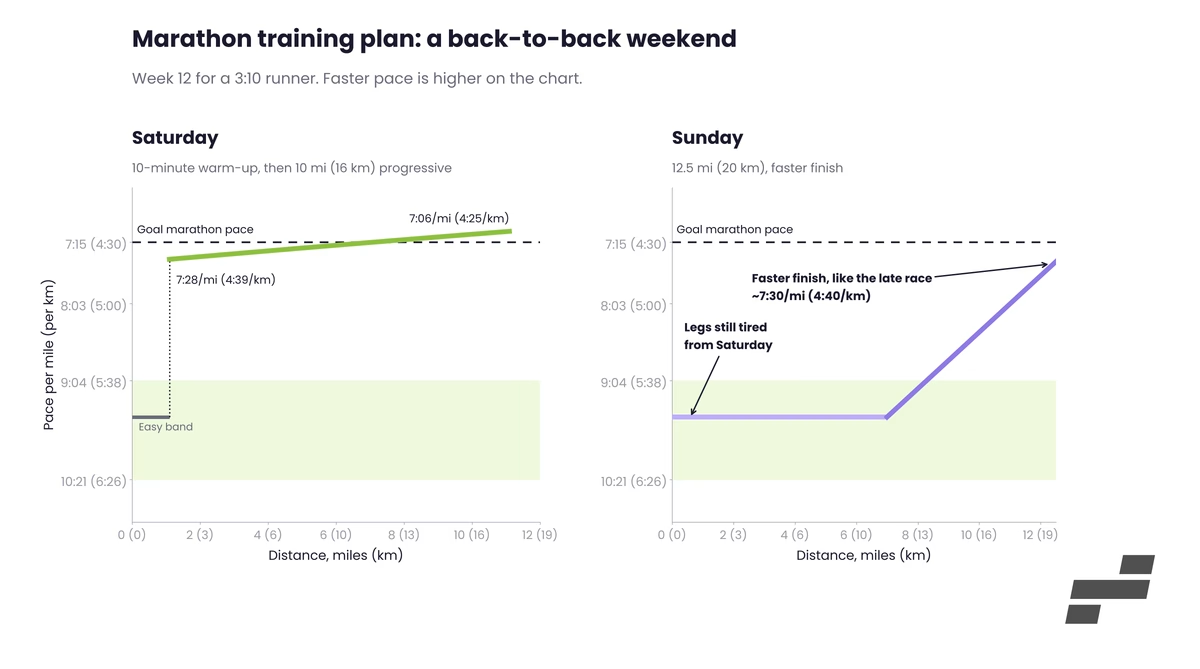
Friday becomes the rest day in those weeks. For runners on five days a week, Saturday runs 60 to 75 minutes with the middle part at goal pace, and Sunday runs 1:45 to 2:00 with a faster last 30 to 40 minutes.
This is also why the long run can stop at 2.5 hours. The back-to-back brings the late-race feeling that a very long single run would, at a recovery cost the rest of the week can absorb.
Specific Phase (Weeks 13 to 15): Running at Race Pace
The specific phase of the marathon training plan moves the quality work onto race pace itself. Sessions get longer and sit at 97 to 107% of marathon pace. Week 13 brings 8 x 1200 m slightly faster than race pace, week 14 a 10-mile (16 km) progressive run through marathon pace, and week 15 the 5 x 2 miles of the second back-to-back. The long run in week 13 is 15 miles (24 km), with the later miles building to just under race pace.
Week 14 holds the last 2.5-hour run, four weeks before race day. Week 15 holds the last back-to-back, three weeks out. That order leaves a full week between the two biggest weekends, and it makes the back-to-back the final long effort of the marathon training plan. After it, three weeks remain for the fatigue to clear.
These three weeks are also the dress rehearsal. Run the Saturday of the back-to-back in race shoes and race-day gear, eat your planned race breakfast before it, and use your race fueling on the Sunday. Anything that causes a problem now still has time to be fixed.
Sample Weeks: Specific Phase
Weeks 14 and 15 are the two biggest weekends of the plan: the last 2.5-hour run, then the last back-to-back.
| Week | Monday | Tuesday | Wednesday | Thursday | Friday | Saturday | Sunday |
| 14 | 45–50 min easy, 6 strides, strength | 10 mi (16 km) progressive through marathon pace (97–103%) | 30 min easy, 10 x 100 m hills and strides | 45 min easy, 6 strides, strength | 10 x 600 m slightly faster than marathon pace (105–107%), 1-min jog between reps | Rest or easy core work | 17.5 mi (28 km) easy, hilly, with race-day fueling |
| 15 | 45 min easy, 6 strides, strength | 8 x 1 km slightly faster than marathon pace (103–107%), 1-min jog between reps | 30 min easy, 6 strides | 40 min easy, 6 strides | Rest | 5 x 2 mi (3.2 km) at and slightly faster than marathon pace (100–105%), 1-min jog between reps, in race shoes and race-day gear | 12.5 mi (20 km), the last 5–6 mi (8–10 km) building toward marathon pace, with race-day fueling |
On five days a week, Wednesday and Thursday merge as in the build phase, the week 14 long run is 2.5 hours by the clock, and week 15 follows the five-day back-to-back.
The Marathon Taper (Weeks 16 to 18)
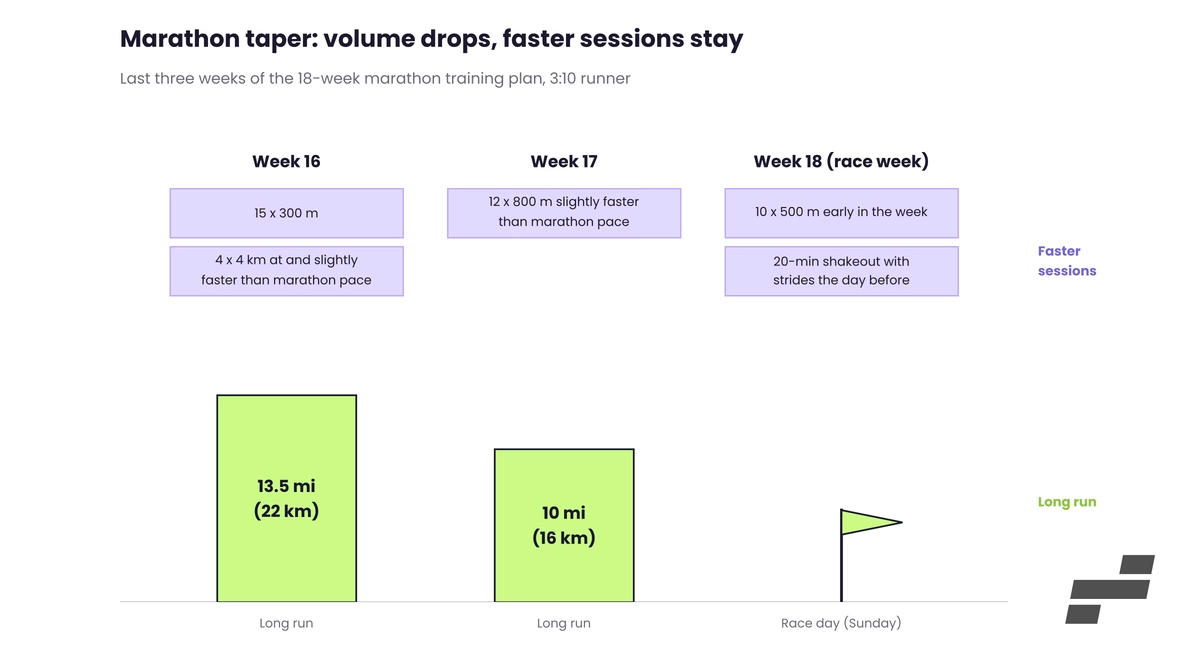
In the taper, volume falls each week while the short, faster sessions stay. Week 16 still holds 15 x 300 m, a set of 4 x 4 km alternating marathon pace with slightly faster running, and a 13.5-mile (22 km) long run. Week 17 drops the long run to 10 miles (16 km) and keeps 12 x 800 m a little faster than race pace. Race week has one last session of 10 x 500 m early in the week, two short easy runs, and a 20-minute shakeout with strides the day before.
The faster sessions keep the legs feeling sharp, while the lower mileage lets the fatigue of the build clear. A review of tapering research by Mujika and Padilla (2003) points the same way: cut the volume, keep the intensity, and train almost as often as before. This marathon training plan follows that shape, since the running days barely change and each one simply gets shorter.
Expect a flat day or two, often in the second week. Legs that have been tired for months can feel heavy while they recover, and it is not a sign of lost fitness. The periodization article explains how to divide a training plan into phases, including how the taper length is set.
Sample Weeks: Taper
Week 17 keeps the same running days, each one shorter. Race week drops to one short session, two easy runs and a shakeout, with the race on Sunday.
| Week | Monday | Tuesday | Wednesday | Thursday | Friday | Saturday | Sunday |
| 17 | 40 min easy, 6 strides, light strength | 12 x 800 m slightly faster than marathon pace (103–105%), 1-min jog between reps | 30 min easy, 6 strides | 40 min easy, 6 strides | 35–40 min easy | Rest or easy core work | 10 mi (16 km) easy |
| 18 (race week) | Rest | 10 x 500 m slightly faster than marathon pace (105%), 1-min jog between reps | 30–40 min easy | 30 min easy, 4 strides | Rest | 20 min shakeout with 4 strides | Race day |
On five days a week, drop Thursday’s run in week 17 and run Sunday’s long run for 1:15. Race week stays the same.
Race day is where training hands over to pacing. Many amateur runners do well with the 10-10-10 approach: a conservative first 10 miles (16 km), goal pace through mile 20 (32 km), then the final 10 km on whatever is left. The article on pacing the race itself covers it in detail.
Adapting Your Marathon Training Plan to 12 or 20 Weeks
The last six weeks keep their shape whatever the plan length. The specific phase and the taper are anchored to race day, so they always run the same way: last 2.5-hour run four weeks out, last back-to-back three weeks out, then the taper. Base absorbs most of the change, and build absorbs the rest.
For 20 weeks, add two weeks of easy running at the front. This suits runners returning from a break or stepping up from lower mileage, and from week 3 onward the structure matches the 18-week plan.
For 12 weeks, you need to be fit already, running close to the week 6 volume of the base phase from day one. Base shrinks to two weeks and build to four. That leaves room for two 2.5-hour runs, in weeks 5 and 8, and one back-to-back in week 9, three weeks before the race. A shorter marathon training plan works when the fitness is already there, because it has no time to build it.
When a Week Goes Wrong
A few days missed to a cold or a busy week need no fixing. Skip them and carry on with the marathon training plan. Squeezing the missed sessions into the following days only stacks fatigue on top of fatigue.
After a full week or more off, repeat the last complete week before moving on, rather than jumping straight back to where the marathon training schedule says you should be. If the lost time means something has to go, keep the last 2.5-hour run and the final back-to-back, and drop an earlier key weekend instead. Those two sit closest to race day and do the most to prepare you for the last 10 km.
Checkpoints That Show the Build Is Working
Three points in the marathon training plan give a fair read on progress:
- End of the base phase (week 6): the weekly progressive run reaches close to marathon pace and still feels controlled, and easy runs on familiar routes feel easier at the same pace.
- End of the build phase (week 12): both 2.5-hour runs are done at easy effort, and the 16 x 500 m session runs a few seconds faster per rep than the same session in week 7.
- Week 15: 5 x 2 miles at and slightly faster than marathon pace, on 1-minute jogs, feels hard but manageable. This is the clearest sign that the goal pace is realistic.
The warning signs matter just as much. Pain that changes how you run, soreness in one spot that is worse the next morning, or easy runs that feel hard for several days in a row all call for a change. In that case, replace the next quality session with easy running or cross-training, and see a physiotherapist if the pain lasts more than a few days.
Common Marathon Training Mistakes
Steady runs drifting too fast is the most common mistake in a marathon training plan. A progressive run meant to finish just under marathon pace turns into a race against last week’s time, and the weekend pays for it. The steady work pays off through repetition, so the right pace is the one you can repeat every week.
Adding mileage and faster sessions at the same time is another. In this marathon training plan, the faster reps arrive once the base mileage is already routine. A runner who skips the base and starts the build on lower mileage takes on two new loads at once.
Fueling also tends to get left to race day. Gels and drinks that sit fine at a desk can sit very differently at marathon pace, and the long runs and back-to-backs are the only chances to find out.
Finally, strength work and strides often drop off once the long runs grow and the weeks get busy. They take little time, and they are part of what keeps the legs holding up through the biggest weeks.
For Coaches: Adapting the Framework per Athlete
Because every session in this marathon training plan is set as a percentage of marathon pace, it carries across goal times with little rework. Set the athlete’s goal pace, and the easy runs, steady runs and reps all follow from it. For slower athletes, long runs set by time keep the 2.5-hour cap the same size of effort for everyone on the roster.
The race date is the place to start. Fix the last 2.5-hour run four weeks out and the final back-to-back three weeks out, then work backward through the earlier key weekends to week 1. Whether an athlete runs five or six days depends on what they recover from, more than on the goal time.
From there, the work belongs to the athlete: steady weeks stacked one on top of the other, two weekends that feel like the late race, and a start line reached on fresh legs at a pace they have already practiced.
For coaches who want to start from more than a framework, the full 18-week plan behind this article is in the EndoGusto library, built out session by session. It is ready to use as it stands, or to adapt to each athlete’s goal pace, training days and long runs, so the groundwork is already done.

Every Phase, Every Athlete
Suggested References
- Balsalobre-Fernández, C., Santos-Concejero, J., and Grivas, G. V. (2016). Effects of strength training on running economy in highly trained runners: A systematic review with meta-analysis of controlled trials. Journal of Strength and Conditioning Research, 30(8), 2361–2368.
- Mujika, I., and Padilla, S. (2003). Scientific bases for precompetition tapering strategies. Medicine and Science in Sports and Exercise, 35(7), 1182–1187.