Marathon Pacing Strategy: How to Pace Your Marathon Perfectly

Helena had put in the work. Twenty weeks of consistent training, long runs built sensibly to 16 and 17 miles, a half marathon tune-up that suggested a 3:45 finish was genuinely in range. A marathon pacing strategy built around an 8:35-per-mile goal. She went through the halfway mark at 1:51, feeling strong and exactly on schedule. At mile 22, she was walking.
The postmortem was straightforward. Miles 1 through 8 averaged four seconds per mile faster than her goal pace. That’s nothing on paper. Over the first half of a marathon, it adds up to roughly two and a half minutes of effort her body hadn’t planned to spend. By mile 20, the account was empty.
Most marathon failures are not fitness failures. They are pacing failures, and they usually happen in the first hour, not the last. A sound marathon pacing strategy starts before the gun goes off: with a realistic goal pace, a clear understanding of why small margins become large problems, and a phase-by-phase execution plan that accounts for the course and conditions, not just the distance.
This article covers all of it. How to set your goal pace from actual training data. The physiology behind why even small overages are disproportionately costly. How to execute from mile one to the finish. How to adjust for heat, hills, and wind. And what to do when the plan starts to crack at mile 17.
Key Takeaways
- Your goal pace should come from your training data, not your race ambitions
- For most amateur marathoners, long runs beyond 2.5 hours produce fatigue that shows up on race day, not fitness that shows up in training logs
- Even effort is a more reliable pacing tool than even pace on any course with hills or wind
- Going out 5% faster than your target doesn’t cost 5% more. It costs far more, because of how your body shifts fuel sources at higher intensities
- Heat above 65°F, headwinds, and significant elevation all require pre-race pace adjustments, not improvisation during the race
- If your marathon pacing strategy starts to fail at mile 17, recalibrating early gives you a real chance to finish strong; ignoring it almost never does
The Goal Pace Problem: Most Athletes Set It Wrong
Marathon goal pace is the fastest pace you can sustain for 26.2 miles on a given day, on a given course, in the conditions you’ll actually face. It isn’t the pace from your best workout three months ago. It isn’t the pace that would give you a round number on the results board. Getting this right is the first and most consequential decision in your entire race.
Most athletes get it wrong. Not because they lack data, but because they interpret that data optimistically.
The 100% Confidence Test
Here’s a useful filter coaches apply: what is the fastest pace you are 100% certain you can sustain for 26.2 miles on race day? Not 90% certain, not “probably,” not “if everything goes well.” One hundred percent.
Most athletes answer with a pace they’re 80% confident about. The training felt good. The long runs held up. The weather forecast looks fine. So they aim slightly beyond what the numbers actually support, reasoning that race-day adrenaline will close the gap.
It won’t. The gap is instead revealed at mile 20, and by then there’s no closing it.
The value of the 100% confidence test is that it forces honesty. If you’re not completely sure you can hold a pace, you’re taking a risk on a distance that does not value overconfidence.
Anchoring to Training Data, Not a Single Number
The most reliable predictors of marathon pace are not found in any one workout. They live in the pattern of your recent training: how your long runs progressed, how your threshold work held up week after week, and, just as importantly, how much residual fatigue you carried between sessions. A standout race from months ago is almost useless as a predictor. A standout workout from three weeks ago is only slightly better. What matters is the trajectory.
This is where pacing stops being arithmetic and becomes an art. A good coach setting a goal pace is not just looking at long run splits or threshold averages. They are looking at how you recovered from your hardest weeks, how consistent your easy runs felt, whether you finished sessions in control or barely held them together, and how your sleep, mood, and work stress tracked across the build. Two athletes with identical long run data can warrant different goal paces, because one absorbed the training cleanly while the other limped through it.
Automated calculators cannot see any of this. They take a few numbers and produce a pace, as if the body were a spreadsheet. The athlete who hit every threshold session but arrived at each one already tired has a very different race pace than the athlete who hit the same sessions feeling fresh. Residual fatigue is not a footnote to training data; it is part of the data, and ignoring it is how goal paces get set 10 or 15 seconds per kilometer too ambitious.
Conservative, steady starts win
Nikolaidis and Knechtle (2017) analyzed pacing data from nearly 300,000 finishers of the New York City Marathon between 2006 and 2016 and found that faster runners consistently paced more evenly than slower ones. The slowest splits across every performance group fell between kilometers 35 and 40, and slower runners showed the most pronounced positive splits. The pattern is consistent: athletes who start at a pace that overestimates their fitness slow the most dramatically in the closing kilometers. In practice, the runners who pace evenly are almost always the ones whose goal pace was set honestly in the first place, with a coach or a careful self-assessment weighing the full picture rather than chasing the best number on the training log.
Training data is honest. Race-day ambition is not. The art is in reading the data completely.
The Physiology of Marathon Pacing Strategy
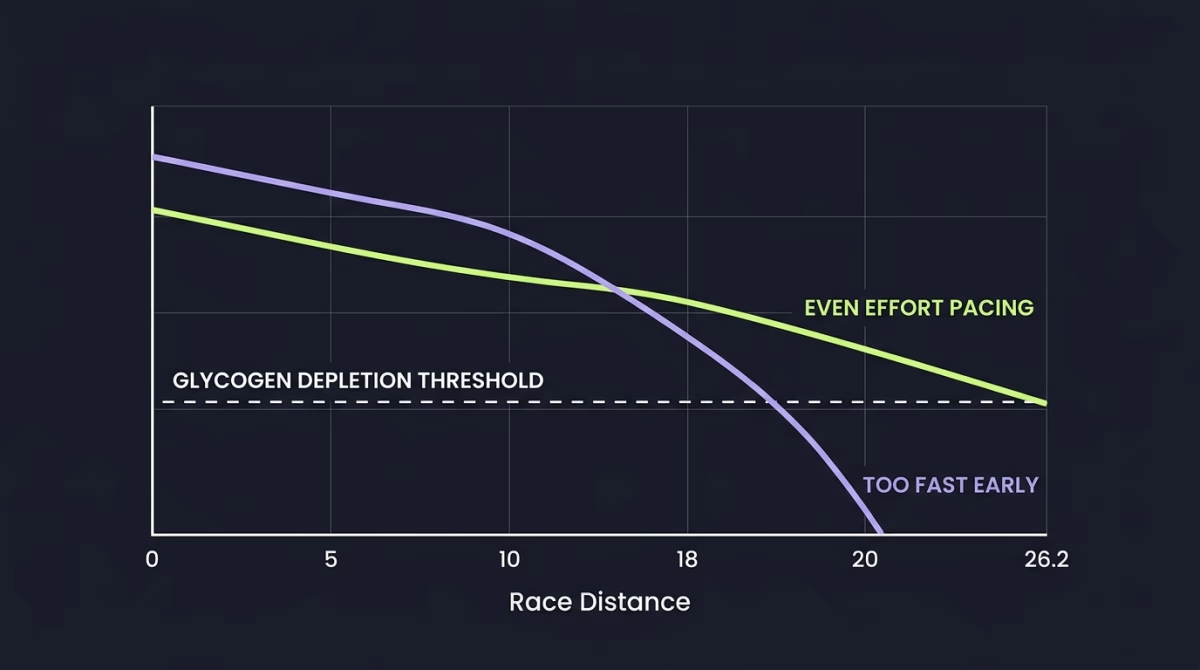
Understanding why pacing matters is not just academic context. It changes how you think during the race, particularly in those early miles when your legs feel effortless and the temptation to push is strong.
Why Glycogen Is Your Hard Ceiling
Your muscles store enough glycogen to fuel roughly two hours of running at marathon pace, as modeled by Rapoport (2010). That window is relatively fixed. What changes based on your pace is the rate at which you burn through it.
Running 5% above your optimal marathon pace doesn’t cost 5% more glycogen. It costs significantly more, because at higher intensities your body shifts toward carbohydrate as its primary fuel source and away from fat. The ratio changes faster than the pace does.
This is why runners who go out ten seconds per mile too fast don’t slow ten seconds per mile in the final miles. They often slow 60 to 90 seconds per mile. The wall is not a fitness failure. It is a predictable metabolic event with a predictable cause. Most athletes who hit it know exactly where it went wrong; they just didn’t connect the early miles to the late-race collapse while it was happening.
Stat callout: A 2010 paper by Rapoport in PLOS Computational Biology modeled the metabolic demands of marathon running and found that small increases in running speed above an athlete’s aerobic threshold produced disproportionately large increases in carbohydrate combustion rate. The implication for race strategy is direct: even a modest early overpace accelerates the depletion timeline significantly.
Even Effort vs. Even Pace: The Distinction That Changes Everything
Most marathon pacing advice focuses on even splits, meaning the same pace throughout, or slightly faster in the second half. That’s correct in principle. In practice, it misses something important.
On any course with hills, wind, or significant terrain changes, maintaining even pace requires variable effort. Holding 8:30 per mile up a sustained climb costs far more physiologically than holding 8:30 per mile on flat ground. That extra cost comes out of the same glycogen budget you’re trying to protect.
Even effort is the more precise target. On a climb, you let pace drift to 8:50 or 9:00 per mile while keeping your effort steady. On the descent, you ease back to 8:20 without actively pushing. The average pace across both sections lands near your goal. The physiological cost is lower than if you had forced 8:30 up the hill.
Consider two runners both targeting 8:30 per mile. Runner A holds 8:30 on every climb. Runner B lets it drift to 8:55 while keeping effort constant, then recovers naturally on the flat. At mile 20, their GPS splits look similar. Their glycogen stores don’t.
Executing Your Marathon Pacing Strategy Phase by Phase
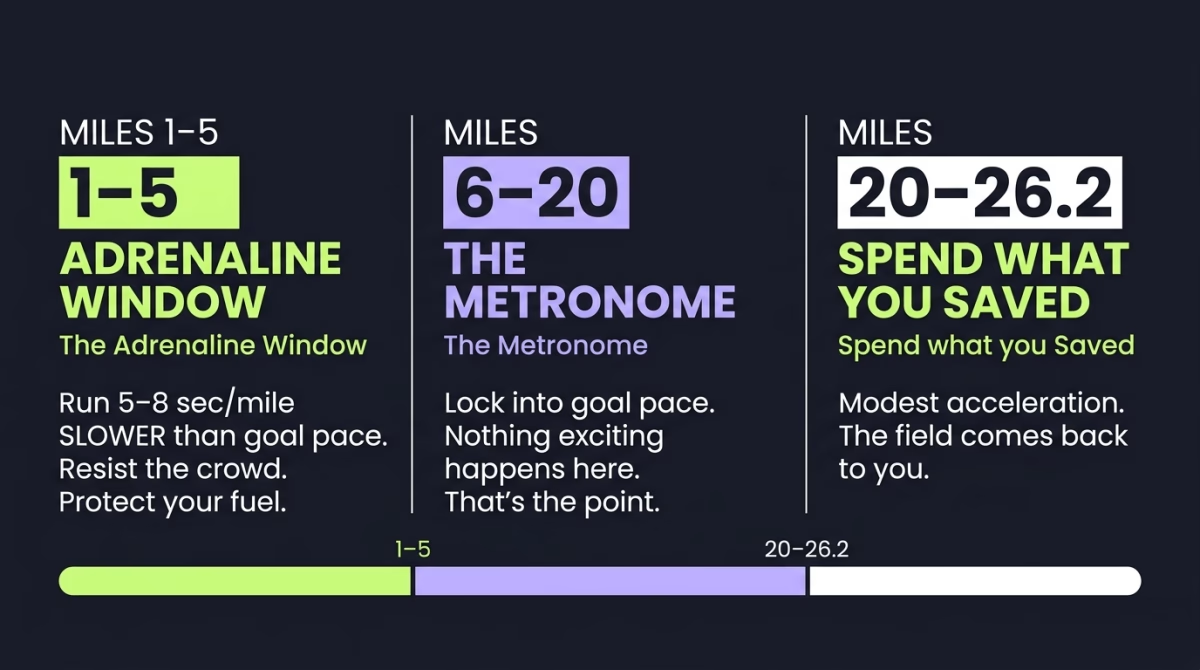
A marathon is three distinct races inside one event. Most athletes treat it as one continuous effort. That’s why so many fall apart in the closing act.
Miles 1–5: The Adrenaline Window
The opening miles are the most dangerous stretch of any marathon. Your legs are fresh. Your glycogen stores are full. The crowd is loud, your competitors are moving, and goal pace feels almost insultingly easy.
That sensation is a trap. It isn’t evidence that you set your goal too conservatively. It’s the predictable result of a rested body running below its ceiling. The pace feels easy because you haven’t been running long enough for fatigue to register yet, not because the pace is wrong.
The correct approach in these first miles is to run 5–8 seconds per mile slower than your goal pace. This will feel uncomfortable in a counterintuitive way. Runners you planned to finish ahead of will pass you. Stick to the plan.
Crowd surging is a related problem worth naming directly. In large races, the opening miles involve constant small accelerations to navigate around other runners. Each surge, even a three-second burst to slip past someone, burns carbohydrate at a higher rate than steady running. Set yourself in the right corral before the start. When the gun goes off, let the field spread naturally and resist every urge to chase.
Miles 6–20: Running Like a Metronome
This is the least dramatic stretch of the race and, consequently, the most important. Nothing exciting should happen here. Your only job is to sustain goal pace with minimal variation and protect the fuel you have left.
The 10-10-10 framework, roughly covering the first ten miles conservatively, the middle ten at goal pace, and the final 10K at full effort, provides a useful mental structure for this section. In practice, the middle stretch is where athletes most commonly drift. Feeling strong encourages a slight push above goal pace. Feeling flat encourages a slowdown. Neither adjustment is usually warranted.
If you feel strong between miles 12 and 18, that’s the plan working. Resist the urge to spend that feeling early. It’s specifically needed from mile 20 onward.
Heart rate is worth monitoring as a secondary check during this phase. On a flat course, it should be relatively stable. A climbing heart rate at a fixed pace signals that your effort is increasing even when the numbers haven’t changed. That often indicates dehydration, rising heat, or accumulated fatigue from an overly aggressive early pace.
Coaching tip: If your heart rate climbs more than 8–10 beats per minute above its steady-state value during miles 13–18, pull your pace back five seconds per mile. Addressing it at mile 15 costs you two or three minutes. Ignoring it costs you the final six miles.
Miles 20–26.2: Spending What You Saved
This is where the race actually starts. Everything before mile 20 was preparation.
If the first two phases went well, you’ll notice two things around this point. First, your legs are tired but not destroyed. Second, runners around you are slowing. Both are expected. The field is sorting itself based on how well each athlete managed their marathon pacing strategy over the preceding three hours.
The goal in this final stretch is modest acceleration, not survival. Runners who negative split marathons don’t sprint the last six miles. They hold pace or add five seconds per mile while the field falls back around them. That’s what it looks like from the outside. From the inside, it feels like finally being permitted to race.
Between miles 23 and 26, athletes commonly fixate on total distance remaining. A more manageable frame is converting remaining distance to time. At 9:00-per-mile pace, mile 24 to the finish is roughly 20 minutes. Most athletes have done hundreds of 20-minute training runs. So thinking in these terms can help the time pass quickly.
Adjusting Your Marathon Pacing Strategy for Course and Conditions
A flat-course pacing plan applied to a hilly race will fail. A goal pace built for 50°F conditions doesn’t hold at 72°F. These adjustments belong in your pre-race planning, not in the decisions you’re making at mile 18 when your judgment is impaired by fatigue.
Running Hills by Effort, Not Numbers
GPS pace on a climb is unreliable as a pacing tool. A 4–5% gradient can add 20 to 40 seconds per mile to your GPS reading while your actual effort barely increases. Chasing your pace target up a sustained hill means pushing harder than your body can sustain. By chasing effort means the climb costs what it should cost, and nothing more.
The practical approach: on any sustained climb, switch your watch display from pace to heart rate or simply run by feel. Let pace drift. On the descent, don’t accelerate to “recover” lost time. Let gravity work passively and return to goal pace on flat ground.
For a course-specific example of how this plays out on one of the most demanding marathon courses in the world, The Athens Marathon: A Pacing Strategy for the Ages covers effort-based pacing across a 13-kilometer climb in detail.
Heat, Wind, and Altitude Adjustments
Heat is the most significant environmental variable in marathon performance. Research by Ely et al. (2007) found that marathon performance slows progressively as temperature rises above roughly 50–55°F, and that slower recreational runners are affected more severely than elites. A working rule many coaches use: for every 10°F above 55°F, add approximately 20–30 seconds per mile to your goal pace.
That adjustment will feel like surrendering before the race starts. But at mile 22 it will feel just right.
A sustained headwind of 15–20 mph adds meaningful effort to every exposed section. Rather than calculating a precise pace adjustment, use heart rate as your reference on exposed stretches and let pace drift accordingly. Attempting to hold pace into a headwind is another efficient way to spend glycogen you need later.
Altitude above roughly 5,000 feet also affects marathon pacing meaningfully. According to research by Wehrlin and Hallén (2006), VO2max declines linearly with increasing altitude in endurance athletes, translating to a 3–5% performance drop at moderate elevations for non-acclimated runners. In practical terms, adding 20–30 seconds per mile to your sea-level goal pace is a reasonable starting point. Adjust downward only if the opening miles feel more comfortable than expected. Individual variation is significant here, so treat the adjustment as a floor, not a fixed target.
When the Plan Is Already Failing
At some point in a marathon, something goes wrong. The question is not whether you’ll face a rough patch. It’s whether what you’re experiencing is a rough patch or a sign that the goal is already out of reach.
The Decision Point at Mile 17
The mile 16–18 window is where most athletes face this question. They’re behind goal pace, or they’re on pace but feeling much worse than expected. The instinct is to push harder and hope the feeling passes.
A more useful approach is to ask two questions. First, has pace slipped or has effort spiked? If pace has dropped but effort is steady, the body may be responding to early glycogen depletion. Pulling back ten seconds per mile now and fueling aggressively at the next aid station gives you a genuine chance of a strong final six miles. If effort has spiked just to hold pace, the budget is already overdrawn. Forcing it from here accelerates the collapse.
Second, is this normal race fatigue or something different? Muscular fatigue that builds gradually is expected and manageable. A sudden change in how you feel, dizziness, or an inability to maintain any pace comfortably is a different signal entirely. In that case, adjusting your goal time and running controlled to the finish is a legitimate and intelligent outcome.
Recalibrating at mile 17 is a coaching decision. Ignoring the signals until mile 22 is a harder way to arrive at the same result.
Training Your Pacing Before Race Day
Race-day pacing is a skill. It can be trained. Most amateur marathoners train as if their only resource is physical fitness. It isn’t. Training stress and life stress draw from the same recovery budget. A 16-mile Sunday run that leaves you flat for three days doesn’t just cost you Monday. It compromises the quality of every session that follows. The athletes who arrive at the start line freshest are rarely the ones who ran the longest. They are the ones whose training fit inside their actual life.
However, most athletes don’t practice it deliberately, which is why many arrive at the start line with a solid plan and no experience executing it under the specific conditions that make early miles feel deceptively easy.
Back-Half Acceleration Long Runs
A simple reframe helps here: stop measuring your long run by miles and start measuring it by time on feet. One workout structure that effectively teaches the body to negative split is the progressive long run. The format is straightforward: 15–16 miles total, with the first 10–11 miles at a comfortable aerobic pace (60–90 seconds per mile slower than goal marathon pace), and the final 4–5 miles at goal pace.
This workout accomplishes two things. It teaches the body to sustain goal pace on genuinely fatigued legs, which is much closer to what miles 22–26 feel like in a race than any fresh tempo effort. It also builds the mental habit of holding back early when the pace feels easy, which is harder than it sounds at mile 8 of a long run when you’re feeling strong.
Coaching tip: The last long run of your training block should fall no fewer than three weeks before race day, not two. Two weeks is a common recommendation that consistently leaves recreational runners carrying residual fatigue to the start line. Three weeks gives the legs, connective tissue, and nervous system the time they actually need to arrive fresh. Build your training calendar around that anchor point first, then work backwards.
The GPS Drift Problem
One practical note for race day: consumer GPS watches accumulate tracking error over the full marathon distance. By the finish line, your watch may read 26.5 or even 26.8 miles. The per-mile pace data, especially in the final miles, can consequently read 5–10 seconds per mile faster or slower than your actual pace.
Use pace as a guide, not a guarantee. If your watch says 8:45 per mile and your effort level suggests 8:52, trust the effort. Chasing GPS numbers in the final miles of a marathon is particularly unreliable.
Common Pacing Mistakes
Setting goal pace from a single standout workout. Threshold sessions happen in controlled conditions, on familiar terrain, with proper recovery before and after. A marathon is 26.2 miles of accumulating fatigue on a public road course. One impressive training run doesn’t raise your ceiling. It confirms the ceiling you already had.
Surging repeatedly in the opening miles. In a large marathon, a runner may accelerate and decelerate fifteen or twenty times in the first five miles just navigating the field. Each surge, even a brief one, costs more than steady running would. Positioning yourself in the correct start corral before the gun is far cheaper than spending energy to compensate for the wrong one after it.
Treating five seconds per mile as a negligible margin. Five seconds per mile over goal pace is 2.2 extra miles’ worth of effort banked at the halfway point. Over 26.2 miles, it means running the first half roughly 3.5 minutes faster than planned. The physiological cost of that margin is not linear. It’s the difference between a controlled finish and a survival exercise from mile 20 onward.
Common mistake spotlight: Chasing excessive long run mileage. Online training plans routinely prescribe 30 to 32-kilometer long runs to athletes targeting 3:45, as if the number itself confers readiness. It doesn’t. For most amateur marathoners, long runs beyond 2.5 hours produce diminishing returns and accumulating fatigue that shows up on race day, not in training logs. A 16-mile long run completed fresh and absorbed well beats a 20-miler that leaves you dragging through the following week.
The Race That Pays Off
A well-paced marathon doesn’t feel exciting for most of the race. That’s the point.
The first five miles feel controlled, almost frustratingly conservative. Miles 6 through 20 are steady and unglamorous. The final six miles are where the work shows up, not in a dramatic surge, but in the simple fact that you have something left to spend when most of the field doesn’t.
That’s what a sound marathon pacing strategy produces: a race where you hold pace while others slow, where the field comes back to you in the final miles, and where the finish line arrives feeling like the result of a plan you executed, rather than a distance you survived.
The math behind it is simple. The execution requires patience. Doing both well is what separates a satisfying marathon from a painful lesson in what to do differently next time.

Run Your Best Marathon with EndoGusto
Suggested References
- Rapoport, B.I. (2010). Metabolic factors limiting performance in marathon runners. PLOS Computational Biology, 6(10), e1000960. https://journals.plos.org/ploscompbiol/article?id=10.1371/journal.pcbi.1000960
- Ely, M.R., Cheuvront, S.N., Roberts, W.O., & Montain, S.J. (2007). Impact of weather on marathon-running performance. Medicine & Science in Sports & Exercise, 39(3), 487–493. https://pubmed.ncbi.nlm.nih.gov/17473775/
- Wehrlin, J.P., & Hallén, J. (2006). Linear decrease in VO2max and performance with increasing altitude in endurance athletes. European Journal of Applied Physiology, 96(4), 404–412. https://pubmed.ncbi.nlm.nih.gov/16311764/
- Nikolaidis, P.T., & Knechtle, B. (2017). Effect of age and performance on pacing of marathon runners. Open Access Journal of Sports Medicine, 8, 171–180. https://pmc.ncbi.nlm.nih.gov/articles/PMC5571841/