Running Race Strategy: How to Pace Every Distance

Most runners spend twelve weeks training for a race and about twelve seconds planning how to run it. The training log is detailed. The long runs are logged. The race plan, though, is usually something like: go out steady, see how it feels, finish strong. That’s not a plan. It’s a guess, and in the final miles of any race, guesses cost time.
A running race strategy is what connects the fitness you’ve built to the result you produce on race day. Two athletes with identical preparation can finish minutes apart because one of them actually thought about how to distribute their effort. The other one winged it.
The other thing that catches people out: they apply the same approach to every distance. The 5K and the marathon are not the same race. They draw on different energy systems, break down differently, and fail in different ways. A pacing plan that works at 13.1 miles will leave you walking at mile 22. One that works at the marathon will cost you 30 seconds at the 5K.
This article covers race-specific strategy from 5K to marathon. You’ll see what each distance actually demands physiologically, where each one typically falls apart, how to adjust in real time when race day goes sideways, and how to practice pacing during training so the race itself isn’t the first time you’ve tried it.
Key Takeaways
- Why the same running race strategy backfires when the race distance changes
- How your warm-up shapes your 5K result more than your first mile does
- The difference between running even pace and running even effort, and when each one matters
- Why your race pacing plan needs a Plan B written before the gun goes off, not improvised at mile 17
- What actually breaks at each distance, and the warning signs that show up before it does
Every Distance Is a Different Race (The Effort Budget)
A running race strategy is a pre-race plan for how you’ll distribute your effort across a given distance. It includes your goal pace, how you’ll structure each phase, and what you’ll do when conditions or your body force a change. The reason strategy varies so much by distance is that different distances pull from a slightly different physiological systems, and each one has its own specific point of failure.
Think of your race-day effort as a finite budget. The size doesn’t shift much from race to race. What changes is the rate at which you’re allowed to spend, and understanding that rate is the whole job.
In a 5K, you’re drawing on a VO2max-driven account. The race lasts long enough to require near-maximal oxygen processing, but short enough that fuel supply isn’t the limiting factor. You can work right at the edge of your aerobic ceiling for most of it.
In a marathon, the aerobic system isn’t the bottleneck. Glycogen is. You have roughly two hours of stored fuel available at race pace, and once it’s gone, the pace drops whether you want it to or not. The same percentage of effort that felt manageable in a 5K will leave you walking by mile 22.
The 10K and half marathon sit between these two, which is what makes them tactically interesting. The 10K borrows from both ends. The half marathon demands enough aerobic management to matter, but not enough glycogen stress to define the whole race.
This is why telling runners to “run even splits” is incomplete advice. At marathon distance, the research favors even-to-slight-negative pacing, where the second half is run 1 to 3 percent faster than the first. That’s a very different approach from what works at 5K, where a slightly fast opening is often the better call. The physiological system you’re drawing from determines your pacing approach, and the distance determines the system. Start there.
Running Race Strategy for the 5K
The Warm-Up Is Your First Move
Most race-day mistakes at 5K distance happen before the gun goes off. Specifically, they happen in the warm-up, or more accurately, in its absence.
A 5K places you near your VO2max from the opening seconds. If your cardiovascular system isn’t already elevated when the race starts, the first kilometer becomes a forced acceleration phase. You’re spending real fitness just getting your engine warm, when you should be spending it on race output.
A workable 5K warm-up runs about 25 minutes total: 12 to 15 minutes of easy running, four to six dynamic mobility drills (leg swings, A-skips, high knees), and four to six 100-meter strides at progressively faster speeds, finishing 5-10 minutes before the start. The goal is to arrive at the line with elevated heart rate, open hip flexors, and a nervous system already told what fast feels like.
Skipping any of this for a marathon costs you almost nothing. Skipping it for a 5K costs real time. Alves and colleagues (2023) found that even warm-up intensity alone could move trained 5K times by several seconds, with the high-intensity protocol also improving pacing strategy across the race. For runners who skip the warm-up entirely, the cost is typically larger because the first kilometer becomes a forced acceleration phase rather than productive race output.
Pacing the 5K: Fast Start, Controlled Middle, Hard Close
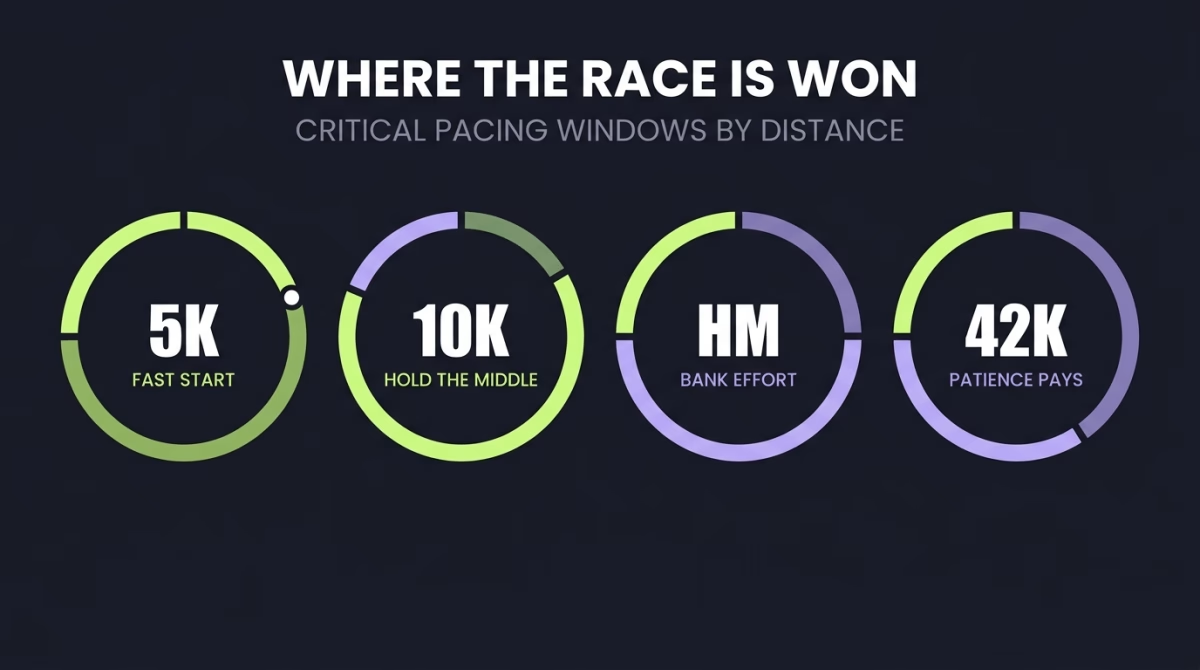
The 5K is one of the few distances where a slight positive split is acceptable and, for some runners, genuinely optimal. You don’t have time for negative-split tactics; the race finishes before you’d benefit from them.
Take a 22-minute 5K runner targeting 7:05 per mile. A sensible plan: mile one at 7:00, mile two at 7:08, mile three at 7:08, then close the final 0.1 at whatever’s left. That’s a flat-to-slight positive split, and the discipline test is mile two, not mile three.
Most age-group 5K runners do something different. They go out at 6:40, feel great through the first mile, then run miles two and three at 7:30 because the early spending came due. The time loss from that pattern is larger than most people realize, and it’s also completely preventable.
Research from a 2006 study cited by Canadian Running Magazine found that moderately trained female runners actually ran their fastest 5K times when they started about six percent faster than race pace, suggesting that for fit, confident runners, a more aggressive front-end carries less risk than expected. The caveat is fitness and mental readiness. If you’re not confident you can hold on, even effort is the safer call.
Where the 5K Falls Apart
For most age-group runners, the 5K starts to crack somewhere between 800 meters and 1.2 kilometers. Heart rate spikes past sustainable territory, breathing goes from rhythmic to ragged, and form starts to break down. From that point, the runner manages damage rather than executes a race.
The clearest signal is your breathing. If respiration turns ragged before the second kilometer, your opening pace was wrong. Pull back five seconds per mile immediately. The next two kilometers will be uncomfortable, but salvageable. Hold the original pace and you’re likely to lose 30 seconds or more in the final mile.
Running Race Strategy for the 10K
The Hybrid Distance
The 10K is the trickiest distance in all of running race strategy because it sits in metabolic no-man’s-land. It’s too long for the controlled aggression that works in a 5K, and too short for the conservative fuel management that defines half marathons and beyond. Most 10K mistakes come from picking the wrong neighbor and pacing accordingly.
Physiologically, the 10K runs at roughly 90 to 92 percent of VO2max for trained runners, as documented by Billat and colleagues across race distances. That’s an intensity you can sustain for 30 to 50 minutes depending on fitness, but only if you settle into it deliberately. Start 5 to 8 seconds per kilometer too fast and you spend the rest of the race paying compound interest.
Pacing the 10K: Settle Early, Hold the Middle, Close Strong
The dominant strategy for the 10K is even pace with a slight negative split, or as close to it as conditions allow. Take a 48-minute 10K runner targeting 7:43 per mile (4:48/km). A workable plan: first mile at 7:50, second mile at 7:45, miles three through five at 7:42, final mile at 7:35 if possible.
Notice what happens in the middle. The runner sits at goal pace for 5K of the race. That stretch, between mile 3 and mile 5, is where the 10K is won or lost. It’s also where attention drifts most. The opening kilometer feels exciting. The closing one feels urgent. The middle just feels like work.
Pack running becomes valuable here. If you can lock onto a runner whose pace matches yours through the middle stretch, the cognitive load drops and the pace holds itself. Just verify their fitness before you commit; pacing off someone who’s overcooking will pull you into their crash.
Where the 10K Falls Apart
The danger zone for the 10K is mile 4 (around km 6 to 7). Runners who survived the opening overpace start to feel its effects here. Runners who paced cleanly start to feel the cumulative aerobic load and mistake it for fatigue.
The signal here isn’t physiological so much as attentional. You’ll notice your pace drifted 5 to 8 seconds per mile slower than goal without consciously easing off. That’s the moment to refocus. Pick a runner ahead, settle behind their shoulder, and rebuild the pace within half a kilometer. Wait until mile 5 to address it, on the other hand, and you’ll cede 15 to 20 seconds you can’t get back.

Running Race Strategy for the Half Marathon
Patience Is the Entire Strategy
The half marathon is where pacing discipline starts to matter more than fitness. Up to 10K, a fit runner can absorb pacing mistakes through raw aerobic capacity. At 13.1 miles, the math stops working in your favor. Every second spent above your sustainable pace in the first 10 kilometers is paid back, with interest, in the final 5.
Cuk and colleagues (2021) analyzed pacing patterns in non-elite half marathon and marathon runners and found meaningfully less variation at half marathon distance, especially among trained runners. The takeaway: the half marathon is the best distance for learning pacing discipline before attempting the marathon, because the consequences of pacing errors are clear, but not as catastrophic as at 26.2 miles.
Pacing the Half Marathon: Banking Effort, Not Time
The “time in the bank” mentality is the most common half marathon mistake. The logic feels reasonable: build a cushion in the first 10K, then defend it in the back half. The physiology disagrees. Time gained at higher intensity costs more in fuel and fatigue than the same time gained later at controlled effort.
Take a 1:50 half marathoner targeting 8:23 per mile (5:12/km). A clean execution looks like this: miles 1 through 3 at 8:30 (ten seconds slower than goal), miles 4 through 9 at 8:23 exactly, miles 10 through 13 at 8:15 if the legs allow. That’s a negative split of roughly 30 to 45 seconds. It produces a finish at or under goal, with the runner passing rather than being passed in the final 5K.
Effort-based landmarks help here more than pace alone. If your perceived exertion at mile 4 is anywhere above 7 out of 10, you’re already in trouble. By mile 10, you should still have one sustainable gear left.
Where the Half Marathon Falls Apart
The half marathon’s danger zone is miles 9 through 11. By this point, you’re too far from the finish for adrenaline to help, and too deep into the race for early conservatism to feel like it was worth it. This is the stretch where runners who started 10 seconds per mile too fast first realize they’re in serious trouble.
The early indicator is heart rate drift. If your HR has climbed 6 to 8 beats per minute above its mile-3 average without a corresponding pace change, you overspent earlier. Pulling back 5 to 8 seconds per mile from mile 8 onward can preserve the second half. Holding pace, on the other hand, will not.
Running Race Strategy for the Marathon
The marathon is the ultimate glycogen management problem, and the strategic margins are smaller than at any other distance. A 5K runner who goes out 5 percent too fast loses 30 seconds. A marathoner who does the same can lose 15 minutes.
Two principles dominate marathon pacing strategy. First, even effort beats even pace on any course with hills, wind, or terrain changes. Holding 8:30 per mile up a sustained climb costs significantly more glycogen than letting pace drift to 8:50 while keeping effort steady. The body doesn’t care about your watch.
Second, the 10-10-10 framework remains the most useful mental structure for race execution. Run the first 10 miles cautiously, the middle 10 at goal pace, and the final 10 kilometers at full effort. Most marathon failures, however, happen in those first 10 miles, which is also when the runner has the least information about whether they’re actually on track.
We cover marathon-specific execution in depth in our full guide on Marathon Pacing Strategy: How to Pace Your Marathon Perfectly. For building a race plan across distances, the marathon is simply the most punishing example of the same principle that applies everywhere: spend your effort in proportion to the budget the distance gives you, and the race rewards you. Spend faster, and no amount of fitness saves the back half.
Reading the Course Before You Race It
Elevation Profiles Tell You Where to Spend and Where to Save
Most race websites publish an elevation profile, which should become part of every running race strategy. Most runners glance at it once and forget it. That’s a mistake that compounds with race length.
A useful course read involves identifying three things: where the climbs are, where the descents are, and where the flat stretches sit relative to the start and finish. A half marathon with most of its climbing in miles 2 to 5 demands a very different opening strategy than one with the climbs concentrated in miles 9 to 11. The pacing plan should change accordingly.
For a hilly course, build effort distribution rather than pace distribution. Plan to be 10 to 20 seconds per mile slower up significant climbs and 5 to 10 seconds per mile faster on equivalent descents. Your average should land near goal pace by the finish, but the splits along the way will look uneven by design, and that’s the point.
A concrete example: the Athens Marathon’s 13-kilometer climb between 18 km and 31 km demands a pacing plan that intentionally gives back 5 to 15 seconds per kilometer through the climb in order to preserve enough fuel for the descent into the Panathenaic Stadium. Runners who try to hold goal pace through that climb almost always pay for it in the final 10 kilometers.
Wind, Heat, and Altitude: Adjusting Before the Gun
Conditions live in the same category as elevation: pre-race adjustments that belong in your plan, not improvisations made at mile 14 when fatigue is already compromising judgment.
A few useful rules of thumb:
- Above 60°F (16°C), expect to add roughly 3 to 5 percent to your goal time per 10°F (5.5°C) above that threshold, with greater impact on slower runners and longer races.
- A sustained 10 mph (16 kph) headwind can cost 10 to 15 seconds per mile at half marathon pace. Tuck behind a runner of similar pace whenever possible; drafting cuts up to 80 percent of the drag cost.
- For altitude races above 5,000 feet (1,500m), expect a 4 to 6 percent slowdown without specific altitude preparation, with the effect roughly doubling at 7,000 feet.
These adjustments are estimates, not guarantees. The principle, however, is firm: make them before the start, not during the race.
When the Plan Breaks: Your Mid-Race Decision Tree
Recognizing the Warning Signs Early
The earlier you notice your race plan failing, the more options you have to salvage it. Three signals are worth tracking actively: heart rate drift at stable pace, perceived effort climbing without a pace change, and form breakdown (shortened stride, dropped shoulders, labored breathing at familiar intensities).
Each of these tells you the same thing. The cost of your current pace is rising, and your fitness account is being drawn down faster than planned. The watch will eventually show this as a pace decline, but by then you’ve already lost 90 seconds you didn’t need to lose.
The Three Choices You Always Have
When the plan starts to break, you have three legitimate responses, and the right one depends on how much race remains and how deep the trouble runs.
The first is recalibration. Pull back 5 to 10 seconds per mile, accept a slower finish, and protect the rest of the race. This works when you catch the problem early (before halfway in a half marathon, before mile 18 in a marathon) and the issue is overpacing rather than physiological breakdown.
The second is shifting to effort-only mode. Ditch the pace target entirely, run by perceived exertion, and let the time fall where it falls. This is the right call when conditions changed mid-race (sudden heat, unexpected wind) or when you realize your goal pace was set too aggressively in the first place.
The third is survival. Forget the goal entirely, focus on finishing, and reframe the race as a training stimulus. This is the right call when the wheels have fully come off; walking before mile 22 in a marathon, or breathing uncontrollably at 8K of a 10K. There’s no strategic genius in finishing in agony when you could finish standing up.
The mistake to avoid, in any case, is trying to maintain the original plan when the plan is clearly broken. That choice maximizes your suffering and minimizes your finish time.
Building a Race Plan You Can Actually Execute
The best running race strategy is one you’ve practiced. A plan that exists only on paper rarely survives the first kilometer of a race.
Distance by distance, the structure holds. The 5K allows more aggressive early spending because the budget is small but fully accessible. The marathon requires restraint because the budget is finite and easy to exhaust. The half marathon and 10K ask for something in between: enough discipline to preserve the second half, enough confidence to hold a genuinely hard pace.
Build the plan around the physiology of the distance. Structure it around your fitness, not your aspirations. Practice the effort levels during training. And write out a contingency before race day, not during mile 17, when fatigue is already filtering your judgment.
When the plan holds, you’ll pass people in the final kilometers. When it breaks, you’ll have a framework for deciding what to do next. Either way, you’ve done something most runners never bother with: you thought about it beforehand.

Train Smarter With EndoGusto
Suggested References
- Alves, M. D. D. J., Knechtle, B., Silva, D. D. S., Fernandes, M. S. D. S., Gomes, J. H., Thuany, M., Aidar, F. J., Weiss, K., & De Souza, R. F. (2023). Effects of High-Intensity Warm-Up on 5000-Meter Performance Time in Trained Long-Distance Runners. Journal of Sports Science & Medicine, 22(2), 254-262. https://pmc.ncbi.nlm.nih.gov/articles/PMC10245000/
- Billat, V., et al. (2020). Maximal Time Spent at VO2max from Sprint to the Marathon. International Journal of Environmental Research and Public Health. https://pmc.ncbi.nlm.nih.gov/articles/PMC7763525/
- Cuk, I., Nikolaidis, P. T., Villiger, E., & Knechtle, B. (2021). Pacing in Long-Distance Running: Sex and Age Differences in 10-km Race and Marathon. Medicina, 57(4), 389. https://www.ncbi.nlm.nih.gov/pmc/articles/PMC8073231/