Coaching the 70.3 Triathlon Athlete for Sustainable Performance

An athlete finishes her first 70.3 triathlon in 5:42. Bike power was steady. Nutrition was on point. The run held together until kilometer 18, and even then, the fade was manageable. By every reasonable measure, it was a successful race.
Three months later, she lines up for her second. Same fitness. Same body weight. Similar course profile. She finishes in 6:11, with a run split 14 minutes slower than the first. Her legs never came around after T2.
The coach reviews the training log and eventually finds the obvious culprit. After the first race, the athlete took five days off and then jumped straight back into build-phase volume. There was no recovery architecture. No deload. No transition between race stress and new training stress.
The preparation worked once, but it was never designed to work twice.
This is the pattern most coaches will recognize. A 70.3 triathlon athlete delivers a strong debut performance, then struggles to repeat it. In fact, the issue is rarely about talent or motivation. It’s about how the training was structured around a single peak instead of a sustainable arc.
The goal of this article is to examine how coaches can shift from one-shot preparation to durable, repeatable 70.3 triathlon performance. You’ll find practical frameworks for season structure, load management, and recovery timing that keep athletes competitive across multiple 70.3 triathlon distances without grinding them down.
Key Takeaways for Coaches
- Why most 70.3 athletes deliver one strong race and then regress
- How to design a half-distance season with two or three meaningful peaks
- The weekly load patterns that protect performance over months, not just weeks
- Why post-race recovery is a structural decision, not a rest period
- Small coaching choices that compound into long-term durability
Why Most 70.3 Triathlon Athletes Peak Once
Half-distance racing attracts a specific type of athlete. Motivated enough to commit to 10-14 hours of weekly training, experienced enough to handle multi-sport logistics, and ambitious enough to chase time goals. These athletes respond well to structured preparation. They absorb load, show up fit on race day, and often deliver genuinely good performances.
Then the cycle breaks.
The Single-Peak Trap
As covered in our guide to70.3 triathlon distances and the demands of the format, most half-distance preparation follows a familiar shape. A base phase builds volume. A build phase adds intensity. A taper sharpens the athlete. Race day arrives, the athlete performs, and then the plan ends. There is no chapter after the race because the plan was never written to have one.
For athletes racing one event per year, this can work. However, the moment an athlete enters two or three 70.3 races in a season, the single-peak model starts to fail. Each new buildup begins from a lower starting point because the recovery from the previous race was unstructured. The athlete, however, doesn’t lose fitness overnight. Instead, they accumulate residual fatigue that masks itself as staleness, flat workouts, or minor soft-tissue complaints that never quite become injuries.
Seiler and Kjerland (2006) observed that endurance athletes who maintained consistent training distribution over longer periods showed more stable performance markers than those who oscillated between aggressive loading and complete rest. The principle applies directly to 70.3 coaching. Athletes who swing between peak training and full shutdown rarely find a rhythm that sustains across a season.
The Performance Cliff After Race Day
Here is what typically happens in the two weeks after a strong half-distance race. The athlete takes four to seven days completely off. Motivation is low. Soreness also lingers. Then guilt sets in, and they return with a hard ride or a tempo run because they “feel behind.” Within ten days, they’re back at pre-race volume without having absorbed the race stress.
This pattern creates a specific physiological problem. Race efforts at 70.3 triathlon intensity, sustained sub-threshold work for four to six hours, produce significant neuromuscular fatigue and glycogen depletion that take longer to resolve than athletes expect. Research by Hausswirth and Le Meur (2011) found that endurance performance markers can remain suppressed for 10 to 14 days after prolonged competition, even when athletes report feeling recovered.
Coaches who treat the post-race window as dead time, rather than as a planned phase, set the athlete up for a weaker second race before the next training block even begins.
Building a 70.3 Triathlon Season Around Durability
Sustainable 70.3 triathlon performance requires coaches to think in seasons, not in race-specific blocks stitched together. The goal is to maintain a high training floor throughout the year so that each race-specific buildup starts from strength rather than from rebuilding.
Two or Three Races, One Continuous Thread
Consider an athlete targeting three half-distance races between May and September. A single-peak model would require three separate build-taper cycles in five months. That’s an enormous amount of physiological oscillation, and it leaves almost no room for genuine aerobic development.
A durability-centered approach looks different. As we explored in Triathlon Periodization: Balancing Three Sports Without Burnout, the goal is to maintain a baseline training structure that only shifts in emphasis, not in total architecture. The base training continues underneath. What changes is the specificity layer on top.
For example, an athlete averaging 11 hours per week during a build phase might drop to 7 or 8 hours for the two weeks following a race. Crucially, those 7 hours are not random. They include easy aerobic work in all three disciplines, light neuromuscular activation, and one moderate-intensity session by the end of the second week. The athlete never falls off the training cliff. They just descend a few steps and climb back.
A Practical Season Layout
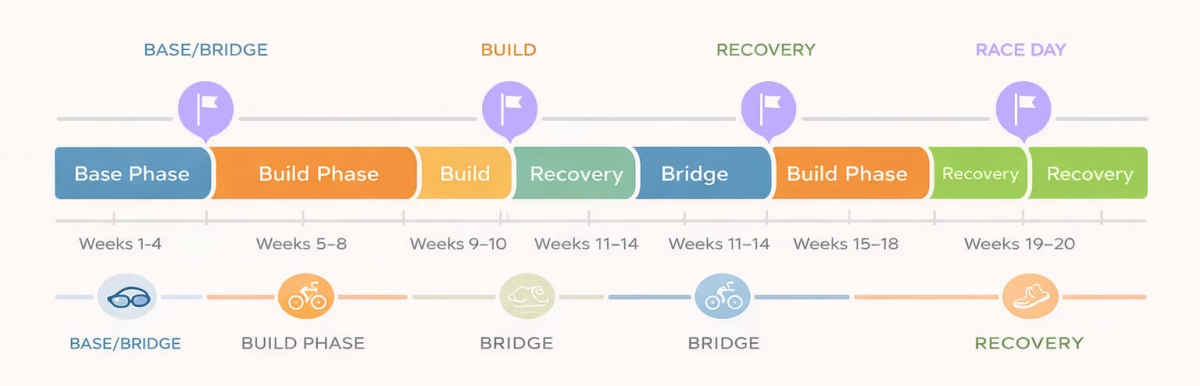
Below is an example six-month framework for an intermediate athlete targeting three 70.3 races. The weeks are approximate and should flex based on the individual athlete’s recovery capacity and response to load.
| Phase | Weeks | Focus | Weekly Volume |
| Base Continuation | 1–4 | Aerobic maintenance, technique | 10–12 hrs |
| Build 1 | 5–10 | Race-specific intensity, long ride progression | 12–14 hrs |
| Race 1 + Recovery | 11–13 | Race, then structured recovery | 7–10 hrs |
| Bridge Block | 14–17 | Moderate load, address limiters | 10–12 hrs |
| Build 2 | 18–21 | Sharpened race-specific work | 12–13 hrs |
| Race 2 + Recovery | 22–23 | Race, then recovery | 7–10 hrs |
| Short Build 3 | 24–26 | Maintenance + specificity | 10–12 hrs |
| Race 3 + Season Close | 27–28 | Race, then transition | 5–8 hrs |
Notice that the athlete never drops below 7 hours and never exceeds 14. The range is deliberate. Sustainability lives in the gap between the floor and the ceiling. If the ceiling is too high, recovery debt accumulates. If the floor is too low, the athlete loses the aerobic base they spent months building.
Bridge Blocks Are the Secret Ingredient
The weeks between races (labeled “Bridge Block” above) are where durable athletes separate from fragile ones. A bridge block is not a second base phase. It’s a short, focused period where the coach addresses one or two specific limiters while the athlete maintains general fitness.
For instance, if Race 1 revealed that the athlete’s run cadence dropped significantly after kilometer 15, the bridge block might include two weeks of neuromuscular run work: short hill repeats, stride frequency drills, and brick sessions with a cadence focus. The volume stays moderate. The intent is surgical.
Coaches using a platform like EndoGusto can review discipline-specific load trends after each race and identify which limiter to target during the bridge block. That visibility turns a vague recovery period into a productive development window.
Load Management That Protects 70.3 Triathlon Performance
Training load in half-distance preparation is often discussed in terms of weekly hours. Hours matter, but they hide the real variable that determines whether an athlete holds up across a season: how load is distributed within and between weeks.
An athlete logging 12 hours per week can be thriving or breaking down. The difference depends on how those hours are sequenced, what intensity they carry, and whether the coach has built recovery into the structure rather than hoping the athlete will find it on their own.
Ceilings and Floors, Not Just Averages
Most coaches track average weekly volume. Fewer track the range between an athlete’s hardest and easiest weeks. That range matters more than the average for 70.3 triathlon athletes racing multiple events per season.
A useful guideline: the heaviest training week should not exceed 130% of the lightest training week within the same mesocycle. If an athlete’s easiest week is 9 hours, the peak week should stay at or below roughly 12 hours. When that ratio stretches beyond 150%, the athlete’s connective tissue and nervous system absorb more oscillation than they can recover from on a rolling basis.
This is especially relevant in triathlon because load is spread across three disciplines with different mechanical costs. A 3-hour ride and a 75-minute run may add up to the same training stress score as two moderate sessions the following day. However, the orthopedic cost of the run is disproportionately high. Coaches need to account for mechanical load, not just metabolic load, when setting weekly ceilings.
The Role of Planned Easy Weeks
Structured recovery weeks are non-negotiable in sustainable 70.3 triathlon preparation. Yet they are frequently the first thing coaches sacrifice when an athlete feels good or when the calendar feels tight.
A practical pattern that works across most intermediate and advanced half-distance athletes is a 3:1 rhythm during build phases. Three weeks of progressive load followed by one week at 60-70% of the peak week’s volume. The recovery week should preserve session frequency, meaning the athlete still trains six or seven days. What drops is duration and intensity, not habit.
For example, if the peak build week includes a 3.5-hour long ride with tempo intervals and a 90-minute run with race-pace segments, the recovery week might include a 2-hour steady ride and a 50-minute easy run. The athlete stays in rhythm. The body absorbs.
Skipping the recovery week once is survivable. Skipping it twice in a row almost always produces a visible drop in session quality within the following block. Coaches who monitor training data inside EndoGusto’s planning tools can spot this pattern early, because workout completion rates and power consistency start to slip before the athlete consciously feels overtrained.
Monitoring Accumulated Strain
Single-session metrics (power output, pace, heart rate) tell you how the athlete performed today. Accumulated strain metrics tell you how the athlete will perform next week.
Two practical indicators worth tracking across a 70.3 triathlon season:
The first is chronic-to-acute training load ratio. When the ratio of recent training stress (last 7 days) to longer-term training stress (last 28 days) exceeds 1.3, injury risk and performance decline both increase. This has been documented across multiple endurance sports by Gabbett (2016) and applies directly to triathlon’s multi-discipline structure. Coaches should watch for spikes that follow rest periods, because athletes returning from a recovery week often overshoot in their eagerness to resume.
The second is run-specific load relative to total load. In half-distance preparation, run volume should generally represent 25-30% of total training time. When it creeps above 35%, overuse injuries become significantly more likely, especially in athletes over 35. Monitoring this ratio week to week catches drift that feels insignificant in isolation but compounds across a build phase.
Both of these metrics become far easier to manage when the coach has a centralized view of swim, bike, and run load in one place. Spreadsheets can do it. A purpose-built coaching platform does it faster and with fewer blind spots.
Recovery Architecture for Repeated 70.3 Racing
Recovery after a 70.3 triathlon is not rest. Instead, it is a planned phase with its own structure, progression, and exit criteria. Coaches who treat it as “take some days off and see how you feel” leave the athlete’s next training block to chance.
What the Body Actually Needs After a Half-Distance Race
A 70.3 race produces several overlapping recovery demands. Glycogen stores require 48 to 72 hours to fully replenish, assuming adequate nutrition. Muscular micro-damage, particularly in the quadriceps and calves from the half-marathon, follows a longer timeline. Neuromuscular coordination, the ability to recruit muscle fibers efficiently at moderate intensity, can remain suppressed for 7 to 12 days.
The mistake most athletes make is using perceived readiness as the recovery gauge. For instance, an athlete might feel fine on day five.. Heart rate at easy pace looks normal. So they do a tempo ride on day six. The session feels acceptable, but it delays the deeper neuromuscular recovery by several days, and that cost shows up two or three weeks later as flat performance during what should be a productive build block.
A Post-Race Recovery Timeline That Works
Here is a framework that has proven effective for intermediate 70.3 triathlon athletes who need to resume structured training within three weeks of racing. Individual variation exists, but the sequence holds for most athletes.
Days 1 through 3: complete rest or very light movement. Walking, easy swimming for 20 minutes if the athlete feels like it. No structure, no metrics, no expectations.
Days 4 through 7: short aerobic sessions in all three disciplines. Thirty-minute easy spin. Twenty-minute easy swim focused on feel, not pace. Twenty-five-minute jog at conversational effort. The purpose is restoring movement patterns, not building fitness.
Days 8 through 10: moderate aerobic sessions return. The long ride can extend to 90 minutes. The run can reach 40 minutes. Intensity stays below Zone 2 ceiling. If heart rate drifts higher than expected at easy pace, the athlete is not yet recovered.
Days 11 through 14: one moderate-intensity session can be introduced. A bike workout with 2 times 10 minutes at tempo is a good re-entry point. If the athlete executes it cleanly, with power and heart rate aligned, the bridge block or next build phase can begin.
The exit criterion is not “feeling good.” It is objective performance at moderate intensity matching pre-race benchmarks. If the athlete’s tempo power is still 5-8% below their established baseline on day 12, the recovery phase extends. Rushing this decision is one of the most expensive coaching errors in multi-race seasons.
How Recovery Demands Shift Across a Season
Here is something that surprises many coaches: the third race of a season requires more recovery infrastructure than the first, even if the race itself was less demanding.
The reason is cumulative residual fatigue. Each race adds a layer of deep physiological stress that surface-level recovery only partially resolves. Tendons adapt slower than muscles. The nervous system carries fatigue signatures that don’t appear in resting heart rate or body weight. By the third race in five months, the athlete’s recovery capacity has been taxed repeatedly.
Practically, this means the recovery phase after Race 3 should be longer and less structured than after Race 1. Where the first post-race recovery might take 12 to 14 days before structured training resumes, the third might need a full three-week transition period with no intensity at all during the first two weeks.
Coaches who plan for this in advance, rather than discovering it when the athlete stops responding to training, protect both the current season and the next one.
Practical Coaching Decisions That Compound Over a 70.3 Triathlon Season
Sustainable half-distance performance is not built in the big moments. It is built in the small, repeated decisions coaches make week after week. Session placement, intensity selection, and knowing when to pull an athlete back are the choices that separate a durable season from one that looks strong in April and collapses by August.
Session Placement Matters More Than Session Content
Two coaches prescribe the same threshold bike session: 3 times 12 minutes at 88% of FTP. One places it on Tuesday after a rest day. The other places it on Wednesday after a 75-minute steady run on Tuesday morning.
The session is identical. The training effect is not.
For 70.3 triathlon athletes carrying 10 to 14 hours of weekly load across three sports, where a key workout lands in the week determines whether the athlete absorbs it or merely survives it. A general principle worth following: the most demanding session of the week should arrive after at least 24 hours of reduced load. If the athlete’s primary limiter is the bike, the key ride gets the best slot. Everything else arranges around it.
Equally important is protecting the day after a long ride. A common mistake in half-distance preparation is scheduling a quality run session the morning after a 3-hour ride. The athlete completes it, checks the box, and feels productive. However, the run quality is compromised, and the cumulative mechanical load from back-to-back lower-body stress accelerates fatigue in ways that don’t surface for another two weeks.
When coaches plan weekly structure inside a platform like EndoGusto, they can visualize how sessions stack against each other across the week and spot these conflicts before the athlete experiences them.
When to Cancel a Workout
One of the most underrated coaching skills is knowing when a planned session should not happen. For athletes preparing for a 70.3 triathlon, the cost of one unnecessary hard session is almost always greater than the cost of one missed one.
Concrete signals that a workout should be replaced with easy aerobic work or full rest:
Resting heart rate is elevated by more than five beats per minute for two consecutive mornings. Sleep quality has been poor for three or more nights. The athlete reports heavy legs before the warmup begins, not just during the first few minutes. The previous key session showed power or pace more than 5% below the athlete’s recent baseline despite normal perceived effort.
Any one of these alone might be noise. However, two together are a pattern. Coaches who respond to patterns early, rather than waiting for a breakdown, keep their athletes healthier across the season. In practice, this means replacing the planned tempo run with 40 minutes of easy swimming or a recovery spin. The athlete loses one session. They protect the next three weeks.
Intensity Selection for Longevity
In 70.3 triathlon preparation, the most productive intensity zone is also the most dangerous. Tempo work, roughly 75-85% of FTP on the bike or marathon pace on the run, sits in the zone that feels satisfyingly hard without feeling destructive. Athletes enjoy it. Coaches similarly see good numbers. So both parties gravitate toward it.
The problem emerges across weeks. When more than two sessions per week involve sustained tempo-range intensity, the athlete’s parasympathetic recovery slows down. Resting heart rate variability, a reliable proxy for autonomic recovery, begins to compress. The athlete still hits their numbers for a while, but the margin between productive training and overreaching narrows steadily.
A sustainable distribution for most intermediate 70.3 athletes: one key bike intensity session, one key run intensity session, and everything else at genuinely easy aerobic effort. That means the long ride includes steady-state work but not threshold intervals. The easy runs are truly easy, at 65-70% of max heart rate, not “easy-ish.”
Coaches who hold this line consistently find that their athletes arrive at race day with more to give, not less. Restraint in training produces capacity on the course.
Coaching for the Long Arc
Half-distance triathlon is growing faster than any other format in the sport. More athletes are racing multiple 70.3 events per season, and many are doing so year after year. For coaches, this shift demands a corresponding change in how preparation is designed.
The athletes who sustain strong performances across seasons are rarely the ones with the biggest training weeks. They are the ones whose coaches built recovery into the architecture, monitored load ratios with precision, and made the small unglamorous decisions, canceling a workout, extending a recovery week, targeting one limiter at a time, that compound into long-term durability.
A 70.3 triathlon rewards fitness. Repeated 70.3 racing rewards intelligence. The distinction matters, and it starts with how the coach structures the months between start lines.

Build Sustainable 70.3 Seasons with EndoGusto
Suggested References
- Seiler, S., & Kjerland, G.Ø. (2006). Quantifying training intensity distribution in elite endurance athletes. Scandinavian Journal of Medicine & Science in Sports, 16(1), 49–56.
- Hausswirth, C., & Le Meur, Y. (2011). Physiological and nutritional aspects of post-exercise recovery. Sports Medicine, 41(10), 861–882.
- Gabbett, T.J. (2016). The training–injury prevention paradox: should athletes be training smarter and harder? British Journal of Sports Medicine, 50(5), 273–280.