Progression Run Workouts: The Pacing Structure That Builds Race-Day Effort Awareness

Philip is aiming at a 3:30 marathon, which works out at 4:59 per kilometer. On Wednesday he runs a sixty-minute progression run workout: twenty minutes at 5:14 per kilometer, twenty at 4:59, twenty at 4:44. Two changes of gear, both faster, the second one made forty minutes into the run.
Those two lifts are the part of the session that racing tests. Holding one effort accurately is what steady and sub-threshold tempo work teaches, and it is the foundation under every pacing decision an athlete makes. Changing effort late, on legs that have already covered forty minutes, is a separate skill. A progression run is where that skill gets rehearsed, in a single continuous run that increases pace in deliberate steps and finishes at a ceiling set in advance rather than at whatever the legs will give.
Threshold speed itself falls over the course of a long run. Philip’s 4:44 can sit safely below his threshold in the first twenty minutes and at or above it by the last twenty, with the number on his watch unchanged. Above that line fatigue arrives faster, so the closing segment is a heavier demand at minute forty than the identical pace would be at minute five. It is also the demand the last ten kilometers of his marathon will make. All of this comes at a recovery cost well below a dedicated interval session. What follows covers the physiology behind the progression run workout, the four formats and their pace bands, where to set the ceiling, and how to place the workout across a block.
Key Takeaways
- A progression run workout increases pace across two to four segments inside one continuous run, each held faster than the one before, finishing at a pre-set ceiling rather than an all-out effort.
- Steady and sub-threshold tempo work trains holding one effort accurately. The progression run adds the upward transition between efforts, asked for at the point in a run where thresholds have already drifted downward.
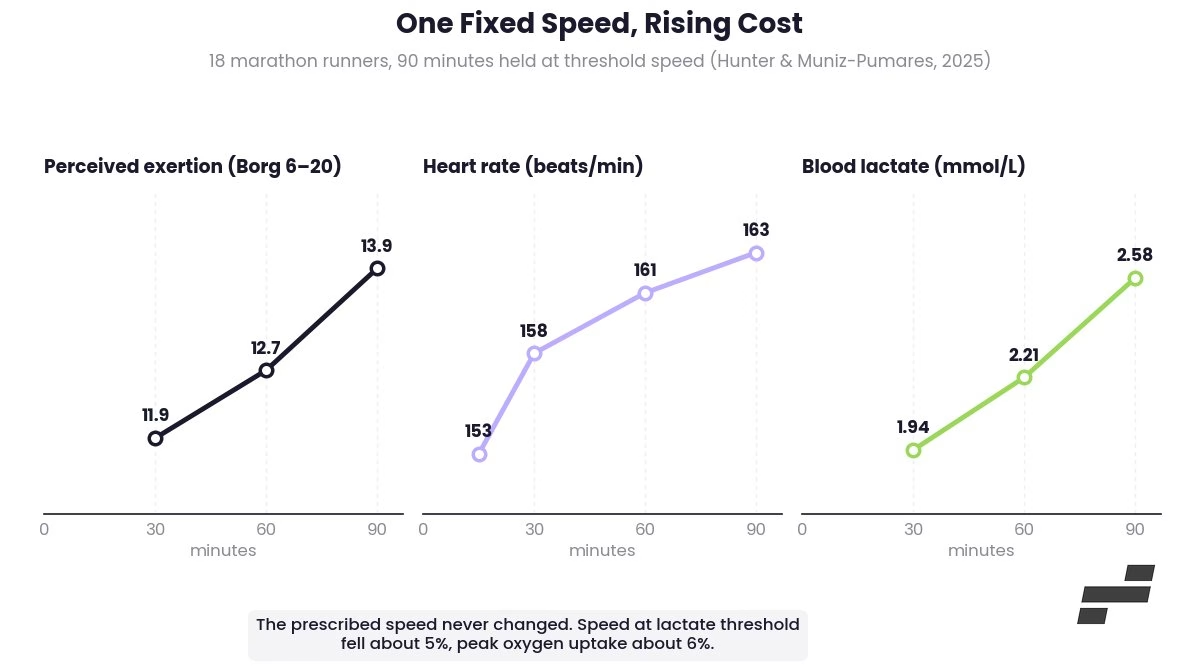
- Ninety minutes at threshold speed lowers speed at lactate threshold by roughly five percent and peak oxygen uptake by about six percent, so a late lift in pace is a trainable quality rather than a question of willingness.
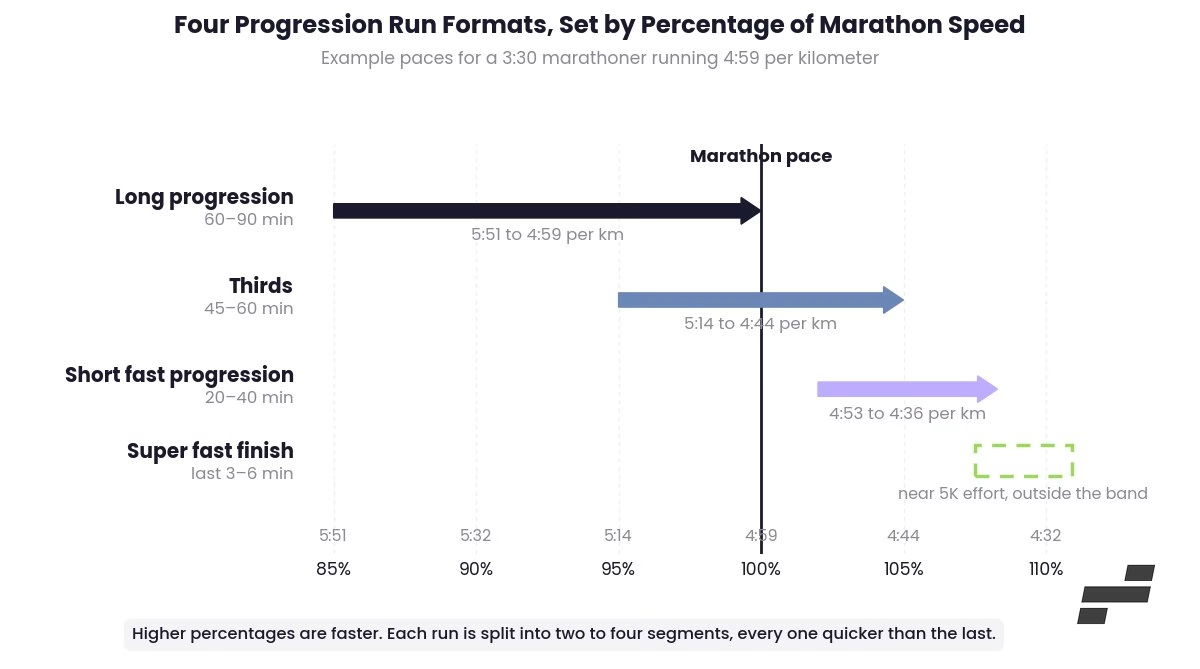
- Canova and Arcelli set progression run pace by duration: 60 to 90 minutes runs 85 to 100 percent of marathon speed, 45 to 60 minutes runs 95 to 105 percent, and 20 to 40 minutes runs 102 to 108 percent.
- The ceiling belongs to the format, running from marathon pace on a long progression up to roughly 10K effort on a short fast progression, rather than to one universal cap.
- Across 82,303 recreational marathoners, the third whose heart rate and speed stayed coupled longest averaged 3:37, while the third that decoupled earliest averaged 3:59.
What a Progression Run Workout Trains
A progression run workout is a continuous run that starts below normal training pace and finishes faster, with the increase distributed across two to four deliberate segments rather than left to feel. The closing effort of the progression running workout is defined before the athlete leaves the door and held under a ceiling. Two adaptations follow: quality aerobic volume accumulated at low recovery cost, and rehearsal at changing gear upward under accumulating fatigue.
Quality Volume at Low Recovery Cost
Twelve to fifteen minutes of strong running at the end of an otherwise easy session adds aerobic quality without the neuromuscular cost of repeated hard intervals. Run once a week through a twelve-week block, those closing segments total close to three hours of work at or near marathon speed. All of it accumulates inside sessions that still read as moderate on the weekly plan. Because the work sits at the top of the aerobic range rather than above it, the session rarely needs a recovery day behind it.
For an athlete whose recovery is limited by work and family rather than by training load, that arithmetic is the whole argument. The quality arrives without a second hard day competing for the same recovery.
Rehearsing the Change of Gear
Each segment change is a calibration rep. The athlete settles into a new effort, names it, then checks whether the pace matches what the effort predicted. A steady tempo run supplies one such reference point per session, held long enough to be learned properly. A progression run supplies two to four, and each one arrives under worse conditions than the one before it.
Tucker (2009) describes perceived effort as a template built from prior experience and continuously compared against incoming physiological feedback, set out in his perception-based model of exercise performance. That is a useful way to think about what repetition is doing here. Every progression run workout adds several points to that template rather than one, and it adds them in the order a race will call on them. At kilometer thirty, the template is what the athlete consults, in seconds, without a calculator.
Why the Same Pace Costs More Late in a Run
What Ninety Minutes Costs at Threshold
The speed an athlete can hold at minute ninety is not the speed they could hold at minute ten, and the difference is measurable. Hunter and Muniz-Pumares (2025) tested eighteen runners preparing for the 2024 London Marathon, a group averaging forty-one years old with a mean finish of 3:17. After ninety minutes of running at their threshold speed, speed at lactate threshold had fallen from 12.8 to 12.1 km/h, and peak oxygen uptake had dropped by about six percent.
Zanini and colleagues (2025) found reductions of six to seven percent in maximal oxygen uptake in trained marathoners after ninety and one hundred twenty minutes of heavy-domain running. Those declines describe what Maunder and colleagues (2021) named durability: the onset and magnitude of deterioration in an athlete’s physiological characteristics over the course of prolonged exercise.
A late lift in pace, then, is not simply a question of whether the athlete is willing to push. The physiological ceiling has come down while the run was happening, so the same pace now sits at a higher fraction of what remains.
Jones (2024) sets out what that means for prescription. Prolonged exercise lowers the lactate and gas exchange thresholds, so a session written for one intensity domain can drift into a higher one as the bout lengthens. Fatigue then develops faster once it does. The domain-crossing evidence behind that point comes from cycling, while the threshold drift described above was measured in runners, so the two lines of work support each other rather than repeat each other. For a progression run the implication is specific. The closing segment is not merely quicker than the one before it. It is a lift toward a boundary that has already moved down toward the athlete.
How the Same Speed Feels Later
The same study recorded what that feels like from the inside. Running at one fixed speed, participants reported perceived exertion rising from 11.9 at thirty minutes to 13.9 at ninety on the Borg scale. Heart rate climbed from 153 to 163 beats per minute over the same window, and blood lactate rose from 1.94 to 2.58 mmol/L. Nothing in the prescription changed. The athlete’s reference point did.
This is the argument for prescribing the final segment as an effort with a pace ceiling rather than as a progression run pace alone. A runner told to hold a fixed number for the last twenty minutes is chasing a target whose cost is rising underneath them. A runner told to run strong but repeatable, with a number they must not exceed, makes the judgment the race will ask for. The ceiling then protects them on the days when that judgment is off.
Durability as a Trainable Quality
Hunter and Muniz-Pumares also found that the size of the threshold decline tracked race performance. Runners whose threshold speed held up best across the ninety minutes ran the fastest marathons (r = 0.68). Two caveats belong on that number. The correlation does not establish that progression runs improve durability specifically, and their protocols ran ninety minutes or longer, so a fifty-minute session produces a smaller version of the same drift. What it does establish is that resistance to the drift is worth training, and the closing segment is a low-cost place to put a demand on it.
Progression Run Workout Formats and Their Pace Bands
Canova and Arcelli separate progression runs by duration and give each one a pace band expressed as a percentage of marathon speed. Higher percentages are faster, so 105 percent of marathon speed sits above marathon pace and 85 percent sits below it. Within each format the run is divided into two, three, or four segments. Each segment is held at a constant speed faster than the one before, which is what separates a progression run workout from a run that simply drifts quicker.
Percentages become usable once they are converted. For Philip at 4:59 per kilometer, 85 percent of marathon speed is 5:51, 95 percent is 5:14, 100 percent is 4:59, 105 percent is 4:44, and 108 percent is 4:36.
The Long Progression
Sixty to ninety minutes, opening at 85 percent of marathon speed and closing at 100 percent, never faster. This is the progressive long run, and the ceiling is the point rather than a limitation of it. Its value comes from the volume held near marathon speed, not from the final segment being quick. Philip opens at 5:51 per kilometer and closes at 4:59, and the session sits comfortably inside a two-and-a-half hour long run cap.
Canova built his marathon method on extending the duration an athlete can hold at or near race speed rather than on gradually adding speed to runs that are already very long. The long progression is that principle in a single session.
Thirds
Forty-five to sixty minutes split into three equal segments, running 95 to 105 percent of marathon speed. The final third crosses above marathon pace into the half marathon range. That is the Wednesday session: 5:14, then 4:59, then 4:44, with only the last twenty minutes sitting above race pace. Twenty minutes of quality arrives inside a session that still reads as moderate in terms of external load.
The lift between segments is a settled change of gear rather than a surge. This format serves the athlete who cannot yet feel the boundary between segment two and segment three. The three-part structure is what makes that boundary teachable.
The Short Fast Progression and the Fast Finish
Twenty to forty minutes at 102 to 108 percent of marathon speed, so even the opening segment runs quicker than marathon pace. For Philip that is 4:53 down to 4:36 per kilometer, a band sitting between his half marathon and 10K efforts.
The fast finish is the lighter relative of this format. The bulk of the run stays properly easy and only the final 10 to 20 percent lifts into the faster band. That delivers the same top-end exposure with far less fatigue building up. Consequently, it suits weeks already carrying a heavy load, where the athlete needs to touch faster running and still arrive fresh at the next key session.
The Super Fast Finish
Three to six minutes near 5K effort at the end of an ordinary easy run sits outside the typology above and does a different job. The dose is too small to add meaningful aerobic quality. What it recruits is turnover and coordination on legs that are already tired, and it builds the habit of finishing a run fast rather than fading out of it.
It belongs in the schedule of an athlete already adapted to fast running. Dropped on someone without that base, three minutes near 5K effort produces soreness out of proportion to its length. The neuromuscular demand does not scale with duration the way aerobic demand does.
The four formats differ in duration, in the pace band they occupy, and in what they leave behind the next day.
| Format | Duration | Pace band (% of marathon speed) | Example paces, 3:30 marathoner | Recovery cost |
| Long progression | 60–90 min | 85% to 100%, closing at marathon pace and no faster | 5:51 → 4:59 per km | Moderate |
| Thirds | 45–60 min | 95% to 105%, three equal segments | 5:14 → 4:44 per km | Low to moderate |
| Short fast progression / fast finish | 20–40 min | 102% to 108% throughout, or in the final 10–20% only | 4:53 → 4:36 per km | Low |
| Super fast finish | Easy run, last 3–6 min | Outside the band, near 5K effort | Faster than 4:36 per km | Very low, once adapted |
Setting the Ceiling on the Final Segment
The ceiling belongs to the format rather than to a single number derived from threshold. On a long progression it sits at marathon pace. On a thirds run it sits at the top of the half marathon range. On a short fast progression it sits near 10K effort. On a super fast finish, duration does the capping instead of pace, since three to six minutes is too short to accumulate real cost.
For athletes who read internal load more reliably than pace, a heart rate cap works the same way, provided the number moves with the format. Roughly 85 to 88 percent of maximum suits a long progression, and 88 to 92 percent suits a thirds run. In the short fast formats heart rate lags the effort enough that it stops being a useful guardrail, so duration and a pace ceiling carry the job instead.
The Twenty-Minute Question
The most useful mid-run test, however, needs no device at all. Could you hold this for twenty more minutes? In the final segment the honest answer should be yes, reluctantly. An athlete who answers no has left the workout and started racing, and the session’s low recovery cost leaves with them.
Naming the segments before the run is what makes that answer meaningful. Conversational. Steady but quiet. Strong but repeatable. During the run, the instruction is to settle into each new segment for two or three minutes before looking at the watch. Then compare what the pace shows against what the effort predicted. Across a block the gap between prediction and reality narrows, and that narrowing is the training effect the format exists to produce.
Coaching tip: Give the first segment a slowest-allowed pace rather than a target. Athletes rarely open a progression run too slow. A floor removes the temptation to bank time in the opening third, which is the most common way the session turns into something else.
Three Split Shapes and What They Tell You
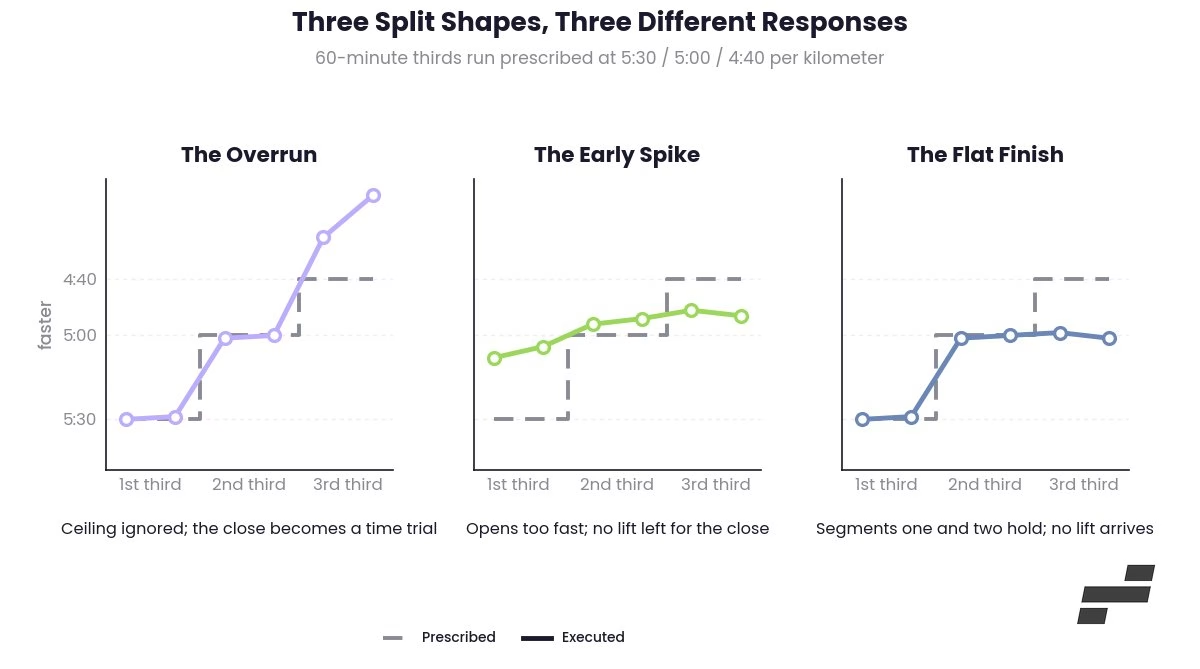
A completed progression run leaves a split shape. Read a progression run at the segment boundaries, where prescribed and executed pace separate. A session that averages exactly on target can still have missed every transition in it.
The Overrun
The opening segments go to plan, then the final segment runs past its ceiling and becomes a time trial. The file looks impressive and the athlete reports a great session. What it cost, though, is both halves of the format’s value: the recovery stays elevated into the next day, and the calibration work disappears, because nothing gets calibrated at maximum effort. The response is the ceiling and the twenty-minute question, applied before the run rather than diagnosed after it.
The Early Spike
The athlete runs faster than prescribed in the opening segment, often within the first ten minutes, and by the midpoint the session has become a different workout. This pattern signals a perception gap rather than a fitness problem. The athlete cannot yet feel the boundary between easy and steady, so the body settles at the pace it prefers rather than the pace on the plan.
More calibration work follows, not more fitness work: shorter segments, effort checks every five minutes, and a slowest-allowed pace on the opening segment. Fitness is not the constraint here, so adding fitness work changes nothing.
The Flat Finish
The opening segments go to plan, the final segment arrives, and the lift never comes. The athlete pushes and the pace barely moves. This one is a fatigue signal. The durability research explains why it surfaces here first: raising intensity late in a run depends on physiological headroom that accumulated load has already spent.
The response lives in the schedule rather than in the workout. Check the preceding ten days for stacked quality, cut the next hard session, and repeat the progression run after two or three easy days. If the lift returns, the diagnosis was load. If it does not, the conversation moves to sleep, life stress, and fueling. On fueling specifically, carbohydrate oxidation fell measurably across the ninety-minute runs in the Hunter and Muniz-Pumares data. The authors point to reduced glycogen availability as a likely contributor to the threshold decline, which makes intake during longer progression runs a real lever. NooMinds is a straightforward way to work out what an athlete should actually be taking in during sessions of that length.
Programming Progression Runs Across a Block
Progressive run training holds its place across a whole season. What changes is the dose, and three variables carry it: how long the fast segment runs, how high the ceiling sits, and how often the workout appears. Holding all three fixed for twelve weeks spends the format without developing it.
Base: Habit and Vocabulary
In base the dose stays conservative. Long progressions with the closing segment capped at marathon pace, once a week, placed on days bracketed by easy running. The job at this stage is habit and vocabulary. The athlete learns the segment structure and starts building the effort language while the aerobic work of the phase continues undisturbed. The ceiling stays low because a higher one would generate fatigue the base phase has no use for.
Build: Raising One Variable at a Time
The dose rises through the build phase along whichever variable serves the goal race. For a marathoner, the fast segments lengthen while the ceiling holds near marathon pace, which is the extension principle applied week by week. For a 10K runner, the ceiling rises toward the 102 to 108 percent band while segments stay shorter. A super fast finish can join that week to sharpen turnover. Frequency then resolves by subtraction: progressive run training fills the quality space left after the phase’s key sessions are placed, never the reverse. How the phases themselves sequence across a season is a separate set of decisions, covered in our guide to running periodization.
Taper: Keeping the Template Fresh
Close to the race the coach uses the format differently. Volume drops with the taper, but a short fast finish ten to fourteen days out keeps the effort template fresh at almost no cost. The final segment runs at goal race effort, and the athlete rehearses the specific judgment race day will ask for: recognizing the target effort quickly and settling into it without negotiation. That rehearsal is what makes negative split running an executable plan rather than an intention.
Using One Repeated Progression Run as a Durability Benchmark
Repeat a single progression run at an identical prescription three or four times across a block and it stops being only a session. Same route, same duration, same segment structure, same ceiling. With the progression running workout itself held steady, what changes between repetitions is what the athlete brings to it. Three comparisons carry most of that information, and none of them needs more than the athlete already records.
Did the Ceiling Get Cheaper?
The first is whether the closing segment held its ceiling at a lower reported effort. Suppose an athlete runs the same final pace in March that they ran in January. If they now describe it as strong but repeatable where it used to sit near the edge, the quality the race depends on has moved. This comparison needs one habit from the athlete: a brief note after the run, recorded every time.
Where Heart Rate and Pace Separate
The second is where heart rate and pace separate. Smyth and colleagues (2022) analyzed 82,303 recreational marathoners and found the internal-to-external workload ratio rose by about 16 percent on average, first appearing around kilometer 25. The spread mattered more than the mean. The third of runners who held coupling longest first decoupled at kilometer 33 and averaged 3:37. The third who decoupled earliest did so by kilometer 19 and averaged 3:59. In a progression run the same separation shows up as heart rate climbing through a segment where pace is holding steady.
Some upward drift is ordinary physiology, since heart rate rises over a prolonged run even at constant workload, a pattern Coyle and González-Alonso (2001) described in their work on cardiovascular drift. The size of the mismatch is the part worth acting on. In the marathon data, however, the decoupling was driven mainly by speed falling away rather than by heart rate climbing. A progression run where the athlete simply cannot hold the segment pace is therefore the more common version of the signal.
What the Next Easy Day Says
The third comparison is the next easy day, and the expectation is format-specific. A fast finish should leave no trace at all: same pace, same heart rate, same feel as any other easy day. A long progression may leave mild residual heaviness, and that is within specification rather than a warning. Elevated heart rate on an easy run following a fast finish is the reading that means the ceiling was exceeded, and the next prescription tightens it.

The Skill the Format Builds
A progression run gives an athlete repeated, low-cost practice at the judgment a race asks for at its hardest moment: can I go now, and still hold it? Philip opens his long progression at 5:51 per kilometer in November and closes it at marathon pace with the last segment feeling like genuine work. By March the same session closes at the same pace and he reports it as comfortable. That change is what he carries to the start line, and it is what lets him run the final ten kilometers of his marathon faster than the ones before them.
Make the Ceiling Make Sense
Compliance on a progression run usually breaks at the ceiling, and it breaks because the number looks arbitrary from the athlete’s side of the plan. A runner who understands why the final segment stops at marathon pace runs it at marathon pace. EndoGusto keeps the prescription and the reasoning behind it in the same place the athlete opens the session, so the ceiling arrives with its explanation attached.

Give Every Prescription Its Reason
Suggested References
- Hunter B, Muniz-Pumares D. (2025). Durability of parameters associated with endurance running in marathoners. Eur J Sport Sci, 25:e70073. DOI: 10.1002/ejsc.70073
- Zanini M, Folland JP, Blagrove RC. (2025). The effect of 90 and 120 min of running on the determinants of endurance performance in well-trained male marathon runners. Scand J Med Sci Sports, 35(5):e70076. DOI: 10.1111/sms.70076
- Maunder E, Seiler S, Mildenhall MJ, Kilding AE, Plews DJ. (2021). The importance of ‘durability’ in the physiological profiling of endurance athletes. Sports Med, 51(8):1619–1628. DOI: 10.1007/s40279-021-01459-0
- Smyth B, Maunder E, Meyler S, Hunter B, Muniz-Pumares D. (2022). Decoupling of internal and external workload during a marathon: an analysis of durability in 82,303 recreational runners. Sports Med, 52(9):2283–2295. DOI: 10.1007/s40279-022-01680-5
- Tucker R. (2009). The anticipatory regulation of performance: the physiological basis for pacing strategies and the development of a perception-based model for exercise performance. Br J Sports Med, 43(6):392–400. DOI: 10.1136/bjsm.2008.050799
- Coyle EF, González-Alonso J. (2001). Cardiovascular drift during prolonged exercise: new perspectives. Exerc Sport Sci Rev, 29(2):88–92. DOI: 10.1097/00003677-200104000-00009
- Jones AM. (2024). The fourth dimension: physiological resilience as an independent determinant of endurance exercise performance. J Physiol, 602(17):4113–4128. DOI: 10.1113/JP284205
- Canova R, Arcelli E. (1999). Marathon Training: A Scientific Approach. International Association of Athletics Federations, Monaco.