5K Training Plan for Runners

Every 5K training plan is built on an answer to one question: is the runner trying to finish the distance, or race it? Those are two different programs. One builds a body up to thirty minutes of continuous running. The other takes a body that already runs comfortably and teaches it to hold a pace above its sustainable ceiling for twenty-odd minutes without unraveling. They share a distance and little else, differing in session count, progression rate, and what a hard week looks like.
Most of what goes wrong in 5K preparation traces back to a mismatch between the runner and the plan rather than a flaw in the plan. A beginner dropped into pace-based intervals accumulates impact faster than their tendons adapt, and the plan ends in week three with sore shins instead of a race. A fit runner handed a run/walk progression gets bored by week two, adds intensity on their own, and trains through a gray zone the plan never intended. Placing the runner on the right program, and on the right week of it, comes first.
This article covers both programs: an eight-week plan for a first 5K finish, the reasoning behind it, the changes that make it a time-goal program, and the decision rules for placement, stepping back, and race week.
Key Takeaways for Coaches
- A 5K training plan serves two different goals, finishing the distance and racing it, and the structure changes substantially between them.
- Placement matters more than the plan itself: a runner’s current continuous-run capacity determines which week they should start on.
- Three runs per week is enough for a first 5K because the limiting factor is tissue tolerance to impact, not aerobic fitness.
- Run/walk progressions work by extending run segments while total session time stays nearly flat, which keeps weekly load increases inside what connective tissue adapts to.
- A time-goal 5K plan shifts the emphasis from duration to intensity distribution, adding 5K-pace intervals and threshold work on top of an unchanged easy-running base.
- When a session is cut short or localized soreness lasts 48 hours, step back two weeks, and rewrite those weeks at the earlier load rather than repeating them from the grid.
What a 5K Training Plan Has to Deliver
A 5K training plan is a structured schedule, typically six to twelve weeks long, that prepares a runner to cover 5 kilometers (3.1 miles) either as a first continuous finish or as a timed race effort. It organizes three to five weekly sessions into a progression that builds impact tolerance first, aerobic capacity second, and race-specific speed last, in that order because each layer depends on the one beneath it.
That definition holds for both versions of the plan, but the distance itself explains why the versions diverge. The 5K is overwhelmingly aerobic: a track time-trial study by Duffield, Dawson, and Goodman (2005) put the aerobic contribution to the 3000m at 86 percent in the men tested and 94 percent in the women. The 5K, which takes most runners close to twice as long, draws on aerobic supply at least as heavily. Yet the race is run at an intensity above lactate threshold, close to the pace associated with VO2max for faster finishers.
For a first-time finisher, that second fact barely matters. Their race pace and their easy pace are nearly the same thing, so the plan only has to build the aerobic engine and the structural durability to run for half an hour. For a time-goal runner, the operating point is the whole problem. Their aerobic engine is already built; what fails is their ability to hold 90 to 95 percent of VO2max without the mechanics and the buffering falling apart in the final kilometer.
Every design decision that follows, session count, progression rate, intensity mix, comes from identifying which of those two limiters applies to a given runner. That identification is the placement question, and it comes before week one.
Placing the Runner Before Week 1
Every 5K training plan assumes a starting fitness, and the assumption is usually invisible. A couch-to-5K schedule assumes near-zero run history. A time-goal program assumes twenty minutes of continuous running is already easy. Assigning a plan without checking that assumption produces a mismatch, which leaves an advanced runner under-stimulated or, more often, loads a beginner past what their tissue is ready for.
Placement takes one session, built around one question: how long can this runner currently run continuously at a conversational effort? Have them warm up with ten minutes of brisk walking, then run at an effort where full sentences are still possible, and stop at the first sign of strain. The number that comes out of that session maps directly onto the plan.
| Continuous-run capacity | Placement |
| Under 5 minutes | Beginner plan, week 1 |
| 5 to 10 minutes | Beginner plan, week 3 |
| 10 to 20 minutes | Beginner plan, week 5 |
| 20+ minutes, no recent structured training | Beginner plan, week 6, then the racing plan next cycle |
| 20+ minutes plus regular running for 8+ weeks | Racing plan directly |
Two modifiers adjust the mapping. Run history in the past year moves a runner up one row, because tissue that has adapted before re-adapts faster than tissue adapting for the first time. Injury history moves a runner down one row; a returning runner carrying a previous shin or knee issue gains nothing from starting three weeks ahead.
The placement test also produces the plan’s first benchmark for free. Whatever continuous duration the runner managed becomes the reference for the mid-plan checkpoints later in this article, so the session is worth logging properly: duration, effort, and how the legs felt the next morning.
The 8-Week 5K Training Plan for a First Finish
This 5K training plan runs eight weeks with three run sessions per week and at least one full day between them. Sessions are prescribed in minutes, not distance, because a beginner’s pace varies too much for distance targets to control effort. Every run segment happens at a conversational effort. If sentences are breaking up, the pace is wrong, not the runner.
| Week | Session 1 | Session 2 | Session 3 |
| 1 | 6 × (1 min run / 2 min walk) | 6 × (1 min run / 2 min walk) | 8 × (1 min run / 90 sec walk) |
| 2 | 6 × (2 min run / 2 min walk) | 6 × (2 min run / 90 sec walk) | 5 × (3 min run / 2 min walk) |
| 3 | 4 × (4 min run / 2 min walk) | 4 × (4 min run / 90 sec walk) | 3 × (6 min run / 2 min walk) |
| 4 | 3 × (7 min run / 2 min walk) | 2 × (9 min run / 2 min walk) | 10 min run / 3 min walk / 8 min run |
| 5 | 2 × (12 min run / 2 min walk) | 14 min run / 3 min walk / 8 min run | 18 min continuous |
| 6 | 15 min run / 2 min walk / 10 min run | 20 min continuous | 22 min continuous |
| 7 | 20 min continuous, easy | 15 min continuous, easy | 25 min continuous |
| 8 | 20 min continuous | 12 min easy + 4 × 20 sec relaxed pick-ups | Race or 30 min continuous |
The grid reads as a smooth ramp, but it contains three distinct phases, and each phase is solving a different problem.
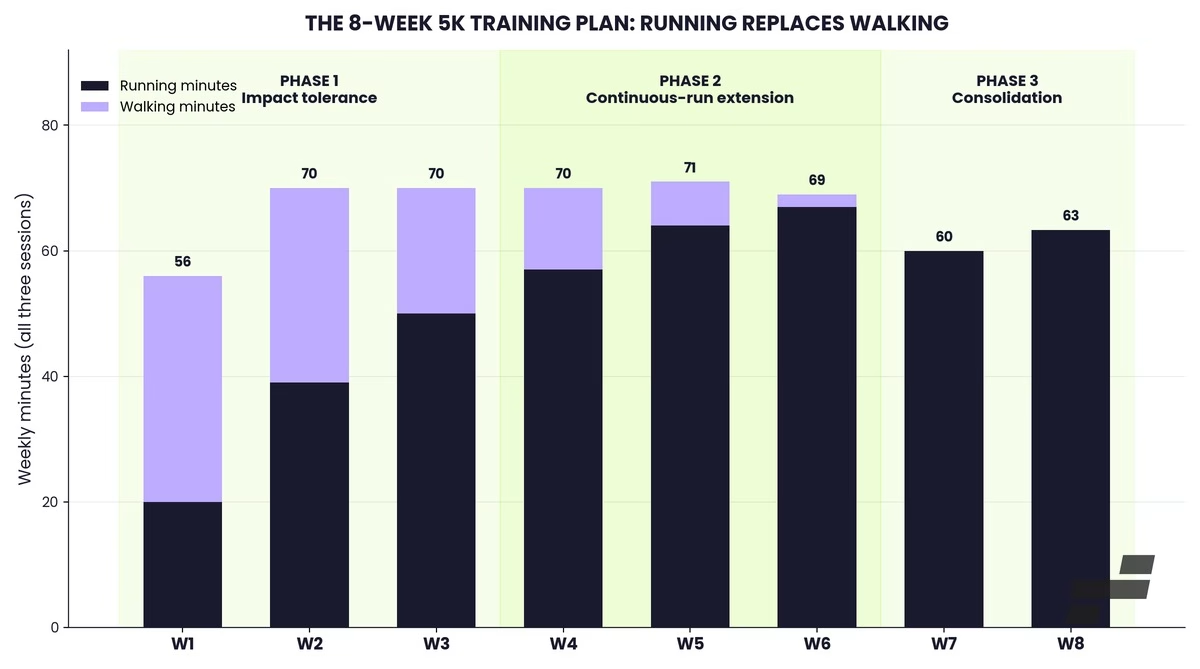
Weeks 1 to 3 build impact tolerance. Total running time per session stays modest, between 6 and 18 minutes, while bones, tendons, and joint cartilage meet repetitive impact for the first time. Those structures adapt on a slower schedule than the heart and lungs do, and in a runner with no training history that gap is at its widest, which is why the early weeks feel too easy. The plan is paced to the slower system on purpose.
Weeks 4 to 6 extend the continuous run. Walk breaks shrink from structural to residual, and single run segments stretch from 7 minutes to 22. The aerobic stimulus now leads. Total session time barely moves across these weeks. What changes is how much of it is spent running, and that substitution, rather than addition, is what keeps the weekly load progression manageable.
Weeks 7 and 8 consolidate. Week 7 pulls volume back slightly after the week 6 peak, then week 8 sharpens with short relaxed pick-ups two or three days before the race. The pick-ups are 20-second reminders of quicker mechanics, enough that race morning’s adrenaline pace does not feel foreign.
Placement sets where the grid begins; the plan still runs eight weeks. A runner placed at week 3 or week 5 enters at the week the test points to, follows the grid forward, and once week 6’s sessions are done, keeps extending running minutes at the same rate for the weeks that remain. Their seventh week is still the pull-back and their eighth is still the race. The phases still apply; a placed runner simply carries the build further before the taper.
The Logic Behind the Progression
Three runs per week is the design load for a first 5K training plan. A beginner’s cardiovascular system could tolerate five sessions within a few weeks, but bone responds to repetitive impact on a cycle of remodeling that involves temporary weakening before rebuilding stronger. Warden, Davis, and Fredericson (2014) describe bone stress injury as exactly this mismatch: microdamage accumulating faster than the remodeling process can clear it, which is the mechanism behind tibial and metatarsal stress injuries in new runners. The 48-hour spacing between impact sessions is a coaching convention rather than a finding from that paper, since remodeling runs over weeks rather than days. What it buys at three sessions a week is that impact days never land back to back.
The run/walk ratio does the same job inside the session. Walking between run segments is dosage control for the tissue. The lungs recover inside a minute either way. Ten one-minute impacts with breaks produce a different structural stress than one ten-minute impact block, even when the running time is identical. Four weeks of fragmented dosing come before the first continuous run, in week 5.
Each weekly slot carries its own role through the first six weeks. Session 1 introduces the week’s new run/walk structure at its gentlest. Session 2 repeats it, shaving walk time, which is where the progression actually happens. Session 3 carries the week’s longest run segment, and it holds that job through the taper as well. A runner who knows the roles can adjust when life interferes: dropping Session 2 costs a repetition, dropping Session 3 costs the week’s longest run.
Everything in the grid happens at conversational effort. At this stage easy running is the adaptation driver itself, and our guide to easy run training covers what that pace is actually building.
How to Train for a 5K Race Against the Clock
Once a runner holds twenty minutes continuously and has been running regularly for a couple of months, how to train for a 5K race becomes a different question. The limiter moves from durability to intensity tolerance: the race now happens at a pace the runner can only sustain for roughly the race’s duration, and training has to teach the body to operate there.
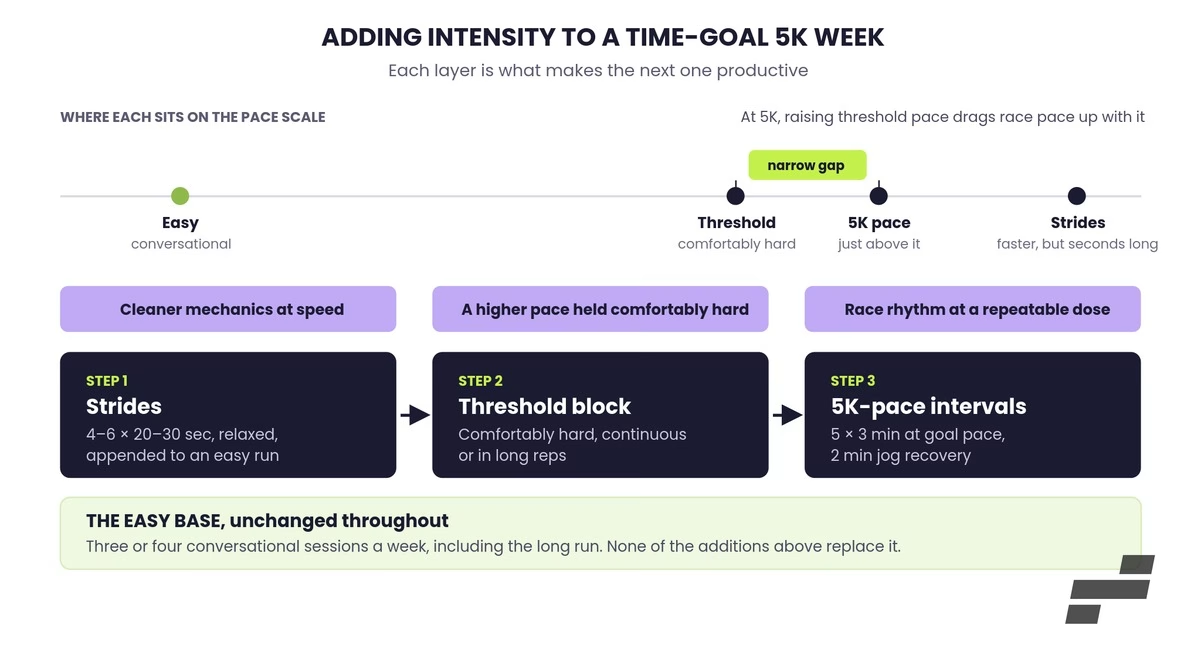
The base stays. Easy conversational running still fills most of the week, three or four sessions out of the four or five, because the aerobic engine established in the beginner progression remains the thing being raced on. What gets added is one, at most two, quality sessions per week that touch the intensities the race demands.
The additions arrive in order. Strides come first, relaxed 20-to-30-second accelerations appended to easy runs, which prepare mechanics for faster work at almost no fatigue cost. A block of threshold work follows, raising the pace the runner can hold comfortably hard, which drags 5K race pace up from below. Only then do 5K-pace intervals enter, teaching the rhythm and the discomfort of race intensity in fragments with recovery, such as 5 × 3 minutes at goal pace with 2-minute jogs. What makes this order specific to the 5K is how little separates threshold pace from race pace at this distance. Raise the first and the second follows, which is why the threshold block comes before the race-pace work rather than alongside it.
A representative week for a runner targeting 25 to 28 minutes, running four days:
| Day | Session |
| Tuesday | 35 min easy + 4 × 25 sec strides |
| Thursday | Quality: threshold or 5K-pace intervals, ~40 min with warm-up and cool-down |
| Saturday | 30 min easy |
| Sunday | 45 to 50 min easy long run |
One quality session a week is the right dose at this level. A second is worth adding only after the runner has recovered fully between sessions for several consecutive weeks. Added earlier, it tends to flatten the easy days rather than sharpen the hard ones. Race-pace judgment is a separate skill from fitness, and how to spend effort across three miles and change is covered in our guide to pacing every distance.
Mid-Plan Decision Rules
An eight-week 5K training plan meets eight weeks of real life, and the response to a setback is easier to get right when it has been decided in advance. In the moment, the decision rests on one bad session and whatever mood came with it. Settled beforehand, it rests on the pattern across the week and on the rules below.
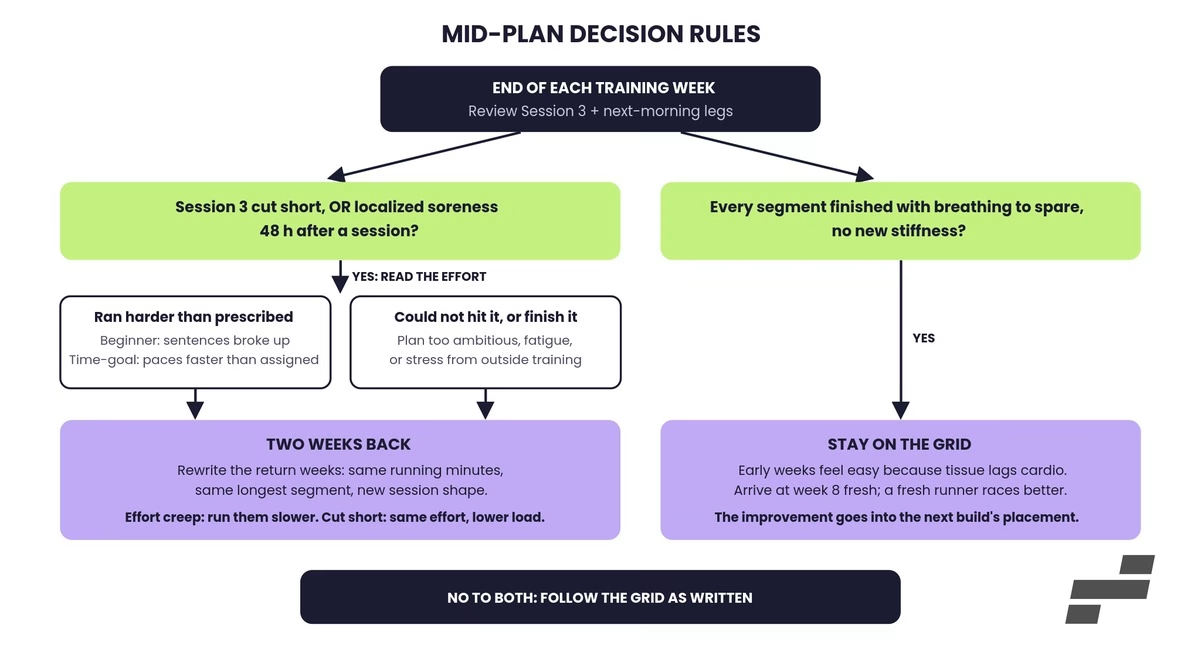
Two things call for a decision: the final run segment of Session 3 had to be cut short, or the legs still carry localized soreness (one shin, one knee, one arch, rather than general muscle fatigue) 48 hours after a session. When either appears, the next question is how the week’s effort compared with what was prescribed.
Reading the signal
The first signal is that the sessions were run harder than prescribed. For a beginner, that means sentences broke up during segments that were still completed. For a time-goal runner, it means paces on the watch faster than the ones assigned. Each week in the plan is built to produce a particular adaptation at a particular effort, and running it faster means that adaptation was never collected. The response is to go back and collect it, with the return weeks run deliberately slower.
The second signal is that the prescription could not be hit, or the session ended before it was finished. Something is limiting, and the candidates are familiar: the starting week was more ambitious than the runner’s actual base, fatigue has accumulated across weeks, or stress from outside training has crept in. Which one applies matters less than it seems, because the response is the same. Go back two weeks.
Two weeks rather than one is the default for a first-time or returning runner, and the reason is what each choice costs. Two weeks back costs two weeks. One week back that turns out to be insufficient costs that week, then the two that were needed anyway, plus another failed key session in between. A program completed without holes finishes further ahead than one that stalls twice on the way. A runner with years of consistent training behind them may need only a single week; for the audience this plan is written for, two is the safer call.
Writing the return weeks
Going back two weeks does not mean re-running those weeks from the grid. The load returns to that level; the shape of the sessions can change, and changing it keeps the runner doing something new rather than repeating a week that already went badly. The two things to hold constant are total running minutes and the longest single segment, because those are what the tissue responds to. Everything else is open.
A runner stepping back from week 5 to week 3, for example, holds Session 3 at the week’s longest segment and rebuilds the rest around the same numbers:
| Session 1 | Session 2 | Session 3 | |
| Week 3 as written | 4 × (4 min run / 2 min walk) | 4 × (4 min run / 90 sec walk) | 3 × (6 min run / 2 min walk) |
| Return week 1 (week 3 load) | 3 / 4 / 4 / 3 / 2 min runs, 2 min walks between | 2 × (4 min / 90 sec), then 4 × (2 min / 60 sec) | 6 / 4 / 6 / 2 min runs, 2 min walks between |
| Week 4 as written | 3 × (7 min run / 2 min walk) | 2 × (9 min run / 2 min walk) | 10 min run / 3 min walk / 8 min run |
| Return week 2 (week 4 load) | 7 / 5 / 5 / 4 min runs, 2 min walks between | 9 / 6 / 3 min runs, 2 min walks between | 10 / 5 / 3 min runs, 3 min then 2 min walks |
Running minutes and longest segment match the original week in every session; the sequence and rep count do not. If the trigger was effort creep, the walk breaks in these weeks are walks rather than jogs, and every segment finishes with sentences intact. If the trigger was a session that could not be completed, the effort stays where it was and the reduced load does the work. Either way, the runner re-enters week 5 having done two weeks of training rather than two weeks of penalty.
When the runner is ahead
The opposite case, a runner who finishes every session with breathing to spare and wakes up with nothing to report, stays on the plan as written. Each week is doing a job whether or not it feels necessary, and the weeks that feel easiest are the early ones, where the cardiovascular system has adapted and the tissue has not yet caught up. The reward arrives on race day. A runner who is ahead of the plan lines up fresh, and a fresh runner performs better than a tired one at the same fitness. The improvement that made the weeks feel easy is real, and it goes into the next build, which starts from a higher placement.
Both rules run off the same measurement the placement test produced, the longest comfortable continuous run. No separate retest is needed, because Session 3 reproduces it every week. That is why logging Session 3 honestly matters.
Race Week
The work that decides the race is done by the Monday of race week, and the week’s remaining job is to arrive at the start line rested without going stale. Resting too little leaves the legs heavy on race morning; resting completely for seven days leaves them flat, oddly unresponsive, and lacking tone, a sensation runners often misread as lost fitness.
Training volume, counting everything but the race itself, drops to roughly half of a normal week. For the beginner plan that is already built into week 8, with a 20-minute continuous run early in the week, then a short easy run with relaxed pick-ups two or three days before the race, then rest or a 15-minute walk the day before. For the time-goal runner, the same shape applies at their scale: the quality session shrinks to a brief
Same shoes, same breakfast, same time of day as training, where the race schedule allows it. Race week is when runners reach for upgrades instead, whether that is new footwear, a new fueling product, or an unusually early bedtime that backfires into a restless night.
From First Finish to Racing It
The 5K hands back a next step quickly. A runner who finishes their first one is past the twenty minutes of continuous running the racing plan asks for, with eight weeks of consistent training behind them, which is the other half of that entry test. The racing version then feeds into a 10K build on the same terms. Each cycle reuses the same placement test and the same decision rules on a progressively larger base, and each time the runner lines up for a 5K they do it on more fitness than the last.
Placement and mid-plan corrections are where a printed plan stops being useful, because a fixed grid has no way to record that an athlete needed week 3 twice or came back from a sick week in week 6. EndoGusto keeps the plan and the athlete’s actual training in one place, so when the schedule needs revising, the coach adjusts the remaining weeks rather than reissuing the whole thing.

Keep the plan current with the athlete
Suggested References
- Duffield, R., Dawson, B., & Goodman, C. (2005). Energy system contribution to 1500- and 3000-metre track running. Journal of Sports Sciences, 23(10), 993–1002. https://doi.org/10.1080/02640410400021963
- Warden, S. J., Davis, I. S., & Fredericson, M. (2014). Management and prevention of bone stress injuries in long-distance runners. Journal of Orthopaedic & Sports Physical Therapy, 44(10), 749–765. https://doi.org/10.2519/jospt.2014.5334