Couch to 5K Plan: 9 Week Beginner Running Program

A couch to 5K plan asks for nine weeks, three sessions a week, and around half an hour a session. It opens with 60-second run intervals separated by walking and ends with 30 minutes of continuous running. Nothing in it assumes an athletic background, and nothing in it needs one. The distance between not running at all and running for half an hour looks far larger from the couch than the schedule makes it, and most of what closes it is turning up three times a week for two months.
Most people could go out today and cover 5 kilometers. Walk some of it, shuffle the rest, and 40 or 45 minutes would do it, whatever their current fitness. The nine weeks are not there to make the distance possible. They are there to make it repeatable: to get a body through 5 kilometers in a state that can go again next week, and the week after that.
That difference is about the joints rather than the lungs. Fitness comes quickly. Within two or three weeks breathing settles, and sessions that felt alarming at the start stop feeling that way. The parts of the body that absorb the impact — bones, tendons, the tissue around the joints — rebuild far more slowly, over months rather than weeks. Nine weeks is how long the slower half takes to catch up, which is why the plan runs over two months instead of the two or three weeks it takes to start feeling fitter.
What that feels like from the inside is uneven. The first session is the most intimidating one and also the easiest thing the plan will ever ask for. Some weeks feel good enough to tempt a runner into doing more. Others feel like going backwards, most often around week 5, where the running stretches longer than anything the body has done before and five weeks of unfamiliar effort has started to add up. Neither is a sign that the plan has stopped working. Reaching week 9 depends far more on staying with it through the flat patches than on being fit enough on any particular day.
How well it works for any particular person depends less on starting fitness than on two things the printed schedule cannot account for: how hard the intervals get run, and what happens the first time a week is missed.
Key Takeaways for Coaches
- The plan runs nine weeks with three sessions a week, building from 60-second run intervals to 30 continuous minutes, with at least one rest day after every run.
- Nine weeks is set by connective tissue rather than fitness. Breathing improves within two to three weeks while tendon and bone adapt over months, so the schedule stays conservative through the period when the runner feels ready for more.
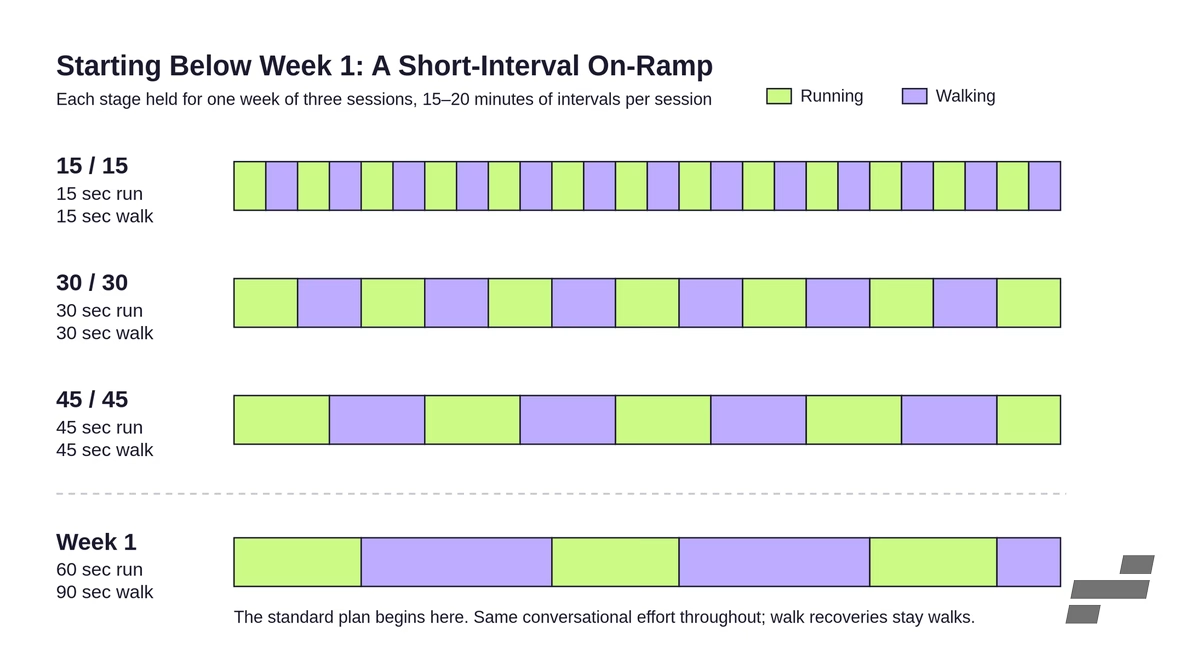
- Anyone who cannot hold 60 seconds of running can start below week 1 with 15 seconds running and 15 seconds walking, then progress through 30/30 and 45/45 before entering the plan.
- Run every interval at an effort that allows a full spoken sentence. Perceived effort is the only control a beginner needs, and running the early intervals too hard is the most common reason weeks 4 and 5 fall apart.
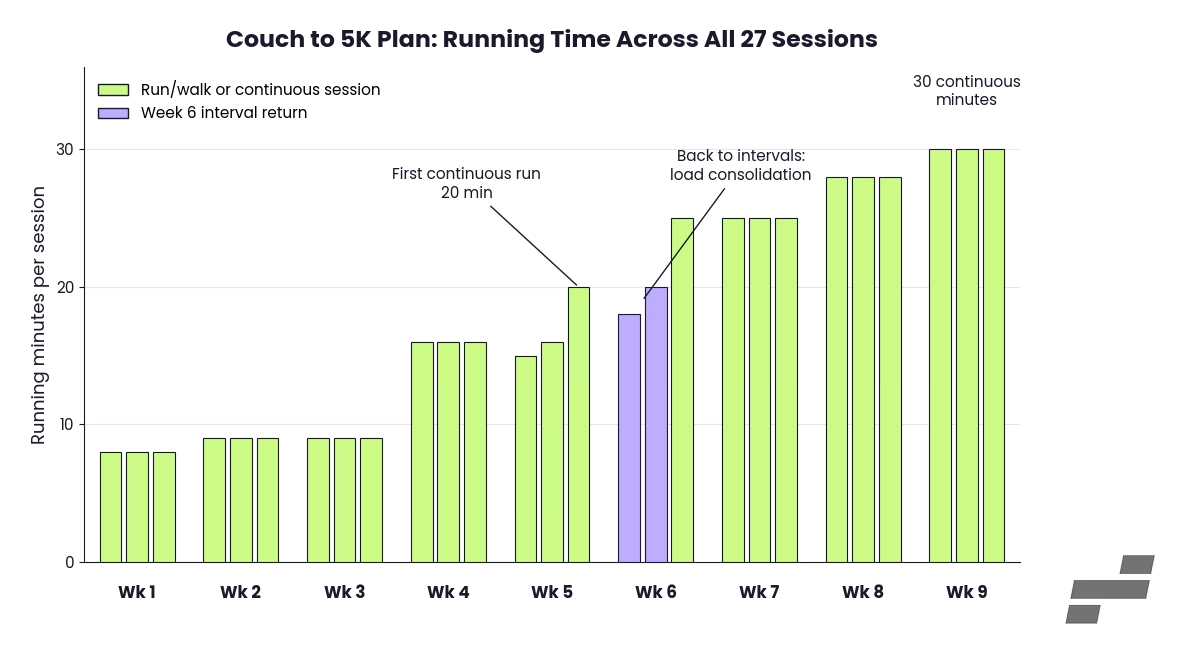
- Week 6 returns to run/walk after week 5’s first 20-minute continuous run, which keeps total running time climbing while capping the length of any single unbroken effort.
- Repeat a week when two of its three sessions could not be completed as written. After a break of more than a week, restart at or before the last week completed rather than where the plan stopped.
- Thirty minutes of easy running covers a bit over 3 kilometers, and a graduate can finish a local 5K on the strength of the nine weeks alone.
Why the Plan Takes Nine Weeks
A couch to 5K plan is a nine-week program that takes a non-runner from no running to a continuous 30-minute run. It schedules three sessions a week, each alternating timed run and walk intervals, with the run share growing week over week. Every session opens with a five-minute warm-up walk and closes with a five-minute cool-down walk, and every run day is followed by at least one rest day.
Three days a week with rest between them is the rule the rest of the structure depends on. Aerobic systems respond within days: plasma volume expands and breathing eases inside the first few weeks. Bone, tendon and ligament remodel on a scale of weeks to months. Magnusson, Langberg and Kjaer (2010) describe tendon collagen turnover operating on that slower timescale, with net synthesis turning positive a day or two after loading. The remodeling happens between sessions, which makes the rest day part of the dose.
Each running stride loads the lower leg with roughly two to three times body weight. Even the eight minutes of total running in week 1 delivers several hundred loading cycles per leg. For a body with no recent impact history that is already a meaningful dose, and the schedule raises it by the smallest useful increment.
The consequence is that progression is limited by tissue while the aerobic system runs ahead of it. In a meta-analysis across runner populations, Kluitenberg and colleagues (2015) found that novice runners carry the highest injury proportions of any group, a pattern consistent with fitness outpacing structural capacity in the first months of running. The schedule keeps sessions short precisely when they start to feel easy, because the ease is aerobic.
The 9-Week Couch to 5K Training Plan, Week by Week
Each week’s structure repeats across its three sessions, except weeks 5 and 6, which build across the week toward a milestone run.
| Week | Session structure (after 5-min warm-up walk) | Total running per session |
| 1 | Run 1 min / walk 90 sec × 8 | 8 min |
| 2 | Run 90 sec / walk 2 min × 6 | 9 min |
| 3 | Run 90 sec, walk 90 sec, run 3 min, walk 3 min × 2 | 9 min |
| 4 | Run 3, walk 90 sec, run 5, walk 2.5, run 3, walk 90 sec, run 5 | 16 min |
| 5 | Session 1: run 5 / walk 3 × 3 · Session 2: run 8, walk 5, run 8 · Session 3: run 20 continuous | 15 → 16 → 20 min |
| 6 | Session 1: run 5, walk 3, run 8, walk 3, run 5 · Session 2: run 10, walk 3, run 10 · Session 3: run 25 continuous | 18 → 20 → 25 min |
| 7 | Run 25 continuous, all three sessions | 25 min |
| 8 | Run 28 continuous, all three sessions | 28 min |
| 9 | Run 30 continuous, all three sessions | 30 min |
Every session ends with a 5-minute cool-down walk. Rest or walk on the days between.
Where to Start
Week 1 assumes a body that can run for 60 seconds at a time and walk briskly for half an hour. That assumption fits many beginners, but not all of them. Choosing the entry point deliberately matters, because starting a rung too high produces a failure that gets read as a lack of aptitude.
When 60 Seconds Is Too Long
For some beginners, 60 seconds of running is out of reach in week 1, and the reason is rarely fitness. A minute is long enough for breathing to escalate past the point where a new runner can stay calm, and that experience ends first attempts more often than any physical limit.
Shorter bursts change the problem. In a 1960 study, Åstrand and colleagues had a subject cover the same amount of hard work at the same speed two ways: once as one continuous effort, and once chopped into short pieces with rest in between. Done in one go, it lasted nine minutes. Broken into 30-second pieces, the same work felt moderate and carried on for a full hour.
The shorter the bursts, the bigger that difference, and it is largest somewhere around 10 to 30 seconds. That is why 15 seconds of running is manageable for someone who cannot yet run for a minute. The running is not slower. There is simply enough walking between the efforts for the body to keep up.
A practical on-ramp uses that effect directly, with each stage held for one week of three sessions:
- 15 seconds running, 15 seconds walking, repeated for 15 to 20 minutes
- 30 seconds running, 30 seconds walking, for the same total time
- 45 seconds running, 45 seconds walking, for the same total time
Anyone completing the 45/45 stage comfortably can enter the plan at week 1. Two details decide whether this works. The running is done at the same conversational effort the rest of the plan uses. Since 15 seconds is short enough to invite sprinting, it is important to keep the effort conversational for the approach to work. And the recovery stays a walk rather than a jog, because the recovery is what makes the format tolerable.
The same short formats are useful after the on-ramp for a different reason. Weeks 1 to 3 of the standard plan are deliberately monotonous, and monotony is worth guarding against in the weeks before running becomes its own reward. In practice, new runners engage more readily with a format that changes from week to week than with one ratio held flat, and swapping a session for 30/30 or 45/45 at the same total running time keeps the progression conservative while giving the week a different shape.
Higher Body Mass, Long Layoffs, and Previous Injury
Higher body mass raises the force on every stride, which makes the first weeks the highest-risk period rather than a reason to avoid running. The adjustment is one or two weeks of walk-only sessions before week 1: 30 minutes of brisk walking three times a week, building tolerance the plan otherwise assumes is present. Widening the walk intervals through weeks 1 to 3 and holding each of those weeks an extra session before progressing extends the program to roughly 11 or 12 weeks, with the added time placed where it protects most.
The same runway applies after years of complete inactivity regardless of body weight, since unloaded tissue loses capacity either way. A history of shin splints, stress fracture, plantar fasciitis or knee injury calls for the same slower entry, and for a professional opinion before starting if the injury is recent or still symptomatic.
The Runner Who Finds Weeks 1 to 3 Easy
Feeling underworked in the first weeks is common for former athletes, cyclists, swimmers and generally active people. Recent impact history is the deciding question. Anyone who has been running three or four times a week within the past few months can reasonably start at week 3 or 4. Anyone whose aerobic fitness comes from non-impact sport should start at week 1 anyway, because a strong aerobic system lets them run longer and faster than their tendons are prepared for, which is the exact mismatch the plan exists to manage.
Boredom in the early weeks is better answered by adding a brisk walk on rest days, or by varying the interval structure, than by adding running.
What Each Phase is Doing
Weeks 1 to 3: Absorbing Impact
Total running time barely moves across the first three weeks, from 8 minutes to 9. What changes is the shape of it. Run segments stretch from 60 seconds to 3 minutes while total session time holds nearly flat, so the tissue dose stays almost constant while the body practices longer stretches of continuous loading. Three weeks at the same volume gives connective tissue an uninterrupted stretch of remodeling before the dose rises, which is also why these weeks feel easier than most beginners expect.
Weeks 4 to 5: The First Continuous Blocks
Week 4 nearly doubles running time to 16 minutes and flips the ratio, so from here on every session contains more running than walking. Week 5 then changes the workout across the week, funneling from three 5-minute runs to two 8-minute runs to the single 20-minute run that closes it. Total running time rises only four minutes over week 4, but 20 unbroken minutes is the longest continuous load the body has met, and that is the stimulus the week is built around. It also changes the runner’s model of the sport: after it, the walk break becomes a choice rather than a requirement.
Weeks 6 to 9: Consolidate, Then Extend
Week 6 returns to run/walk intervals, which on paper reads as a step backward from ground already won. Total running time keeps climbing across it, 18 minutes then 20 then 25, while the walk breaks cap the length of any single unbroken effort. That combination is the nine-week logic compressed into one week: raise the total, hold the peak, and let structure catch up with the week 5 milestone before the final push.
From week 7 the plan becomes repetition: three runs of 25 minutes, then three of 28, then three of 30. Nine near-identical sessions across weeks 7 to 9 are where the body consolidates its new normal, and holding a duration for three sessions before raising it is the same rule that governed the run intervals in weeks 1 to 3.
How Hard the Running Should Feel
A first-time runner has nothing to pace against. There is no history, no sense of what a given speed feels like over ten minutes, and usually no device beyond a phone timer. That is not a gap to fill before starting. Perceived effort is the control the whole program runs on, and it is the one a beginner can read accurately from the first session.
The talk test makes it concrete. At the right effort a runner can speak a full sentence out loud without gasping between words. Breathing is audible and slightly quicker than normal, and the legs feel like they could keep going for longer than the interval asks. For some beginners that is barely faster than a brisk walk, and it is still the correct effort. Because the reading comes from the body rather than a screen, it adjusts on its own for heat, hills, tiredness and a bad night’s sleep.
Beginners commonly run the early intervals too hard, and the cost is deferred. Sixty seconds is short enough to sprint, and sprinting it carries no visible penalty in week 1. The same effort applied to a 5-minute interval in week 4 does not survive, and the collapse gets read as a lack of ability rather than a habit formed three weeks earlier. Checking the talk test partway through the first interval of every session catches it early, while it is still cheap to fix.
A phone timer covers all nine weeks. Interval lengths are the only measurement the schedule needs, and effort supplies the rest. A tracking app adds a record of what happened, which is useful for spotting whether the sessions are actually going in, but the numbers it produces are not targets during this program. Distance and pace start to matter later, once there is a measured event in view.
Learning to read effort now is worth more than any of it. Every training system a runner meets afterward — easy days, threshold work, race pacing — rests on being able to tell one effort from another and hold it steady. Nine weeks of run/walk intervals is an unusually good place to calibrate it, because the walk breaks give repeated chances to feel the contrast between working and recovering.
Speed work belongs in a runner’s second season. Once continuous running is established, strides are the first pace stimulus worth adding, and that is months after this program ends.
Running Indoors
The full program transfers to a treadmill without modification, and for some runners it is the better version. One question tends to come up early: whether to set an incline. Running outside costs slightly more energy than running on a flat belt, mostly because of air resistance, and the usual advice is to set the treadmill to 1 percent to make up the difference. That advice traces back to Jones and Doust (1996), who tested it at speeds far quicker than anything in these nine weeks. At beginner paces the difference is too small to notice. So a flat belt is just fine but 1% works to slightly reduce impact and can be left to the individual to choose.
The belt’s consistent surface removes the curbs, cambers and potholes that complicate early outdoor running, and it suits heavier runners managing impact carefully as well as anyone self-conscious about being seen learning to run. Precise speed control also helps: find the setting that passes the talk test on the day, and the belt removes the drift toward running short intervals hard. Rerun the test each session, since the right setting moves with heat and tiredness. One habit is worth avoiding, though: holding the handrail unloads the legs and reduces the adaptation the sessions are meant to produce.

When the Plan Meets a Life
Missed Sessions and Repeating a Week
Repeating a week is built into the plan, and the first question is why the sessions did not happen. A week broken up by work, travel or weather is a different problem from a week the body could not complete, and the two call for different answers.
If life got in the way and the runs that did happen went fine, there is nothing to repeat. Three runs a week with a rest day after each still leaves room for a fourth: run Monday, Wednesday, Friday and Sunday, and every session has its rest day. An extra run the following week makes up a missed one without going beyond what the plan had already asked for across the two weeks. What does not work is squeezing the missed run in beside another one, because the rest day between runs is part of the plan rather than a gap in it. Early on, this is usually the better path. The habit is still forming, and repeating a week can feel like going backwards at exactly the point when momentum matters most.
If the sessions happened but fell apart — run intervals collapsing into unplanned walking, or soreness and tiredness that had not cleared by the next run — repeat the week. One rough session proves nothing, since a bad night’s sleep can produce it. Two incomplete sessions describe the week, and the answer is running it again rather than pressing on.
Where the stall happens is predictable. Week 5’s 20-minute run and week 6’s 25-minute run are the two largest jumps in continuous running the program contains. A stall there usually traces back to running the intervals too hard, so the first intervention is slowing down. Rerunning week 5 at the same effort produces the same result. Slow the run intervals until the talk test passes clearly, then attempt the week again.
Soreness and Injury Signals
Muscle soreness that fades within 48 hours and eases once moving is adaptation working as designed, and the plan continues through it. Pain that sharpens during a run, localizes to one spot on a bone or tendon, or changes the way the runner moves is a stop signal. Anything that alters gait ends the session, and if it returns on the next attempt after two or three full rest days, the plan pauses for professional assessment rather than another repeat. Shin and knee complaints are the most common of these in new runners, and both respond better to an early week of walking than to a month of pushing through.
Coming Back After Missed Time
More attempts end here than anywhere else in the plan. A cold, a work trip, a week of weather or a stretch of childcare takes out a week or two. The runner comes back, resumes at the week they stopped on, has a bad session, and concludes that everything is gone. Nothing in the printed schedule covers this, which leaves the decision to a moment when motivation is already low.
The rule that holds up is to go back further than seems necessary:
- Under a week: resume at the same week.
- One to two weeks with no running at all: repeat the last week completed in full.
- Two to four weeks: drop back two weeks.
- More than four weeks: return to week 1, which will pass quickly.
The reason to err backward is the same mismatch the whole plan is arranged around. Aerobic capacity fades slowly and rebuilds within a session or two, so a returning runner usually feels capable of the week they stopped on. Connective tissue tolerance declines on the slower schedule it was built on, and it is the part that has to be rebuilt rather than remembered.
A week that turns out to have been unnecessarily easy costs three sessions. A week that turns out to have been too much can cost the whole schedule.
Running the 5k
The program ends at 30 minutes of running rather than at a measured 5 kilometers, which is the same achievement described two ways. At the easy effort of week 9, half an hour covers a bit over 3 kilometers, and the rest of the distance arrives on race day. A runner holding three 30-minute sessions a week can enter a local 5K and finish it. That is a finish, and it is what the nine weeks were for.
The clock is not the point of your first race. Finishing the distance after nine weeks of building up from 60-second intervals is the achievement, whether it takes 30 minutes or 45. Times become useful later, once there is a previous time of your own to measure against. The only comparison worth making now is with the person who started week 1.
Parkrun and local charity 5Ks absorb walk-break runners without a second glance, and a finish line and a crowd deliver something no training run does. The walk break was a tool for the first six weeks, and it does not stop being one because the run has a bib on it. For anyone who would rather arrive having already covered the distance, adding 3 to 5 minutes to one run a week gets there inside a month, but it is a preference rather than a requirement. After
Where the Schedule Stops and Judgment Starts
A printed plan makes three decisions in advance that cannot really be made in advance: where a particular person should start, how fast they should move through it, and what to do when the plan meets a stubborn shin or a week lost to work. Week 1 assumes an average untrained body. Neither holds for a 25-year-old who plays pick-up basketball twice a month or a sedentary 58-year-old with an old knee surgery, and those are the decisions that determine whether an attempt finishes.
What the nine weeks produce is a habit of three runs a week held through two months of Mondays that offered reasons to skip. That is worth more than any single run inside it, and worth more than a structured next goal, because a runner with a stable weekly pattern can build toward anything. Protecting that rhythm for another two or three months at the same easy effort is the whole job after week 9. After that, the question changes from finishing 5 kilometers to running it better, and a structured 5K training plan becomes the right next step — the same careful progression, now with sessions aimed at pace rather than time on feet.
Entry point, progression rate, and response to interruption are what a coach supplies, and EndoGusto is built for making them. Coaches can build the nine-week progression once, adjust the entry point per athlete, and see which sessions actually happened, so a missed Wednesday gets addressed before it becomes a missed month.

Get from the Couch to the 5k
Suggested References
- Åstrand, I., Åstrand, P.-O., Christensen, E.H., & Hedman, R. (1960). Intermittent muscular work. Acta Physiologica Scandinavica, 48, 448–453. https://doi.org/10.1111/j.1748-1716.1960.tb01879.x
- Jones, A.M., & Doust, J.H. (1996). A 1% treadmill grade most accurately reflects the energetic cost of outdoor running. Journal of Sports Sciences, 14(4), 321–327. https://doi.org/10.1080/02640419608727717
- Kluitenberg, B., van Middelkoop, M., Diercks, R., & van der Worp, H. (2015). What are the differences in injury proportions between different populations of runners? A systematic review and meta-analysis. Sports Medicine, 45(8), 1143–1161. https://doi.org/10.1007/s40279-015-0331-x
- Magnusson, S.P., Langberg, H., & Kjaer, M. (2010). The pathogenesis of tendinopathy: balancing the response to loading. Nature Reviews Rheumatology, 6(5), 262–268. https://doi.org/10.1038/nrrheum.2010.43