Beginner Running Plan: 12 Week Program to Start Running

Most people arrive at a beginner running plan for reasons that have very little to do with running. A health check that didn’t go the way it was supposed to. A stretch of months that took a psychological toll. A decision that something has to change. Plenty of them arrive with no athletic history at all: no childhood sport, no gym years, nothing that ever made moving around feel like it belonged to them. For anyone in that position, the hardest part of starting is almost never the running. It is the strangeness of the first few weeks, and that wears off sooner than most people expect.
A plan can take care of the rest, and this one asks for less than most people brace for. Week 1 is just walking. No session in the first month runs much past half an hour, and no run segment anywhere in the twelve weeks is meant to be fast enough to stop a full spoken sentence.
What the plan has to solve is two separate problems running on two different clocks. The physical one is getting muscles, tendons, and joints ready for an impact they have never absorbed, and it responds to steady, graded increases in load. The behavioral one is building a week that reliably holds three runs. That clock is quieter and slower, and fixed days are what move it: same days, same times, until going for a run stops requiring a decision.
Life interrupts that rhythm anyway, and usually with no warning: a work trip, a sick child, a stretch where everything else has to come first. Nothing is lost when it happens. Three weeks of work does not disappear in seven days, and any week of this program can be repeated instead of abandoned. Whatever brought someone to week 1 is still there when the disruption clears, and that is what makes coming back possible. A twelve-week plan finished in fourteen weeks is still a twelve-week plan finished.
This 12-week program is built for both clocks at once. Three sessions per week take a new runner from a walking foundation to 30 minutes of continuous running, at a progression rate that protects tissue adapting slowly. The endpoint is not a finish line. It is a week that still contains three runs after the program ends, at a level of activity that covers what adults are advised to do for their health anyway.
Key Takeaways
- A 12-week beginner running plan serves two adaptation timelines at once: connective tissue learning to tolerate impact and a running habit becoming automatic, and the second typically takes longer.
- Three sessions per week, ideally anchored to the same days and times, build the habit faster than the same sessions scattered wherever the week allows. When a week makes that impossible, moving a session keeps far more of the habit than dropping it.
- Novice runners get injured at more than double the rate of recreational runners per hour of running, which is why the early weeks of this plan hold back more than it will feel like they need to.
- Walk breaks are a trainable skill, and they remain a legitimate format after week 12; a brisk, purposeful walk keeps the session’s aerobic value while a drifting shuffle gives most of it away.
- The type of soreness, not its presence, decides whether the next run happens: broad muscle soreness that eases during a warm-up is adaptation, while localized pain that sharpens as running continues is a stop signal.
- Week 12 ends at 30 minutes of continuous running. Three sessions of that size cover the weekly activity adults are advised to get, so the end of the program is a place to stay.
12 Weeks to Build the Body and the Habit
Twelve weeks is enough time for both of those jobs, and the slower one is what sets the length. The behavioral research puts a number on it. Lally, van Jaarsveld, Potts, and Wardle (2010) tracked 96 volunteers repeating a new daily behavior in the same context and found automaticity took a median of 66 days to plateau, with wide individual variation and exercise behaviors sitting at the slow end of the range.
Twelve weeks clears that median with room to spare. Fitness arrives well before then. The extra weeks belong to the slower job, which is reaching the point where a scheduled run no longer requires a decision.
One detail from the same study matters for morale in month two: missing a single opportunity did not measurably damage habit formation. One skipped session is just that, just a day off, not a regression. The plan only starts losing something when skipping becomes the pattern, which is why the interruption rules later in this article are written around weeks, not days.
The physical side sets the ramp rate. Videbæk, Bueno, Nielsen, and Rasmussen (2015) pooled injury data across runner types and found novices sustained 17.8 running-related injuries per 1,000 hours against 7.7 for recreational runners. The same hour of running costs a beginner more than twice the injury risk it costs someone with a year of adaptation behind them, and the gap has nothing to do with effort, attitude, or willpower. Tissue that has never been asked to absorb impact is simply still being built. The schedule below stays deliberately conservative through the first six weeks because that is the window where the risk is highest.
The 12-Week Beginner Running Training Plan, Week by Week
A beginner running plan should schedule three sessions per week on non-consecutive days, starting from a brisk walking base and progressing through short run intervals toward continuous running. Each session lasts 30 to 40 minutes including a walking warm-up and cool-down. Over 12 weeks, the run segments lengthen while walk breaks shrink, ending at 30 minutes of nonstop running at an easy, conversational effort.
Every session below follows the same frame: 5 minutes of brisk walking to start, the prescribed work, 5 minutes of easy walking to finish. The work is written in time because a new runner’s pace can swing by two minutes per kilometer from one day to the next, and time is the only unit that holds the effort steady across that swing. All run segments happen at a pace where full sentences are still possible. That conversational ceiling is the intensity that builds the aerobic system this whole program exists to construct, and the reasoning behind it is covered in easy run training.
| Week | Session 1 | Session 2 | Session 3 |
| 1 | 30 min brisk walk | 30 min walk with 5 × 30 sec relaxed jogs | 30 min walk with 8 × 30 sec relaxed jogs |
| 2 | 10 × (30 sec run / 2 min walk) | 8 × (45 sec run / 2 min walk) | 10 × (45 sec run / 90 sec walk) |
| 3 | 8 × (1 min run / 2 min walk) | 8 × (1 min run / 90 sec walk) | 7 × (90 sec run / 2 min walk) |
| 4 | 8 × (90 sec run / 90 sec walk) | 6 × (2 min run / 90 sec walk) | 5 × (3 min run / 2 min walk) |
| 5 | 5 × (3 min run / 90 sec walk) | 4 × (4 min run / 2 min walk) | 3 × (6 min run / 2 min walk) |
| 6 | 3 × (7 min run / 90 sec walk) | 2 × (10 min run / 2 min walk) | 12 min run / 3 min walk / 6 min run |
| 7 | 3 × (6 min run / 2 min walk) | 2 × (9 min run / 90 sec walk) | 10 min run / 2 min walk / 10 min run |
| 8 | 2 × (12 min run / 2 min walk) | 15 min run / 2 min walk / 8 min run | 16 min continuous |
| 9 | 18 min continuous | 12 min run / 2 min walk / 10 min run | 20 min continuous |
| 10 | 20 min continuous | 15 min easy / 2 min walk / 8 min run | 24 min continuous |
| 11 | 22 min continuous | 18 min continuous, easy | 26 min continuous |
| 12 | 24 min continuous | 15 min continuous, easy | 30 min continuous |
One note on reading the schedule, session 3 is always the week’s longest single effort, so it is definitely the session to keep when sessions need to be cut any given week.
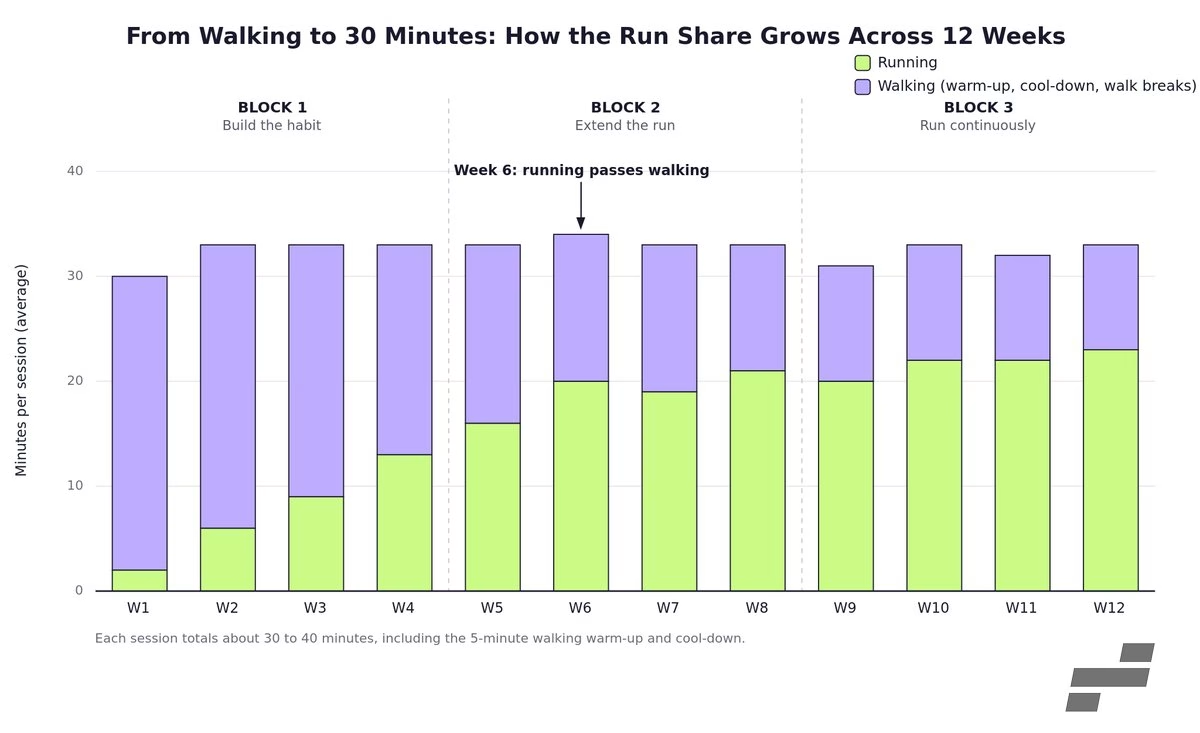
What Each Four-Week Block Builds
The grid divides into three blocks of four weeks, and each block asks for something different: first showing up, then running for longer than you walk, then running without stopping.
Weeks 1 to 4: Attendance Is the Product
Session content is deliberately undemanding, and week 1 contains almost no running at all, because the block’s job is to install three fixed appointments into a life that has never held them. Pick the three days now, before week 1, and defend them the way a standing appointment gets defended. Each session run in its usual slot makes the next one easier to start, and that repetition in a stable context is what turns a fixed day into a habit. When the sessions float around the week instead, a busy stretch arrives with no default to fall back on.
The 30-second jogs inside the walks have a job too. They let the body sample impact in doses small enough to recover from by the next lamppost, and they teach the first version of the run-to-walk transition, a skill the next block leans on heavily.
Weeks 5 to 8: Running Becomes the Main Event
The middle block flips the session’s proportions. Walking now frames the running instead of containing it, and single run segments grow from 3 minutes to 16. Somewhere around week 6, most people notice that the session has stopped being intervals with some jogging in them and started being a run. For a lot of them, that is the week the word runner stops feeling borrowed.
Week 7 is the one week in the block that does not climb. Adaptation happens between sessions rather than during them, and someone six weeks in is usually feeling strong enough to want more at exactly the point where tissue is still catching up to fitness. A week of holding steady protects against injuries that can tend to pop up just when things are feeling great.
Weeks 9 to 12: Continuous Running, Owned
Two of three weekly sessions are continuous by week 9, and the remaining interval session keeps total time up without stacking three long unbroken efforts into one week. The 30-minute run in week 12 should feel like a longer version of week 10 rather than a summit attempt. Finishing it gasping means the running was too fast. Anyone who arrives at week 12 still wanting a walk break in the middle of that session is doing this right.
The Walk Breaks Are a Skill
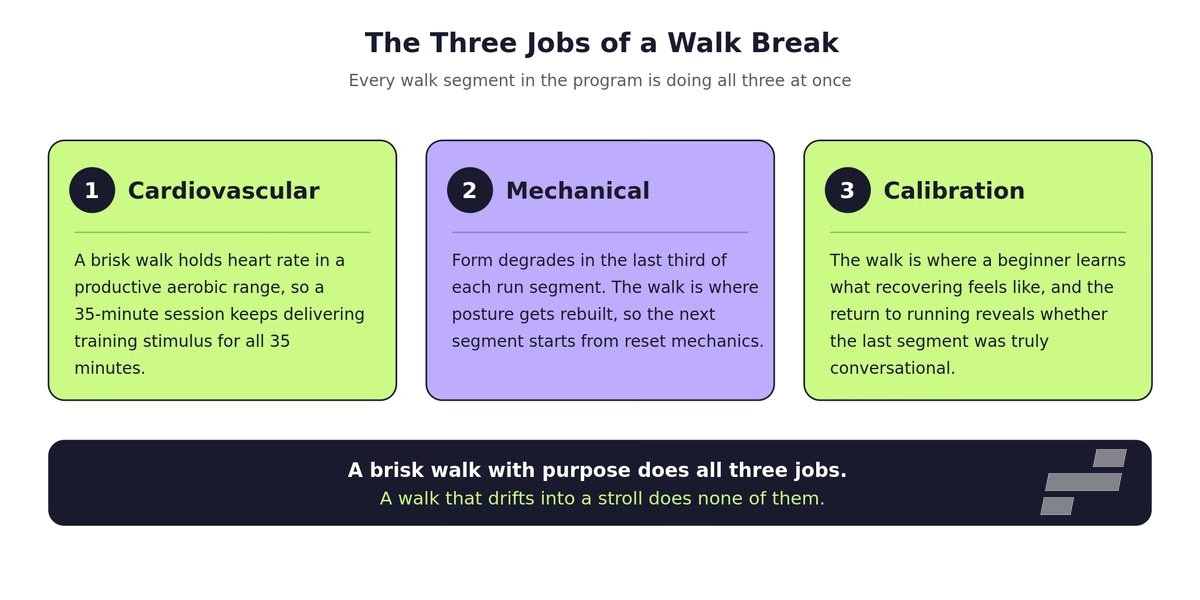
The walk segments deserve the same attention as the run segments. They are doing three jobs at once, and a walk that drifts into an easy stroll gives up all three.
The first job is cardiovascular. A brisk walk holds heart rate in a productive aerobic range between run segments, which means a 35-minute session keeps delivering training stimulus for all 35 minutes. Let the walk collapse into barely moving and the session becomes ten short runs separated by rest, a much smaller dose than the plan intends. This is why the run segments are held at a conversational effort throughout. When the running is easy enough to talk through, the walk is not there to recover from it; it is more of the same training, at a lower gear.
The second job is mechanical. Running form degrades as a new runner fatigues, usually in the last third of each run segment. The walk is where posture gets rebuilt: shoulders back down, eyes up off the shoes, stride reorganized. Each run segment then starts from reset mechanics instead of inheriting the previous segment’s decay. Treating the first ten steps of every walk as a deliberate form check turns dozens of transitions per week into free technique practice.
The third job is calibration. The transition into each walk is where a beginner learns what recovering actually feels like, and the transition back into running reveals whether the previous segment was truly conversational. A runner who dreads the end of every walk break has been running too hard, and that signal shows up here before it shows up as a bad week.
So walk with intent: a pace with purpose behind it, arms moving. The only slow, ambling walks in this program are the five cool-down minutes at the end.
None of this expires in week 12. Run/walk is a permanent format in its own right, and famed coach Jeff Galloway built an entire coaching method on it. Walk breaks hold the effort conversational when the legs are tired, they make a longer session available sooner than continuous running would, and they cost nothing in aerobic benefit. The plan thins the walking out because that is how continuous running gets built, not because walking is a phase to grow out of. Finishing the twelve weeks and keeping a walk break in one session a week is a complete result, and a successful one.
Reading Soreness
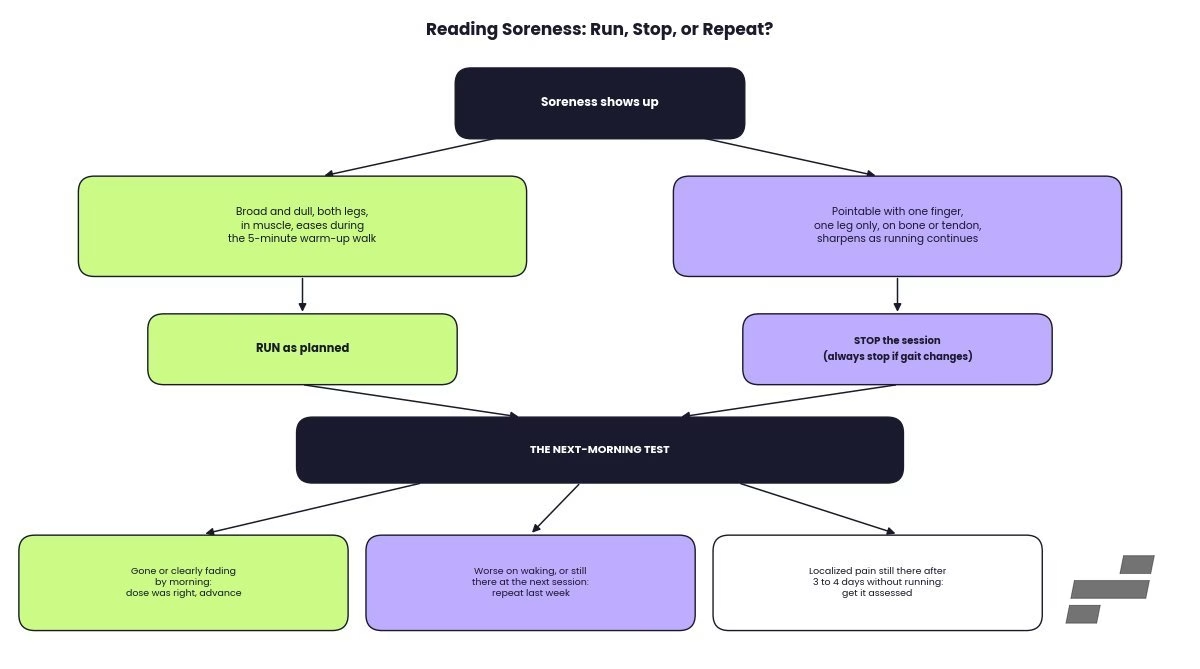
A new runner will be sore, and that is expected rather than a sign that something has gone wrong. The useful question is never whether something aches but what kind of ache it is. The first six weeks need a working triage, because this is the window where the body is least used to impact and where the wrong response in either direction costs the most. Pushing through the wrong pain builds an injury; resting the wrong soreness teaches the runner that any discomfort means stop, and caution ends a program as reliably as an injury does.
Adaptation soreness has a recognizable signature. It shows up in muscle, usually both legs at once: quads, calves, glutes. It is broad and dull rather than pointable, it peaks a day or two after a session, and it fades as the body warms up. The five minutes of brisk walking that opens every session doubles as the diagnostic, which is one of the jobs a warm-up before running keeps doing for the rest of a runner’s life. Soreness that loosens across those five minutes and the first run segments is the training working, so keep running the workout as planned.
The stop signals are the mirror image. Pain the runner can point to with one finger, especially on bone or tendon: the shin’s inner edge, the Achilles, the top of the foot, the side of the knee. Pain in one leg only. Pain that sharpens as the session continues instead of easing. And the brightest signal of all: pain that changes how the runner moves. Any limp, hitch, or favoring ends the session on the spot, because every stride on altered mechanics loads tissue in patterns that will cause longer term repercussions than the benefits of a run can cover.
Between those poles sits the next-morning test. If yesterday’s session left soreness that is gone or clearly fading by the following morning, the dose was right. If it is worse on waking, or still present at the next scheduled session two days later, the week’s load exceeded the tissue’s current budget: repeat the previous week’s sessions instead of advancing. One localized pain that survives three or four days of not running has earned a professional’s eyes, not another test run.
When Life Interrupts the Plan
Twelve weeks is long enough that something will interfere: a deadline, a virus, a school holiday. An interruption handled by a rule is survivable. It is the guilt afterward that turns a missed week into a stopped program, so the rules are worth setting before they are needed.
One missed session. This is the smallest problem in the program, and there are two good answers. The first is to let it go: the habit research cited earlier found that a single missed opportunity did no measurable damage, and the fitness behaves the same way, so the plan picks up at the next scheduled slot with nothing owed.
The second is to run it anyway, later in the same week. Three sessions with a rest day after each leaves room for a fourth, since Monday, Wednesday, Friday and Sunday all keep a day between them, so a missed run can be recovered without ever putting two runs back to back. For most people this is the better answer. The fitness will not notice either way; what matters is what gets checked off.
Skipping one run is harmless on its own, but getting comfortable with skipping is what turns three sessions a week into two, and two into one. A week that ends complete keeps that from starting. The only version that does not work is stacking the make-up run next to another session, because for a beginner the rest day between runs is doing as much work as the runs are.
A missed week. Legs that rested for seven days but stayed healthy have lost far less than the runner fears. Repeat the last completed week, then continue from there, because that re-enters the progression at a load the body has already proven it handles.
If the lost week went to an illness that came with a fever or settled in the chest, treat the first run back as a test rather than a session. Run Session 1 of the last completed week, see how the legs answer, and carry on with the rest of that week if the answer is good. Illness takes more out of the legs than most people expect, and it tends to show up in the first session back rather than in how you feel the day before.
Two weeks or more. Step back one full week of the program for each week missed, and hold the run segments truly easy – even by this plan’s standards for the first few sessions. The finish date moves, and that is all that moves. Fourteen or sixteen weeks with the program completed leaves a runner somewhere that a clean twelve weeks abandoned in week five never reaches.
After Week 12: Running is Yours Now
The 30-minute run at the end of week 12 is not a qualifying time for anything. What it marks is that three runs a week now have a fixed place in the calendar, which is the conversion this program exists to make. Three sessions of 30 to 40 minutes also covers the activity adults are advised to get for their health. The World Health Organization puts the weekly range at 150 to 300 minutes of moderate activity or 75 to 150 minutes of vigorous activity, and easy running sits at the vigorous end for most beginners.
Week 13 is the real test, and it passes if it looks like week 12 without a plan attached. Holding the three slots is the whole job: one longer run, two shorter ones, every one of them at conversational effort. The long session can sit at 30 minutes indefinitely, or grow by a few minutes every few weeks for anyone who wants more. A first 5K is one of the doors this base opens, and a structured 5K training plan starts from roughly this fitness. Leaving that door shut is a valid outcome too.
Pace targets, interval sessions, and a distance goal several sizes up are all on the horizon or not at all, and that’s ok. The habit may be automatic by now, but the tissue has only twelve weeks on it. Tendons and joints keep adapting long after the running starts to feel easy, and that is the argument for letting the next step wait a while.
Twelve weeks earlier, running needed a plan, a decision, and willpower three times a week. Now it needs shoes. The 30 minutes are worth having, but the harder thing was showing up on the ordinary days and starting again after the weeks that fell apart. That part is never lost.

Track progress from Week 1 and beyond
Suggested References
- Lally, P., van Jaarsveld, C. H. M., Potts, H. W. W., & Wardle, J. (2010). How are habits formed: Modelling habit formation in the real world. European Journal of Social Psychology, 40(6), 998–1009. https://doi.org/10.1002/ejsp.674
- Videbæk, S., Bueno, A. M., Nielsen, R. O., & Rasmussen, S. (2015). Incidence of Running-Related Injuries Per 1000 h of running in Different Types of Runners: A Systematic Review and Meta-Analysis. Sports Medicine, 45(7), 1017–1026. https://doi.org/10.1007/s40279-015-0333-8