Running Strides Workout: How to Program Strides Effectively Across a Block

A running strides workout is rarely a workout. It attaches to something else: the end of an easy run, the last step of a warm-up, the few minutes after a tempo. That is what makes it the most repeatable fast running in a distance runner’s week. A track session happens once or twice a week. A race happens a few times a season. Strides can happen three or four times a week, every week of the year, for a few extra minutes each time.
Run that arithmetic and the case for programming them carefully makes itself. Three or four touches a week across a fifty-week year is more than a hundred and fifty separate exposures to fast running, against roughly half as many quality sessions and a handful of races. Nothing else in a distance plan gets that many repetitions at that speed.
The reps themselves barely change across a block. Six by twenty seconds looks the same in October and in May. What changes is the job those reps are doing, where in the week they attach, and how much fast running is already happening around them. Those three variables are the programming decision, and they are what the rest of this article works through.
Key Takeaways for Coaches
- Strides are controlled accelerations to roughly 85 to 95 percent of top speed, held briefly and released; they train mechanics and neuromuscular coordination rather than fitness, which is why they leave almost no fatigue behind.
- Strides attach to other sessions rather than standing alone, so three or four touches a week is normal and most of them add nothing to the week’s recovery cost.
- The job changes by phase: maintaining access to speed in base, supporting quality work in build, and preserving turnover through the taper, where strides should be among the last elements cut rather than the first.
- Bracketing a hill session with strides, four before and four to six after, primes the first rep on the way in and restores flat step length on the way out.
- The most useful stride data is the athlete’s own report, since strides sit at the top of a runner’s speed range and are run often enough that a heavy set registers before fatigue shows up anywhere else.
What a Running Strides Workout Is
A running strides workout is a set of short, controlled accelerations, usually four to eight reps of 15 to 30 seconds or about 60 to 100 meters, run at roughly 85 to 95 percent of top speed with full recovery between reps. Each rep builds gradually to fast-but-relaxed running, holds it briefly, and eases back down. Strides develop speed mechanics and neuromuscular coordination rather than fitness, which is why they leave almost no fatigue behind.
Relaxation governs the effort. A stride sits at the fastest speed an athlete can hold while staying visibly loose: shoulders low, face soft, turnover quick without reaching. When strain appears, the rep has drifted past its purpose. Pace anchors still have a place as a cross-check, and they work best where a stride is rehearsing one specific pace, such as the final reps of an interval warm-up. As the primary instruction, though, relaxation self-adjusts to the athlete’s freshness on the day and keeps attention on movement quality rather than on hitting a split.
Strides, Sprints and Surges
A sprint is a maximal effort, where the athlete chases top speed and accepts the strain that comes with it. A stride stops deliberately short of that ceiling, because the last 5 to 10 percent of speed carries most of the tissue risk and adds little to the mechanical rehearsal. A surge is different again: a pace injection inside a continuous run, with no recovery, training the ability to change gears under fatigue. All three belong somewhere in a season. What separates them for programming is preparation: a surge sits inside a run already underway, a stride asks nothing beyond being warm, and a sprint needs a build-up of its own before it is safe to run.
What Strides Actually Train
Strides train the nervous system, not the engine. Twenty seconds of fast running does nothing measurable for aerobic capacity, and it is not meant to. The adaptation lives in motor recruitment: activating more muscle fibers, in better sequence, with less wasted co-contraction. Fast running is a skill, and skills improve through frequent, high-quality, low-fatigue repetition.
At stride pace the body organizes itself toward efficiency in ways that never happen at easy pace. Ground contact shortens, the foot lands closer under the hips, the arm swing tightens. An athlete who visits those positions a few times a week keeps them accessible, and they carry over into everyday running. Reduced ground contact time and improved motor unit recruitment are the mechanisms most often proposed for why fast, forceful running improves economy, though the direct evidence for that comes from explosive strength protocols rather than from strides specifically.
The third effect is range. A runner whose fastest weekly pace is threshold lives in a narrow spread of speeds, with race pace sitting near the top of it. Paavolainen and colleagues (1999) put nine weeks of numbers on how quickly that spread closes. Their control group of endurance athletes trained normally, and over those nine weeks both maximal 20-meter speed and five-jump performance declined. The experimental group, who replaced about a third of their training volume with explosive strength work, improved 5 km time and running economy while the control group did not. Strides are not explosive strength training and should not be sold as producing those gains. The control arm is the part that matters here: nine weeks of ordinary endurance training was enough to make trained runners slower over 20 meters. That is the practical argument for holding strides in every phase rather than saving them for the sharpening weeks.
How to Run a Stride
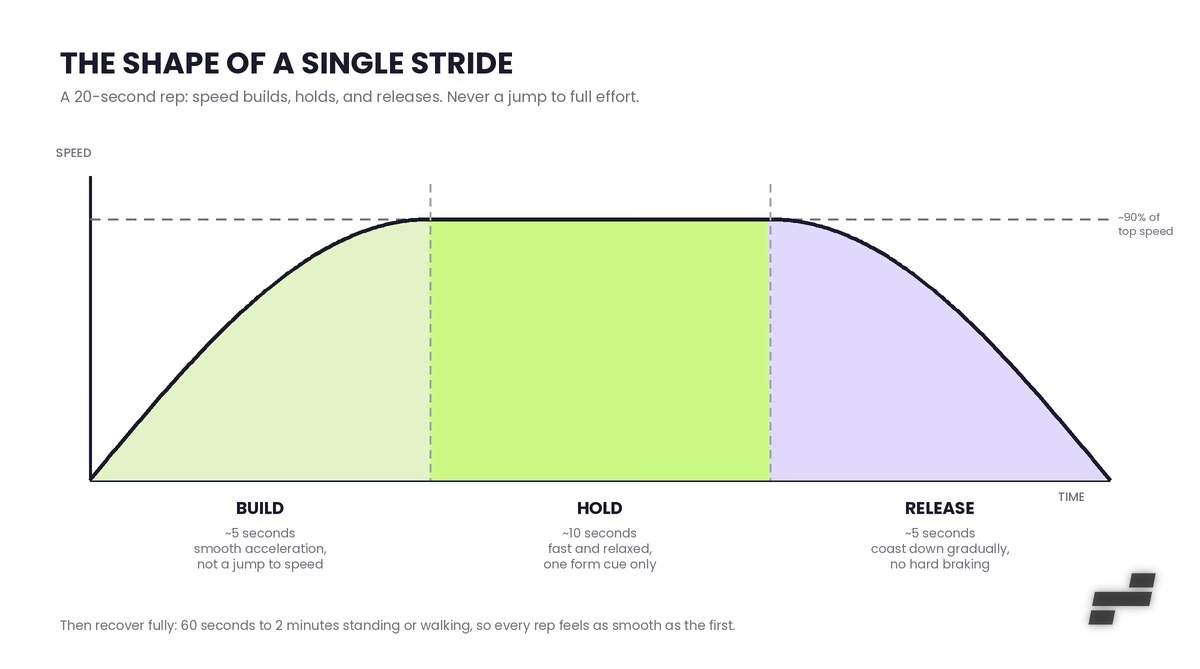
Executed well, a stride has a distinct shape: a patient build, a short window of genuinely fast running, and a gradual release. Athletes who have never been taught that shape tend to run strides as small sprints, jumping to full effort in the first two steps. The build is not a formality. It gives tendons and the nervous system a graded loading curve, and it is the main reason strides carry so little injury risk despite the speeds involved.
The Shape of a Single Rep
The first third is acceleration, smooth and progressive, reaching target effort after about five seconds rather than immediately. The middle third is the payoff: fast, relaxed running where the athlete’s full attention goes to movement. The coaching cues belong here. Quick feet rather than long reach. Arms driving straight forward and back. Tall posture with a slight whole-body lean. One cue per rep works better than five at a time, since an athlete juggling a checklist at speed executes none of it. The final third is deceleration, coasting down over several strides instead of braking. Stopping abruptly from near-top speed loads the joints with exactly the forces the build was designed to avoid.
How Much Recovery Between Reps
Recovery between standalone strides should be generous enough that rep six feels as smooth as rep one, which usually means 60 seconds to 2 minutes of standing or walking. The work period is far too short for the limiter to be aerobic; it is the nervous system’s ability to reproduce quality movement. If rep five feels ragged where rep two felt fluid, the recovery was too short, and the session has started training fatigue resistance instead of mechanics.
Warm-up strides are the deliberate exception. There, 30 to 45 seconds of walking is enough, because the job is arriving at the first interval warm and switched on, and the shorter recovery keeps heart rate climbing rather than settling back down.
Where Strides Attach in the Training Week
Strides attach to other sessions rather than occupying one, which is why three or four touches a week costs a distance runner so little. Each attachment point does a different job. Four of them cover almost every use.
At the End of an Easy Run
Here the athlete arrives warm but mildly fatigued, which makes the reps a rehearsal of good mechanics on tired legs, the exact skill a race finish asks for. The placement also protects the easy day’s purpose: the aerobic work stays easy, and the speed arrives in a dose too small to compromise recovery. Since it asks nothing extra of the schedule, this is the default for base-phase maintenance and for any athlete building the habit. The logic of keeping easy days genuinely easy, which this placement depends on, is covered in our article on easy run training.
Inside the Warm-Up Before Quality Work
As the last step before intervals or a race, strides raise heart rate progressively and give the athlete a feel for the target pace before the first rep counts. That role belongs to the warm-up’s own logic. The programming note here is about accounting: warm-up strides ride on a session that is already happening, so they add no separate recovery cost and do not need to be subtracted from anything. An athlete finishing an easy run with strides on Monday and running four more inside Wednesday’s warm-up has not overdone it.
After a Sub-Threshold or Tempo Run
Three or four strides at the end of a controlled tempo give the athlete a few seconds of genuinely fast mechanics on legs that have just spent thirty minutes at a moderate, repetitive cadence. Sub-threshold work is valuable partly because it is monotonous, and monotony is also its cost: stride length and turnover settle into one narrow pattern for the whole session. Finishing fast interrupts that pattern before the athlete goes home. The dose stays small on purpose. The tempo was the session, and these reps are not meant to add to it.
On Both Ends of a Hill Session
Hill work is the clearest case for using strides twice inside the same session. Four strides after the warm-up prime the legs so that the first hill rep is not the first fast thing they do. Four to six flat strides after the last rep do a different job.
Uphill running changes the shape of the stride as well as the effort. Vernillo and colleagues (2017) describe uphill running as producing higher step frequency, shorter aerial time, and a progressive shift toward mid- and forefoot contact compared with level running at the same speed. One study in that review found that at a 7 percent grade, cadence rose about 4.5 percent while stride length fell about 4.3 percent. An athlete who finishes a hill session and stops has just spent time reinforcing a shortened, high-frequency pattern.
A few flat strides afterward let that athlete apply the hip drive and force production the hills just recruited to a normal step length on level ground. Whether the transfer is measurable has not been tested directly, so treat it as coaching rationale rather than established physiology. What it reliably does, though, is send the athlete home running the way they intend to race, rather than the way they climbed. Hill session structure, gradient selection, and progression are covered in hill repeats for runners.
Added together, a normal build week might hold strides at the end of Monday’s easy run, inside Wednesday’s interval warm-up, and on both ends of Saturday’s hill session. That is four touches. Only the Monday reps are strides the athlete would have skipped had nobody prescribed them; the rest ride on sessions already in the plan.
Programming the Running Strides Workout Across the Block
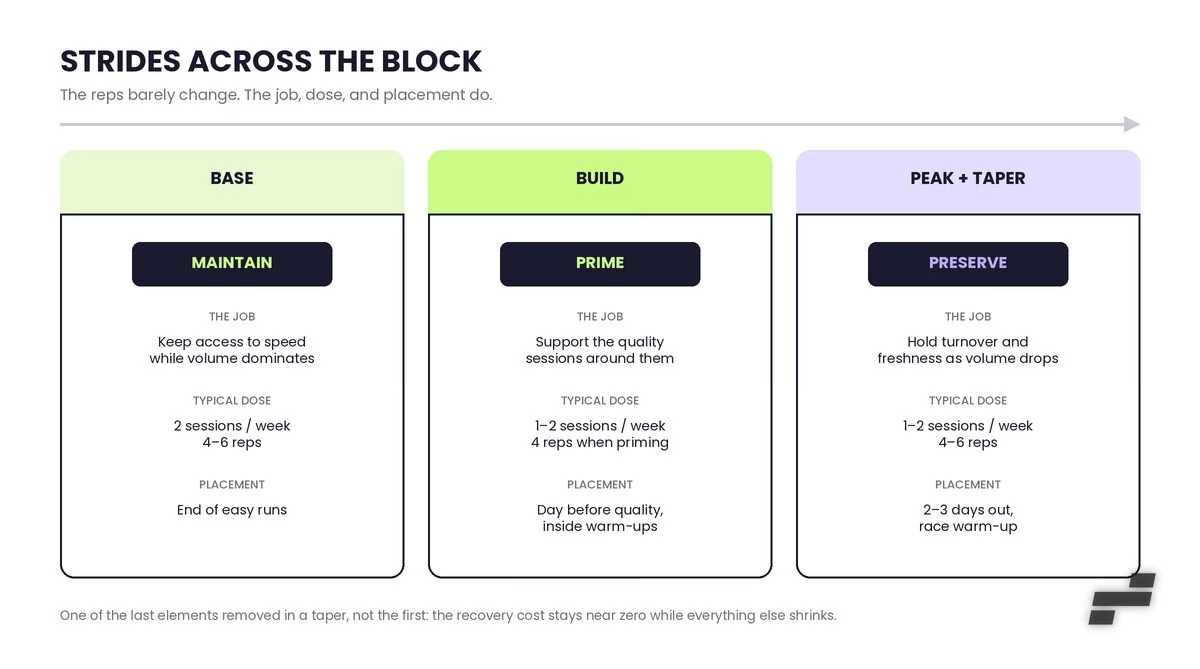
A running strides workout can appear in every phase of a training block without ever creating a scheduling conflict. What changes is the job. Naming that job by phase is what drives dose, placement, and even which cue the coach gives on the day.
Base: Keeping Access to Speed
In base, strides are insurance. The phase runs on volume and easy running, and weeks of exclusively slow paces let the neuromuscular qualities of fast running erode, at roughly the rate Paavolainen’s control group demonstrated. Two or three touches a week, four to six reps each, are enough to stop that at almost no cost to recovery. The intent is maintenance, so the cueing stays relaxed and the progression stays flat.
Base is also where strides do quiet developmental work with newer athletes. A runner who has never trained fast can spend eight or ten weeks learning the shape of a stride, one added rep at a time, and reach the build phase already comfortable with controlled speed. That comfort is the difference between a first interval session that teaches pacing and one that teaches panic.
Build: Strides as Session Support
Once quality sessions enter the plan, strides stop being the fastest thing in the week and start supporting the things that are. Most of the touches migrate onto other sessions: inside interval warm-ups, on both ends of hill work, at the end of a tempo. Standalone sets after easy runs can drop to one or two a week, since the athlete is now getting fast running elsewhere and much of the mechanical rehearsal is happening inside the sessions themselves.
Build is also when stride surface and equipment can bend toward the goal. An athlete heading into a hilly race can take one weekly set onto a gentle grade. A track athlete can run them in racing shoes to rehearse the equipment. Specificity moves like these cost nothing and compound across an eight-week build.
Peak and Taper: Turnover Without Cost
In the taper, most training levers get pulled down, and strides are the one that does not need to be. Volume drops, sessions shrink, and the athlete’s main risk becomes staleness: legs that feel flat from doing less. Strides hold turnover and freshness at a recovery cost near zero, so they belong among the last elements removed from a taper week rather than the first.
The final-week prescription is short and familiar: four to six strides two or three days out, and a few inside the race warm-up. Nothing new appears here, because the taper is a poor time to introduce a stimulus. An athlete who has run strides all season long executes these on autopilot.
Dosing Strides by Athlete and Event
Stride dose scales along two axes: how much fast running the athlete’s tissue is prepared to absorb, and how much their event actually asks for.
Starting From Zero
For an athlete new to fast running, the entry protocol is deliberately small: four reps of 15 to 20 seconds at the end of one easy run per week, adding a single rep every week or two as long as the last rep still looks like the first. The limiter is tissue. Calves, hamstrings, and the Achilles adapt to speed on a slower timeline than fitness does, and a conservative ramp is most of what keeps the tool low-risk. General soreness after the first few sessions is expected. Sharp or localized pain is a reason to stop the session and find out what is causing it, not to hold the dose steady and carry on.
Event Distance
A 5K or 1500m athlete lives close to stride pace in competition, so they tolerate and benefit from more: up to eight or ten reps, twice a week, sometimes graduating into formal speed work. A marathoner’s race sits far below stride pace, and that distance is exactly why the dose stays in the plan. Months of marathon-specific training pull the range of trained paces narrow, so a few small weekly sets keep mechanics and turnover from drifting while the aerobic work dominates. The marathoner’s dose is smaller, four to six reps, but its priority is arguably higher.

Masters Athletes and Returning Runners
For masters athletes, the case for strides is more specific than just keeping fast twitch fibers active. Korhonen and colleagues (2006) took muscle biopsies from 91 male sprinters aged 18 to 84 and found that type I fiber cross-sectional area held steady with age while type II fiber area declined, alongside a shift toward slower myosin heavy chain isoforms. These were lifelong sprint-trained athletes who were still training fast. The selective loss of fast fibers happened anyway.
Strides do not prevent that. What they do is keep an athlete using the fast-twitch capacity that remains, which is the part that goes quiet fastest when a training week contains nothing above threshold. For a masters runner, that argues for keeping strides year-round even when racing plans are vague.
For athletes returning from injury or a long layoff, strides offer graded exposure to speed in doses measured in seconds, which makes them a natural first rung on the ladder back to workouts. In both cases the stride count itself stays ordinary. What changes is that the fast running around it has shrunk, so the strides end up carrying proportionally more of the load.
What a Heavy Set of Strides Tells You
Strides repeat at the same effort every week, which makes them a reference point. That reference is not in the training file. Only the middle third of a rep is held at speed, which leaves eight or ten seconds of steady running, and GPS pace across that window carries more error than the differences a coach would want to read. In addition, end-of-easy-run strides are rarely lapped in the first place.
The reliable signal is the athlete’s self-reported feedback. Strides sit at the top of a runner’s speed range, where accumulating fatigue surfaces earlier than it does at easy pace, and they happen often enough that the athlete knows what normal feels like. A runner who usually finds strides fun and reports that they felt heavy has produced better information than any file will.
That takes one habit: a note after the reps, in just a few words. Smooth. Flat. Heavy. Across a block it builds a record of when the athlete stopped enjoying fast running, which is usually when a down week is due, and it costs about five seconds to track.
When the reps do feel bad, strides are the one element in the week that can be abandoned at no cost. An athlete who cannot find relaxed speed on a given day should stop at two reps rather than grind through six. The set was maintenance, and one missed maintenance dose changes nothing, while six reps of strained mechanics rehearse exactly the pattern the tool exists to prevent.
When Strides Stop Being Enough
Strides have a ceiling. They maintain and rehearse speed; they do not build much of it. An athlete who has run consistent strides for months, whose mechanics are stable and whose stride pace has plateaued, has extracted most of what the tool offers.
If that athlete’s racing still shows speed as a limiter, no top gear when a competitor lifts, or a finish that never materializes, the next step is dedicated development work: maximal-velocity sprints, short hill sprints, and the diagnostic thinking that matches the tool to the specific gap. That progression, and the readiness markers that gate it, can be found in our running speed training article.
Sprint work does not replace strides. Strides stay in the week as the low-cost floor while sprint work becomes the stimulus on top. What changes is the expectation: strides go back to being a maintenance tool.
Writing the Prescription With Intent
A coach who knows whether this week’s strides are maintaining, supporting, or preserving will place them differently, dose them differently, and read them differently three weeks later. The athlete on the other end of that arrives at the sharpening phase with speed still available, mechanics rehearsed across a hundred and fifty short exposures rather than a dozen, and a coach who can see a bad week coming before it costs them a session.
Programming strides is less about the reps than about remembering them: a few extra minutes that have to land on the right days for fifty weeks running. Inside EndoGusto, they can be built into a plan as a recurring element with the intent attached, so a coach is not rewriting the same line every Sunday and an athlete can understand why four reps sit at the end of Monday’s run.

Build Strides Into Every Phase
of Your Training Plan
Suggested References
- Korhonen, M. T., Cristea, A., Alén, M., Häkkinen, K., Sipilä, S., Mero, A., Viitasalo, J. T., Larsson, L., & Suominen, H. (2006). Aging, muscle fiber type, and contractile function in sprint-trained athletes. Journal of Applied Physiology, 101(3), 906–917. https://doi.org/10.1152/japplphysiol.00299.2006
- Paavolainen, L., Häkkinen, K., Hämäläinen, I., Nummela, A., & Rusko, H. (1999). Explosive-strength training improves 5-km running time by improving running economy and muscle power. Journal of Applied Physiology, 86(5), 1527–1533. https://doi.org/10.1152/jappl.1999.86.5.1527
- Vernillo, G., Giandolini, M., Edwards, W. B., Morin, J.-B., Samozino, P., Horvais, N., & Millet, G. Y. (2017). Biomechanics and physiology of uphill and downhill running. Sports Medicine, 47(4), 615–629. https://doi.org/10.1007/s40279-016-0605-y