Fartlek Training for Running: How to Program Effort-Based Speed Work

Two sessions share the name. One is 45 minutes over rolling trails, the runner surging whenever the terrain invites it, nothing timed. The other is a fixed ladder: two 90-second efforts, then four of 60 seconds, four of 30, four of 15, each followed by an equal stretch of easy running. Both are fartleks, and both are correct.
What they have in common is narrow. The running is continuous, the recovery is a jog rather than a stop, and the intensity is set by effort rather than pace. Fartlek training for running says nothing else: not how many surges, not how long, not how fast.
That last one is what makes the format useful across a whole year. Strong but repeatable describes a slower pace in November than in March, and the runner does not need to be told. A workout written in minutes per kilometer goes stale as fitness moves. One written in effort updates itself.
The surges also do not have to be fast to be worth running. A moderate surge with a brisk recovery still asks the body to produce lactate in one set of fibers and burn it in another. That exchange is much of what decides how a runner holds pace late in a race. What fails is a run with no contrast at all: written as 45 minutes with some pickups, a fartlek produces 45 minutes of one pace and trains neither side of it.
This article covers what defines the session and what the surge and float actually train, why effort-based surging transfers to racing, how much to specify, and which workouts suit which coaching problem. It closes on the season, the week, reading the file, and what fartlek cannot deliver.
Key Takeaways for Coaches
- A fartlek is defined by three things: continuous running, a jog float instead of a standing rest, and intensity set by effort rather than pace. Surge count and length are separate decisions.
- Because intensity is written as effort, the same line works all year. Strong but repeatable is a slower pace in base than in a sharpening week, and it updates itself as fitness moves.
- The surge-and-float shape trains both sides of lactate metabolism, production in the fast fibers and uptake and oxidation in the slow ones, which makes a moderate fartlek a real base-season workout.
- Float intensity is a design decision. Clearance runs fastest at roughly 60 to 100 percent of lactate threshold, so a brisk float clears better than a shuffle, while a slower float buys a harder surge.
- An open fartlek can take the VO2 slot and a fixed surge-and-float can take the threshold slot, but neither replaces repetition work, which needs the standing recovery a fartlek never provides.
- Fartlek cannot develop true maximal velocity, because the jog float means every surge starts on partly loaded legs and caps out below the runner’s actual top end.
What Defines a Fartlek
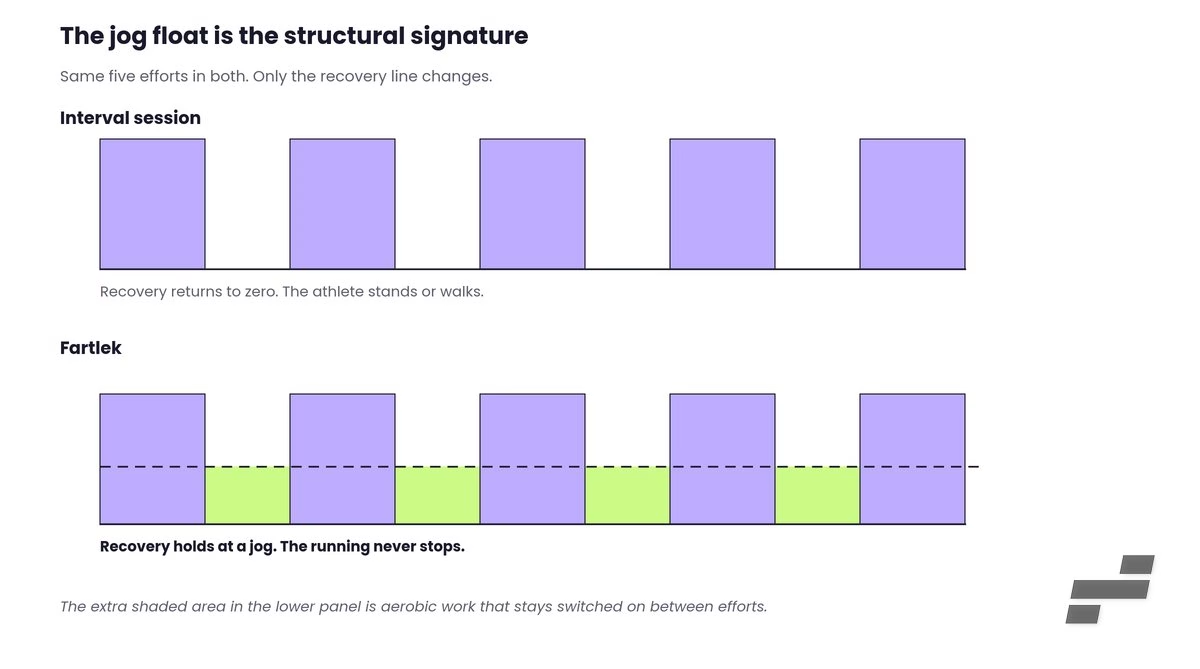
A fartlek is a continuous run in which faster surges alternate with easy jog floats, with intensity set by perceived effort rather than by a pace target. The running never stops. Surge length, surge count, and total duration all vary from one workout to the next, and all three are the coach’s to specify or to leave open. The jog float is the structural signature, because it keeps the aerobic system loaded from the first minute to the last.
Two rules make a run a fartlek, and breaking either one produces something else with a different job. Add a standing recovery and it becomes an interval session, and it should be programmed as one, with the rest ratios that go with it. Attach a pace band to the surges and it becomes a broken tempo. That is a legitimate and widely used workout. The runner is now executing a number rather than reading their own effort, though, which is what a fartlek exists to train.
The practical boundary therefore sits against interval work rather than against tempo. An interval session uses measured rest, so each rep starts from a partly restored state and can hit a specified pace. Our guide to interval training for running covers the rest-ratio decisions behind that precision. A fartlek gives both up, and the next surge begins on legs that never stopped working.
Where the Method Came From
The word is Swedish and translates roughly as speed play. Gösta Holmér, a former Olympic decathlete who became Sweden’s national coach, built the method in the late 1930s after a decade of watching Finnish teams beat his own. Rather than move the fast running onto a track, he put it inside a continuous run over forest loops and told his athletes to go hard when the instinct took them.
The freedom was real, and it was also bounded. A Holmér session covered about twelve kilometers, and up to five of those were faster than race pace. Gunder Hägg and Arne Andersson, the two runners the method is best known for, traded the mile world record five times through the 1940s and brought it from 4:06 to 4:01. The instruction they were given specified the effort and the amount of it. What it left open was the timing.
What the Surge and Float Actually Train
Two mechanisms sit underneath the shape, and between them they explain why a fartlek is useful across a much wider intensity range than its reputation as a speed session suggests.
The Exchange Inside the Run
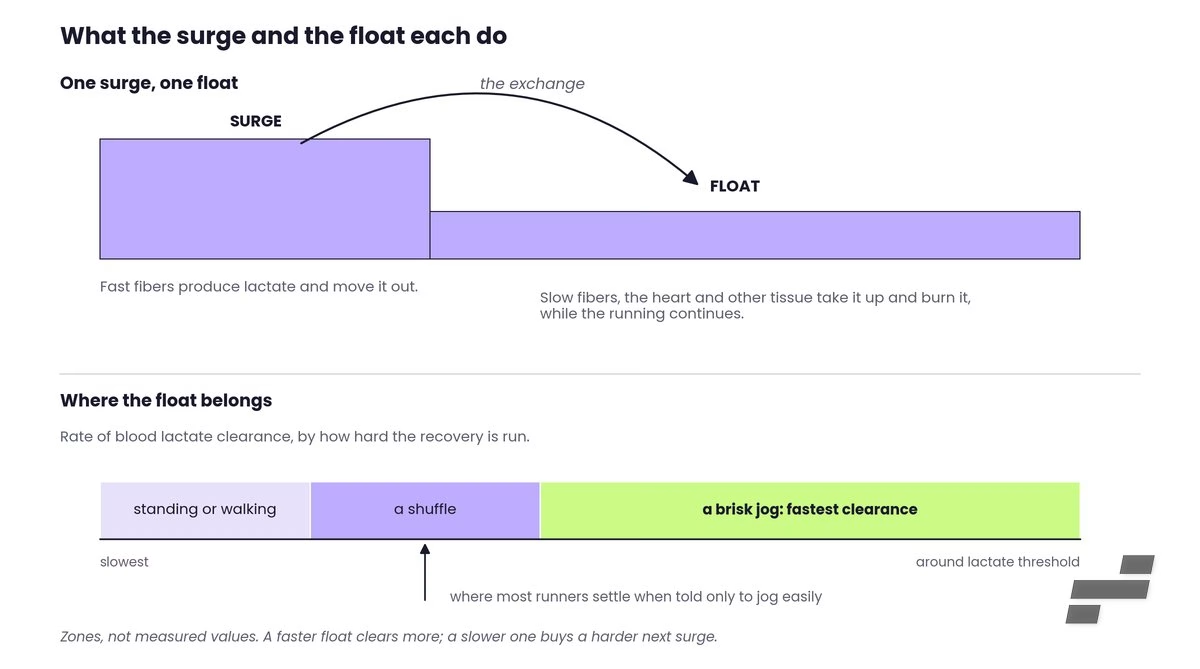
Lactate is not waste. It is produced by the glycolytic fibers doing the surging, and it is taken up and burned as fuel by oxidative fibers, by the heart, and by other tissues. Separate transporter proteins handle each direction, one moving lactate out of the fibers producing it and another moving it into the fibers consuming it.
A surge-and-float run rehearses both directions repeatedly inside one session. The surge loads the production side. The float asks the consumption side to work while the athlete is still running, which is the condition that matters, because it is the condition a race imposes.
The consumption side is trainable, and training it does not require fast running. Dubouchaud and colleagues (2000) put subjects through nine weeks of endurance training at 75 percent of peak oxygen uptake. The uptake transporter increased in both the cell membrane and the mitochondrial membrane, alongside a rise in citrate synthase activity of about 75 percent. That is ordinary aerobic work producing a clearance adaptation.
How Fast the Float Should Be
Most fartlek instructions say to jog easily and stop there. The evidence suggests that is not quite right. Menzies and colleagues (2010) had ten runners complete five-minute bouts at 90 percent of VO2max, which lifted blood lactate from around 1 to around 4 mmol per liter, then recover at intensities ranging from complete rest up to lactate threshold. Recovery between roughly 60 and 100 percent of threshold cleared lactate faster than recovery at 40 percent, and every active recovery beat standing still.
In practice, that puts the float faster than most runners choose for themselves. A brisk jog clears better than a shuffle. It does not follow that the fastest float is always the right one, because a float run close to threshold caps how hard the next surge can be. Float intensity is a design decision with a real trade-off. Strong floats clear more and hold the aerobic system high. Easy floats buy a harder surge.
Time at the Top
When the surges are fast, the shape does something further. Billat and colleagues (2000) had eight trained distance runners alternate 30 seconds at the velocity associated with VO2max with 30 seconds at half that velocity, then compared it against a continuous hard run. The intermittent format held them at VO2max for close to eight minutes on average, against under three for the continuous effort. Individual variation was wide, so the numbers read as a direction rather than a dose. Oxygen uptake falls more slowly than running speed does, so a short float clears part of the cost of the surge while the aerobic system stays near the top of its range.
Why Effort-Based Surging Transfers to Racing
Races change pace without permission. A pack splits, the course tilts, someone moves with two kilometers left, and the response has to come out of whatever state the legs are already in. An interval session rehearses none of that. The runner knows the rep starts at the line, knows how long it lasts, and spends the recovery preparing for a start they can see coming. A fartlek surge begins mid-stride, from a loaded state, with nothing granting permission.
Speed that shows up in training and never appears in a race is a specific problem, and running speed training treats it as its own limiter. Deployment is a skill separate from capacity, and it has three parts: recognizing the moment, committing without a countdown, and settling back to rhythm afterward.
In championship racing the pattern shows up in the results. Renfree and colleagues (2020) analyzed 125 performances across four global 10,000m finals. The capacity to produce and absorb large pace variation, particularly acceleration in the closing stages, was associated with higher finishing positions. That is an elite tactical field, though, and most age-group athletes are not racing for position over 10,000 meters.
For age-group athletes the same skill matters for a less tactical reason. A rolling half marathon imposes pace variation on everyone in it, so holding even effort means changing pace deliberately dozens of times. A headwind on the return leg does the same, and so does a group surging through every water station. A runner who can only change gear when the watch tells them to meets all of these unprepared, and the cost is a slower second half.
How Much Structure to Prescribe in Fartlek Training
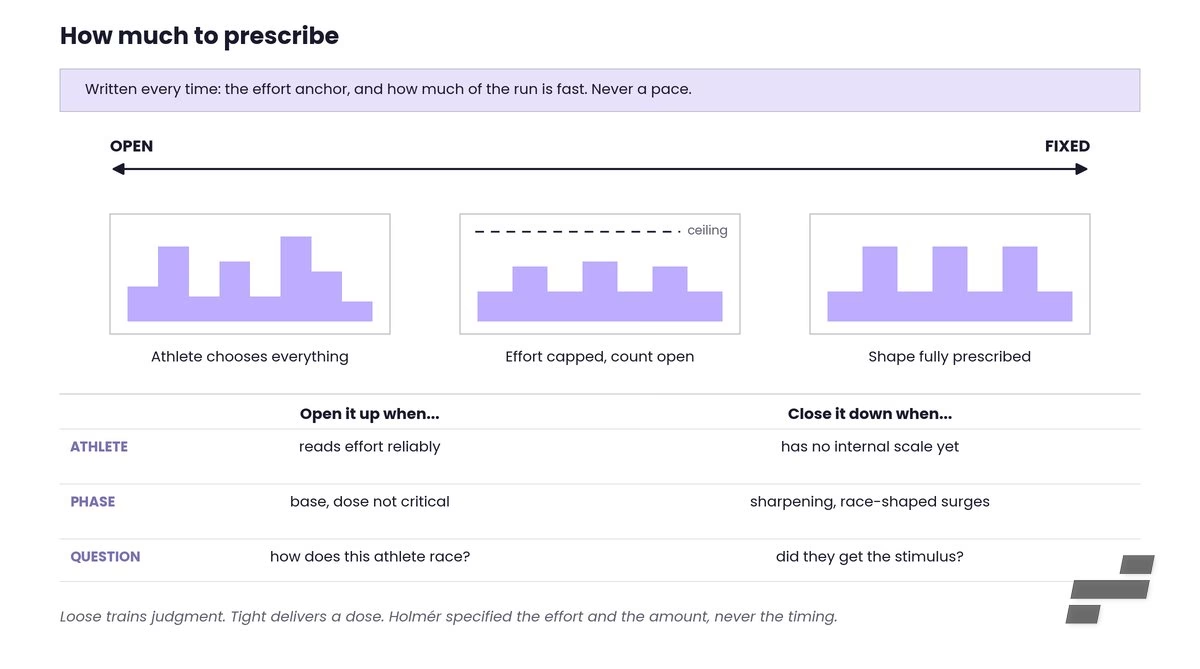
The effort anchor and the amount of fast running are written every time. How tightly the rest is specified decides which of two products the athlete gets. Written loosely, the run trains decision-making, and the runner lives with the consequences of their own choices. Written tightly, it delivers a controlled aerobic dose with something close to interval precision, minus the standing rest. Neither setting is the correct one, and three things decide how much of the shape to specify in a given week.
What Decides How Much to Specify
The first is how well the athlete reads effort. A runner three months into structured training has no reliable internal scale yet, so a loose session asks for judgments they have no basis for making. Prescribe the shape, leave the intensity to feel, and the workout teaches them what strong feels like without requiring them to already know. A runner with five seasons of racing behind them can be handed a 45-minute window and eight surges. They will judge the difference on the run, so the 30-second efforts come back genuinely fast and the three-minute ones hold their effort to the end.
The second is the phase. Base work tolerates a loose session because nothing downstream depends on the exact dose that week. Sharpening does not. Six weeks out, the surges need to be shaped like the goal race, which means specifying duration and effort even though the pace stays unwritten.
The third is what the coach needs to learn. A loosely written session is a diagnostic instrument, since it returns information about how an athlete distributes effort when nobody is deciding for them, which a prescribed one structurally cannot produce. A tightly written one returns a known dose instead. If the question is how this athlete races, open it up. If the question is whether they got the stimulus, close it down.
How to Write the Session
A fartlek that holds together on the road is written in four parts: the container, the amount of fast running, the effort language, and the float instruction. The container is total duration plus the warm-up and cool-down. The amount is how much of that time is quick, whether expressed as a surge count or as kilometers. The effort language stands in for the pace band and is usually the part left thinnest. The float instruction needs an intensity, not just the word easy, because that is the variable most runners get wrong in both directions. The shape, meaning exactly when each surge starts and how long it lasts, is the only part that is genuinely optional.
Open version: warm up 15 minutes, then 45 minutes with 8 to 10 surges, no two the same length, the shortest around 30 seconds and the longest around 3 minutes. Surge effort is strong but repeatable. Float at a steady jog, quicker than your easy pace but comfortably below the effort you could race for an hour. Cool down 10 minutes.
Fixed version: warm up 15 minutes, then 6 x (3 minutes strong + 2 minutes float), continuous. Strong means an effort you could hold for about 20 minutes if you had to. The float is a jog, not a steady run, because these surges are hard enough that a fast float will cost you the last two. Cool down 10 minutes.
The open version hands over the decisions and keeps the range. The fixed version hands over the intensity and keeps the dose. The float instruction differs between them on purpose, because the surges do.
Matching the Fartlek Running Workout to the Coaching Problem
Three coaching problems point to a fartlek for different reasons, and each one wants a different amount specified.
The Athlete Who Races Worse Than They Train
Some runners produce excellent training files and flat races. The intervals hit their splits and the tempo holds its band. Then a modest surge from a competitor breaks them, not physically but tactically, while they are still deciding whether to respond. An athlete who checks pace every 200 meters has trained accuracy rather than judgment, and a race asks for the second one. This athlete wants as little specified as possible: a run where the watch offers nothing useful and effort is the only signal available.
Quality on a Compromised Week
A fartlek scales to whatever the athlete brought that day, which makes it the most portable quality session on the schedule. It needs no facility and no fixed dose. A tired runner self-selects six modest surges, a fresher one pushes ten strong efforts, and both are legitimate executions of the same written line. For a coach working remotely that property does real work, since it adjusts to the athlete’s actual state without a rewrite from a distance. Specify half of it here: cap the effort, leave the count open.
First Speed, and Speed After Time Off
The first speed work of a runner’s life and the first after a layoff share a requirement, which is intensity with a wide margin for error. A prescribed 6 x 800m at a pace from three months ago invites a runner to chase numbers their tissues are not ready to honor. A fartlek carries no such invitation, because there is no split to fail. For a newer runner the same property lowers the barrier from the other side. Surging to a tree line teaches the feel of faster running without requiring them to know what 5K pace means yet. Prescribe the shape tightly here and keep the efforts short.
Session Shapes by Intent
Each of these is a starting point to adapt, not a specification to hit.
| Session | Shape | Coaching intent |
| Swedish original | About 12 km, with 4–5 km of it faster than race pace, athlete picks the moments | Judgment, plus a real dose of fast running |
| Base fartlek | 40–60 min, 6–8 x 3–5 min moderate, floats held brisk | Lactate clearance and aerobic volume without pace pressure |
| Mona | 2 x 90 sec, 4 x 60 sec, 4 x 30 sec, 4 x 15 sec, equal floats; pace rises as efforts shorten | One written line that works in every phase |
| Kenyan 1:1 | 20–30 x (1 min strong + 1 min float) | Aerobic ceiling under continuous load |
| Surge and float | 5–6 x (3 min strong + 2 min float) | Threshold time without a standing recovery |
| Cover and settle | 5 x (90 sec strong + 30 sec at race effort) | Responding to a move, then racing again |
| Hill fartlek | 45 min rolling route, surge every climb | Strength and gear change dictated by terrain |
| On-ramp | 30 min, 6 x 20–30 sec brisk, 3+ min floats | First speed exposure, or the return from a layoff |
Cover and settle is worth a closer look, because its second segment carries the whole thing. The 90-second effort is easy to write and easy to run, since every athlete can surge. What decides races is the moment afterward, when the runner has closed the gap and has to hold race effort on legs that just spent above it. Two things tend to happen instead: the athlete stalls well below race effort to recover, or never settles and carries the surge until it breaks them. The 30-second bridge at race effort trains the third option, forcing the transition from covering to racing while the cost of the surge is still in the legs.
Group settings sharpen most of these further. When one athlete calls the surges and the others respond, the reaction itself gets trained, because nobody knows an effort is coming until it arrives. Rotating the caller keeps that honest across a season.
How Fartlek Changes Across a Season
The workout name in the plan looks similar all year while the job underneath it changes. What changes is not only the shape. It is the surge intensity, the float intensity, and how much fast running the run contains.
Base
This is where the moderate version belongs, and where it gets undersold. Surges sit at a comfortably strong effort rather than a hard one, floats stay brisk, and the total volume of quick running is high relative to how hard any of it feels. Nothing here needs to be fast. The run loads the production and consumption sides of the lactate exchange repeatedly, and that is an adaptation aerobic work drives on its own. It does so without asking an out-of-form runner to hit a number they cannot yet hit.
The effort anchor is what makes this work. In November, strong but repeatable might sit well outside the pace the same runner will call strong in March. Both are correct on the day. A pace-anchored session in the same slot would either be too fast in November or too slow by March, and would need rewriting in between.
Build
Surges tighten toward threshold and 10K effort, and floats drop to an easy jog so the surges can hold their intensity across the full set. This is where the prescribed version earns a quality slot on its own, and where the aerobic ceiling work sits. The run starts to look like an interval session that never stops.
Sharpening
Surges take the shape of the goal race, at the duration and effort the athlete expects to face, run on legs that are already tired. Float intensity now depends on what is being rehearsed: a fast float if the race will demand running hard off a hard patch, an easy one if the surges themselves are the point.
The Mona ladder is the clearest illustration, because one written line covers all three phases. Run in base, the efforts sit near threshold and the recoveries stay strong enough to read like a broken tempo. Run in a sharpening week, the recoveries drop to a jog and the efforts climb toward 1500m to 10K effort. Our guide to running periodization covers the phase logic itself. What matters here is that the runner should be told which version they are running, because the title alone will not tell them.
Placing Fartlek in the Week
A fartlek occupies a quality slot. However loose the format feels, the work carries real intensity. It counts against the week’s hard-day budget and needs the same spacing on either side that an interval session would get. The base version is the one exception worth naming, since a moderate fartlek with brisk floats can sit closer to another quality day than a hard one can, in the same way a steady run does.
Which session it replaces depends on how it is written. An open fartlek with surges in the 30-second to 3-minute range sits in the VO2 neighborhood and can take that slot. A prescribed surge and float built around 3-minute efforts accumulates threshold time and can take the threshold slot, which is how many coaches use it when a track is not available. What it does not replace is repetition work, because short near-maximal reps need the full standing recovery that a fartlek by definition never provides.
Once every 1-2 weeks sustains the practice without crowding out the sessions that need precision. Beyond that the coach starts losing controlled data, since a block built entirely on self-selected effort leaves no fixed reference to steer by.
Reading the Completed Fartlek Session
An effort-based run still produces structured evidence. The pace trace of a well-executed fartlek shows two distinct bands: surges that separate clearly from the easy running, and floats that return to a consistent level and hold there. The gap between the bands is the first thing to check, because the characteristic failure of fartlek run training is the two collapsing into one.
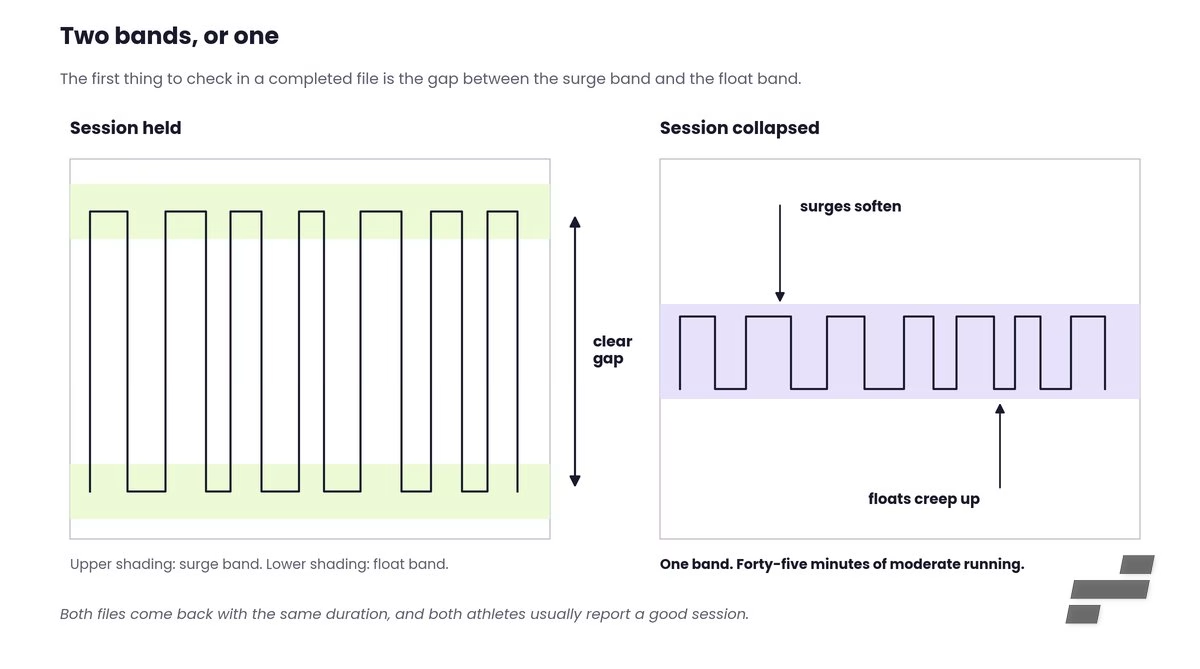
A deliberately moderate run and a collapsed one are easy to confuse and look different in the file. The moderate version still shows two bands. They sit closer together and lower down the range, but the contrast is there and it is consistent from the first surge to the last. A collapsed run shows one band with texture in it, and the surges and floats drift toward each other as the run goes on. The first is a base session doing its job. The second trained neither side and added a hard-ish day to the week.
The direction of the collapse says which correction to make. Floats drifting upward point to an athlete who cannot tolerate feeling slow. Surges fading toward tempo effort point the other way, toward a runner pacing to survive rather than committing to each effort, and the fix is fewer surges with real intent.
What the Pattern Says About the Athlete
The self-selected pattern carries diagnostic weight beyond the single run. An athlete whose surges cluster in the first twenty minutes and vanish afterward is showing how they race: eager early, absent late, the training-file version of a positive split. One whose ten surges all come out at 45 seconds, when the instructions said 30 seconds to 3 minutes, has rebuilt the structure it was written to remove. That usually means running without targets still feels unsafe. Neither needs confrontation. Ask the first athlete for their three strongest surges in the final fifteen minutes, and give the second a route where terrain decides surge length instead of habit.
A prescribed fartlek gets read differently, because the shape was already fixed. The question there is whether the surges held their effort across the full set and whether the floats were still honest on the last one. Say the first three surges separate cleanly and the last three sit barely above float pace. That is a dose problem rather than a judgment problem, and the answer is fewer reps, or a slower float.
For coaches reviewing remotely, this makes fartlek unusually informative. A structured session mostly reports whether the targets were hit. A fartlek reports what an athlete does when nobody is deciding for them.
What Fartlek Training Doesn’t Cover
True maximal velocity sits outside what the format can deliver. Top-end speed develops through short all-out efforts with recoveries long enough that each rep starts fresh, often several minutes of walking for fifteen seconds of sprinting. The jog float, the feature that makes a fartlek valuable everywhere else, guarantees those conditions never occur. Surges that begin on partly loaded legs cap out well below an athlete’s actual maximum, so the ceiling itself never gets touched. That work belongs to dedicated sprint sessions and short hill sprints, programmed with the full recoveries they require.
The other limit applies only to the loosely written version. Raising the lactate threshold depends on accumulating time inside a fairly narrow intensity band. An athlete choosing their own surges spends the run crossing that band rather than sitting in it. The answer is to write it more tightly rather than to reach for a different format. That is why the fixed surge and float belongs in the threshold conversation and the free-form version does not. Our guide to threshold running workouts covers the dose side of that.
Holmér worked this way himself. His weeks combined fartlek with repeat track sessions, tempo runs, and time trials rather than leaning on speed play alone. A coach would arrive at the same arrangement today, for different reasons.
Where Fartlek Leaves the Athlete
An athlete who has run a season of honest fartleks arrives at a race with the gear change already familiar. The surge over a crest, the response when someone moves, the decision to press with two kilometers left: each has been practiced under continuous load enough times to be recall rather than improvisation. The coach’s work happened earlier, in how the run was written and in the review of the file that came back.
Effort-based sessions still need honest oversight, and the training log is where that happens. EndoGusto prices every session by time in zone through ECOs, so a fartlek that flattened into moderate running registers a different load profile than one with real surges and real floats. The coach sees what the week actually cost, adjusts the next session, and keeps the athlete tracking toward the race they are building for.

Keep Every Fartlek Honest With EndoGusto
Suggested References
- Billat, V. L., Slawinski, J., Bocquet, V., Demarle, A., Lafitte, L., Chassaing, P., & Koralsztein, J. P. (2000). Intermittent runs at the velocity associated with maximal oxygen uptake enables subjects to remain at maximal oxygen uptake for a longer time than intense but submaximal runs. European Journal of Applied Physiology, 81(3), 188–196. https://doi.org/10.1007/s004210050029
- Dubouchaud, H., Butterfield, G. E., Wolfel, E. E., Bergman, B. C., & Brooks, G. A. (2000). Endurance training, expression, and physiology of LDH, MCT1, and MCT4 in human skeletal muscle. American Journal of Physiology: Endocrinology and Metabolism, 278(4), E571–E579. https://doi.org/10.1152/ajpendo.2000.278.4.E571
- Menzies, P., Menzies, C., McIntyre, L., Paterson, P., Wilson, J., & Kemi, O. J. (2010). Blood lactate clearance during active recovery after an intense running bout depends on the intensity of the active recovery. Journal of Sports Sciences, 28(9), 975–982. https://doi.org/10.1080/02640414.2010.481721
- Renfree, A., Casado, A., Pellejero, G., & Hanley, B. (2020). More pace variation and pack formation in successful world-class 10,000-m runners than in less successful competitors. International Journal of Sports Physiology and Performance, 15(10), 1369–1376. https://doi.org/10.1123/ijspp.2019-0852
- Schatzle, J., Jr. (2002, November). Finding fartlek: The history and how-to of speed play. Running Times. https://www.runnersworld.com/advanced/a20816077/finding-fartlek/