Running Periodization: The Structural Decisions Behind an Effective Training Plan

Put two training plans side by side for the same athlete, the same race, the same seventeen weeks. Both read base, build, peak, taper, in that order, with the week counts penciled underneath. On paper they are the same plan. Line up the actual training and they can agree on almost nothing: different long-run progressions, a different week for the first threshold session, different weekly load, a different rule for when to push and when to ease off.
This gap is where running periodization actually lives. The phase names are the part anyone can see, which is why they get mistaken for the plan. They are only labels for stretches of time, and that makes them the easy part. A template can generate them. Software can suggest a structure. What no template or algorithm can do is look at one specific runner and judge how many weeks of base they actually need, whether a block landed or only tired them out, how deep to cut a down week, or when a plan that made sense in January has stopped fitting the athlete in front of you. Those are coaching decisions, and they come from knowing the athlete.
This article is about those decisions. Four of them sit under every plan: how long each phase runs, what order the workouts enter, how to read whether a block landed, and how to rebuild when the season breaks it. Make them well and the plan does what a coach built it to do, bring the athlete to peak on the day it matters.
Key Takeaways for Coaches
- Phase length is arithmetic rather than a template: reserve the taper first, then divide the remaining weeks into blocks whose length comes from the athlete’s load-to-deload rhythm.
- A mesocycle runs three to five weeks because that is the loading rhythm plus its down week, and past about four weeks on a single emphasis two shorter blocks outperform one long one.
- Running workouts enter a block in a deliberate order, from general aerobic work toward race-specific intensity, with light speed maintained throughout.
- A block has done its job when three lab-free signals show up: easy pace drifting down, faster recovery between hard days, and a quality session that felt repeatable.
- The peak block flows straight into the taper with no down week between them, since stacking a deload on top of a taper unloads the athlete twice and strips fitness the taper is meant to sharpen.
- A disrupted plan is repaired by re-entering at the phase the athlete’s current fitness supports, and a compressed runway is paid for out of early base rather than out of race-specific work.
What Running Periodization Actually Decides
Running periodization is the practice of dividing a training year into phases, each with a defined length, workout emphasis, and progression, so that fitness arrives on a chosen date rather than at random. The phases give the plan its shape. The decisions inside them, how long each one runs and how the work escalates, are what actually deliver the peak on time.
The vocabulary is worth compressing so we can move past it. A macrocycle is the whole stretch from now to the goal race, often twelve to twenty-four weeks. A mesocycle is a block within it, usually three to five weeks, built around one emphasis. A microcycle is a single week. Those three words describe scale, not strategy. Knowing that a mesocycle is four weeks long tells you nothing about what belongs inside it.
Strategy lives in four decisions: how long each phase runs, what order the training enters, how to read whether a block landed, and how to repair the plan when the season breaks it. Thinking through each phase with these four in mind is what turns a labeled plan into one that brings the athlete to peak on time. The rest of this article takes them in order.
Decision One: How Long Each Phase Should Be
Phase length is the first real decision and it falls out of four things working together: the taper the race demands, the loading rhythm the athlete can sustain, the balance the distance requires, and how much training history the athlete is standing on.
Reserve the Taper First, Then Divide What Is Left
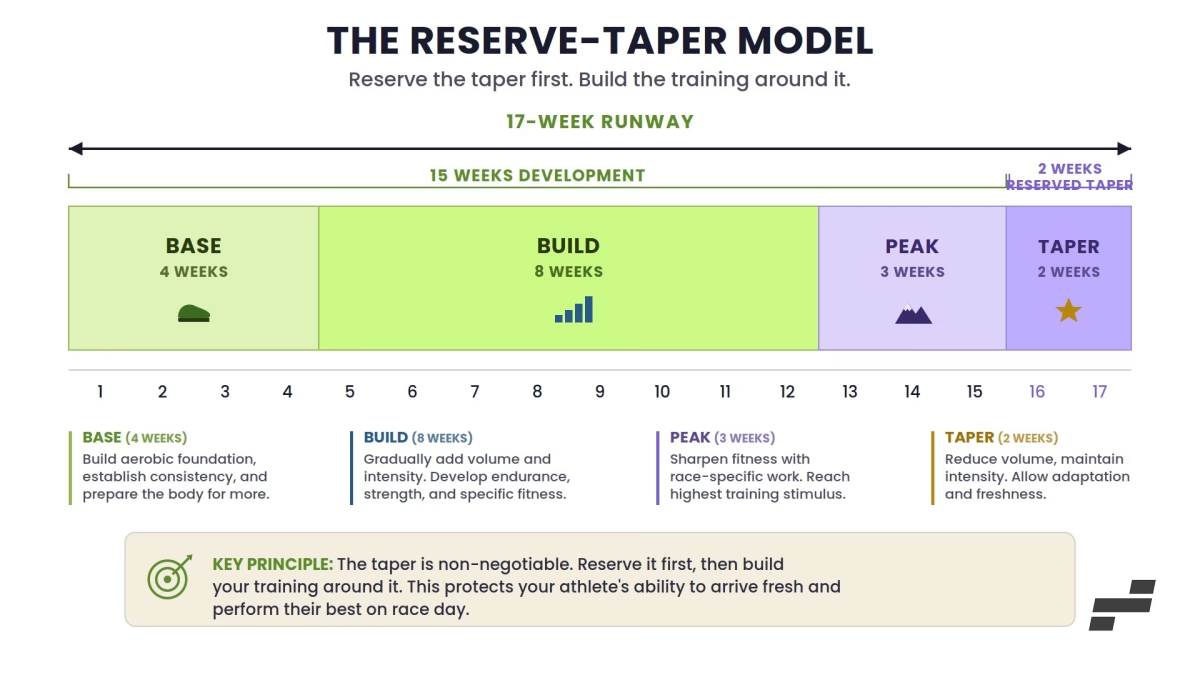
The taper is not what happens to be left at the end of the calendar. It is the one block whose length is known before anything else about the plan, so it comes out first. Subtract it from the weeks remaining, and what is left is the development runway that base, build, and peak have to share.
The length itself is well mapped. Bosquet et al. (2007) pooled twenty-seven studies and found the pooled optimum was a two-week taper that cut training volume by 41 to 60 percent while holding intensity and frequency steady, decaying progressively rather than dropping in a single step. A 2023 endurance-specific meta-analysis extended the workable window to roughly twenty-one days on the same terms. The practical read is to scale within the range by distance: two weeks for a 5K or 10K, three for a half marathon or marathon, fixed before the rest of the plan exists.
Reserving it first also protects it. When the taper is treated as the remainder, it is the block that absorbs every scheduling problem upstream, and it shrinks in exactly the weeks an athlete most needs it intact.
Block Length Is the Loading Rhythm Plus Its Down Week
The mesocycle is described as three to five weeks so often that the number looks arbitrary. It is not. A block is a run of loading weeks followed by one down week, so its length is the loading weeks plus the down week. A 2:1 rhythm gives three-week blocks, 3:1 gives four, and 4:1 gives five. Rather than choosing the block length, you choose the rhythm.
Loading rhythm scales with training age, and the guidance is reasonably consistent across sources. Cejuela and Esteve-Lanao (2019) set 2:1 for newer athletes, for shorter or more intensive events, and for open-ended cycles with no race attached, and 3:1 for more experienced athletes carrying higher volume. Masters runners tend to do better held at 2:1 regardless of experience, since the recovery cost of a third straight loading week climbs faster than the fitness return as an athlete ages.
One more rule shapes the count. Past roughly four weeks on a single emphasis the returns fall off enough that two shorter blocks beat one long one. A ten-week aerobic phase is therefore Base 1 and Base 2, each with its own emphasis and its own down week, not one ten-week slab labeled base.
Race Distance Sets the Base-to-Specific Ratio
The longer the race, the more of the runway belongs to aerobic development, and the less of it can be spent on race-specific sharpening. This is not a preference; it follows from what each event demands. A 10K is run close to threshold, so the specific work that matters can occupy a large share of the build. A marathon is run well below threshold for hours, so the quality that decides it is aerobic durability, and durability is built slowly across volume rather than quickly across intervals.
Across the distances the preparation phase generally holds two thirds to three quarters of the macrocycle, and the distance decides how that share is weighted. For a 10K, base can be relatively short and the specific phase long and rich, because the race rewards sharpening a system the athlete already mostly has. A marathon inverts it: base and the long-run progression take most of the runway, and the marathon-pace block is comparatively short because it sits on top of everything else rather than replacing it.
Training Age Sets the Ramp and the Ceiling
The athlete’s history changes the math in a way distance alone cannot. A runner in their third consistent season is re-expressing fitness they have built before. A first-year runner is constructing it from nothing. Issurin’s work on residual training effects explains why those two jobs run on different clocks: aerobic endurance carries a residual of roughly thirty days, give or take five, which is the longest of any trainable quality. The returning runner is reawakening something that never fully left. The base training timeline breaks down which adaptations arrive fast and which stay slow.
The scheduling consequence is the part that matters here. Connective tissue, meaning tendon, ligament, and bone, adapts far more slowly than the cardiovascular system, and only very prolonged loading produces meaningful structural change (Kjaer et al., 2009). That lag is what caps the ramp. A novice’s heart and lungs will green-light more mileage weeks before the Achilles can survive it, so their base phase has to run longer and climb slower, not because the engine needs it but because the chassis does.
Training age also moves where the climb starts. On a runway of sixteen weeks or more there is room to open near half of peak weekly volume and rise gently. On a runway under ten weeks the plan has to start closer to two thirds of peak, because the same climb has fewer weeks to happen in. Short runways are not gentler versions of long ones. They start higher and they have less margin.
Coaching tip: The familiar guardrails on the rate of climb are worth holding loosely for runners. The ten percent rule and Gabbett’s (2016) acute-to-chronic workload ratio, which keeps weekly load in roughly the 0.8 to 1.3 range and flags anything above 1.5, both come from work where weekly totals predicted injury well. In running specifically, Nielsen and colleagues at Aarhus found that a single oversized session, a run more than about ten percent longer than the longest run of the previous month, predicted overuse injury better than any gradual weekly measure. The practical read is to watch the long run as closely as the weekly total, because that is where the spike usually hides.
Decision Two: The Order Workouts Enter the Block
Every plan contains roughly the same ingredients: easy running, long runs, threshold work, faster intervals, strides. The decision is not which of these to use. It is the order they arrive in, and the order is not arbitrary. It runs from the most general quality to the most race-specific, because each stimulus needs the one before it as a platform.
The Funnel Runs From General to Specific
The funnel starts wide. Easy aerobic running and the long run come first and stay throughout, because they build the delivery system every harder session draws on. A threshold session on an underbuilt aerobic base produces fatigue without much adaptation, since the athlete cannot clear the load fast enough to repeat the quality.
Threshold work enters next, once easy volume has raised the ceiling it pushes against. Threshold sits at the edge of sustainable effort, so it develops the athlete’s ability to hold strong paces longer. It is the bridge quality: aerobic enough to build on base, specific enough to prepare for what comes after. Introducing it after a few weeks of consistent easy volume means the athlete has the clearance capacity to absorb it rather than drowning in it in week one.
Race-specific intervals come last, closest to the goal race, because they are the sharpest and least sustainable stimulus. They cost the most and hold the shortest. Placed early, their benefit fades before race day and their fatigue crowds out the base-building that should still be happening. Placed late, they sharpen a system that is already built, which is exactly their job.
The Distribution Changes Shape, Not Just Sessions
The funnel is easier to hold in mind as a change in the shape of the week rather than a list of sessions swapping in and out. Early in a periodized running training block the distribution is pyramidal: a broad base of easy volume, a moderate slice of threshold, and a thin sliver of anything faster. As the race approaches, that shape drifts toward something more polarized, with the middle thinning and the hard end sharpening while the easy base stays broad underneath.
For most amateur runners the pyramid is the right default for most of the year. The drift toward polarized belongs near the race, and in short blocks where there is no time to build breadth and the plan has to work with what is already there. Pyramidal and polarized are two of several named intensity models, and they are a fuller subject in their own right; there is a separate rundown of periodization models in endurance sports for anyone who wants them laid out side by side.
Speed Is the Exception That Proves the Logic
Short strides and light speed maintenance do not belong to one phase. They thread through the entire block, from base to taper, in small doses. The reason is neuromuscular: keep the fast-twitch recruitment patterns lightly active all along, and the race-specific phase has something to sharpen. Drop them entirely during base and the athlete arrives at that phase having to rebuild coordination before they can develop it.
Coaching tip: Strides are not a speed workout. They are insurance against losing speed while you build everything else. Two to four times a week, a handful of fifteen to twenty second relaxed accelerations after an easy run keeps the neuromuscular door open without adding meaningful fatigue. The athlete who runs strides through base reaches the sharpening phase ready to sharpen rather than ready to relearn.
The order is not a rule to memorize. It is a consequence of one principle: each stimulus should land on ground the previous one prepared, moving from the quality the athlete can build the most of to the quality that costs the most and keeps the least.

Decision Three: Reading Whether a Block Worked
A mesocycle ends. The calendar says advance to the next phase. The calendar does not know whether the athlete absorbed the block or simply endured it, and advancing on a block that did not land stacks hard work on an incomplete adaptation. The job at the end of every block is to read the athlete rather than the date, and to decide among three moves: progress, repeat, or deload.
The Three Signals a Block Landed
None of these requires a lab. The first is easy pace drifting down at the same effort. When the athlete covers more ground at the same heart rate they held three weeks ago, the aerobic system responded, and it responded at the exact intensity the block was built around.
The second is recovery speeding up between hard days. When the athlete bounces back from a quality session needing one easy day where they used to need two, their capacity to handle load has risen. That faster turnaround is what lets the next block carry more, and it usually shows before any pace gain does.
The third is a quality session that felt repeatable rather than maximal. When the last threshold workout of the block ends with the athlete thinking they had one more rep in them, the stimulus has moved inside their range. A session that still feels like a ceiling has not been absorbed. It is still the hard edge, not the new floor.
Read together, the three point to the move. All present: progress, and build on what landed. None present, with the athlete flat and heavy: the block did not land, and the answer is usually a down week rather than more work. Mixed: repeat the emphasis for a week or two and reread. The plan is a hypothesis, and these signals are the data.
Common mistake: Progressing on the calendar instead of the athlete. The plan says base ends Sunday, so Monday starts intervals regardless of whether the base actually built. That is how a sharpening phase gets stacked on a foundation that never set, and why the athlete comes apart late in the build. A five-minute read of the three signals before every phase transition is usually enough to catch it.
How Deep the Down Week Goes
The rhythm already places the down week; a 3:1 block deloads in week four whether or not anything has gone wrong. What the rhythm does not decide is how deep the cut goes. The working number is about twenty percent off the block’s hardest week, which sits comfortably inside the fifteen to thirty percent range the literature supports. Cejuela and Esteve-Lanao (2019) frame it as a reduction from the maximum the athlete tolerated in that block, which is a more useful anchor than a fixed weekly figure, since it scales with what the athlete actually did rather than what the plan assumed. The scheduled deload is the default, but it is not the only one: when the signals above show an athlete flat and heavy ahead of schedule, that is the cue to drop in an extra down week the rhythm did not plan for.
The depth should also track the intensity of what preceded it. A base block built on easy volume clears with a modest cut. A build block loaded with threshold and race-specific work needs more, and coming out of that kind of block a twenty percent trim often leaves the athlete still carrying fatigue into week one of the next block. Cut deeper after the harder block, and hold the intensity while cutting the volume, so the down week sheds fatigue without also shedding sharpness.
When a Dip Is the Point, and When It Is Not
There is a harder read at the end of a deliberately tough block, because productive fatigue and genuine trouble look similar from the outside. Both show up as heavy legs and slightly worse numbers than the week before. The difference is where the line sits, and it is easy to cross.
The distinction matters more than it appears to. In a study of trained endurance athletes, one group was pushed hard enough during an overload phase to tip into functional overreaching, showing a measurable drop in performance and high fatigue by the end. A second group did the same intensified training but stopped short of that state, staying merely fatigued. After the taper, the group that never tipped over supercompensated more, ending up fitter than the overreached group (Aubry et al., 2014). The overreaching was not the goal that paid off later. It was the line you would rather not have crossed.
That reframes what to make of a rough final week. When an athlete hits the last loading week of a hard block heavy and a little slower, the deload that follows is the test. If a few easy days clear it and the numbers come back, the fatigue was productive and the block did its job. If the athlete is still flat after the down week, they pushed past the productive zone, and that is the signal to review the rest of the plan. Fatigue that lifts in a few easy days is the block working; fatigue that outlasts the deload is a warning.
Why the Peak Block Runs Straight Into the Taper
The same finding settles a structural question that plans often answer by reflex. If every other block ends in a down week, it seems consistent to end the peak block the same way and then start the taper. In practice that produces a double unload. The athlete spends one week shedding load, then two or three more shedding still more, and arrives at the start line having lost fitness the taper was meant to reveal.
The cleaner structure is to let the overload feed directly into the taper, which is how Mujika and Padilla (2003) and Bosquet et al. (2007) describe it. The taper does the recovery work a down week would have done, and it does it while holding intensity, so sharpness survives the process. The peak block therefore carries loading weeks only.
That has one consequence worth planning for. If the peak block runs its full length as continuous load, it carries one more consecutive loading week than any other block in the plan, and Aubry’s finding says exactly what that costs. Cap the peak block’s loading run at the same number of consecutive weeks every other block carries. At a 3:1 rhythm that means a three-week peak of loading weeks, then straight into the taper.
Decision Four: Repairing a Plan the Season Broke
No macrocycle survives contact with a real athlete’s life. Someone gets the flu in week seven. A tweaked calf turns one week into three. A work trip fragments a build week into four days of hotel treadmills. The plan on the page assumed none of that would happen, and now it has. The decision is not whether to adjust. It is whether to adjust on purpose or let the disruption make the choice.
The repair principle is simple to state and easy to forget under deadline pressure: re-enter at the phase the athlete’s current fitness supports, not the phase the plan says they should be in. Fitness does not track the calendar. It tracks what the athlete has actually absorbed. Four patterns cover most of what goes wrong.
The Missed Block, Usually Illness
A week or more fully off means some detraining has happened, and the fastest-fading adaptations go first. The re-entry is not the phase you left. It is a short rebuild bridging back to it. Drop to easy volume for several days, watch for the readout signals to turn back the right way, easy pace drifting down, recovery quickening, sessions feeling repeatable, and only then resume the interrupted emphasis. Picking up mid-build where an interval block left off, on a system that has spent a week detraining, is how a returning athlete gets hurt in their first week back.
The Compressed Runway, Usually a Late Injury
Here the problem is not lost fitness but lost time. The goal race has not moved, and there are fewer weeks to reach it. The move is to protect the most race-specific work and sacrifice from the general end. A marathoner who loses three weeks does not cut marathon-pace work to preserve base. They trim base, because the specific block is what the race is decided on and the base is mostly built by that point.
This is the same rule that governs an uneven runway at build time, which is worth noticing because it means one principle covers both. When the development weeks do not divide evenly into blocks, the shortfall comes out of the earliest block rather than being spread across all of them. Early base absorbs the loss in both cases.
There is a floor to this, though. Once the remaining weeks are fewer than the taper the race needs, there is nothing left to compress and the honest answer is that the whole runway becomes a descent. A marathon two weeks out is two gently declining weeks. It is never a peak week followed by a truncated taper, because there is no longer time to absorb what a peak week would cost.
The Fragmented Week, Usually Travel
This one barely counts as a break if it is handled right. The athlete cannot hit the planned volume or the key session, but they can keep the aerobic system ticking and run strides to hold neuromuscular sharpness. Treat the fragmented week as a maintenance microcycle, accept that it will not advance fitness, and resume the progression the following week without trying to make up the lost load. Cramming the missed quality into the week after is how one lost week becomes two.
The Race That Appears Mid-Plan
The most common disruption is not illness at all. It is an athlete who signs up for something. The useful move here is to price the race by priority before touching the plan, using the same A, B, and C convention the season was built on.
A C race is a marker. It goes on the calendar in place of that day’s session, and nothing else changes. A B race is worth arriving at reasonably fresh, so it earns a short freshening of a few days, or the athlete trains through it and treats it as a fitness check. An A race is the only one that reshapes anything: it needs its own taper, and if the original A race is still on the calendar, the plan has become a two-peak season and needs to be built as one.
The grading is also where the coaching actually happens, because the athlete rarely does it honestly on their own. Left to their own enthusiasm, most runners want to race every start line at their best, which quietly turns a running periodization plan built around one A race into four A races in six weeks. The cost of that is real and mostly invisible until it arrives: each true peak demands its own taper and its own recovery, and stacking them means none of them lands. Protecting the athlete from that is the coach’s job, and it is done in conversation, walking them through the trade offs before the calendar fills, so the priorities reflect what the body can actually deliver rather than what the athlete wants to be true.
The Four Decisions on One Plan

The four decisions are not separate checklists. They compound. Phase length sets the frame, sequence fills it, the readout governs movement through it, and repair handles what breaks.
Take a seventeen-week half marathon for an intermediate runner with three seasons behind her. The arithmetic runs one way. Reserve three weeks for the taper, leaving fourteen development weeks. At a 3:1 rhythm the blocks are four weeks long, four of them would need fifteen weeks, so the odd week comes out of the earliest block. Base 1 gets three weeks. The table shows where every other number comes from.
| Phase | Weeks | Length chosen because | Advance when |
| Base | 4 | Half-marathon needs a solid aerobic runway, but three seasons of durability support one base cycle | Easy pace drifts down at held heart rate; recovery between runs quickens |
| Build | 8 | Long enough to layer threshold onto base, then race-specific tempo onto threshold, in sequence | Threshold sessions finish repeatable, not maximal; the athlete could hold the pace longer |
| Peak | 3 | Race-specific work sharpens a system already built; more than three weeks blunts rather than sharpens | Goal-pace segments feel controlled; no lingering fatigue from the build |
| Taper | 2 | Enough to clear accumulated fatigue at this distance without losing sharpness | Race day |
The point is the last column. Every phase advances on a signal, not a date, which is what decides whether the plan delivers its peak or just runs its length.
Running Periodization Is the Decision Layer
Four decisions decide whether a plan works. How long each phase runs, once the taper is reserved and the rhythm chosen. What order the work enters, from broad aerobic base to sharp race-specific edge. How to read whether a block landed before building on it. How to repair the plan when the season breaks it. None of them shows up in the phase names, and making those decisions well is the difference between running a plan and coaching one.
Put the Four Decisions to Work in EndoGusto
Every decision in this article is one the plan has to hold: the phase lengths, the order, the down weeks, the repairs when the season interferes. The Training Arc in EndoGusto is built to carry them. Lay out a season or a short block, and the Arc shapes the phases to the runway, then stays editable as the four decisions play out in real training, so adjusting a block or re-entering after a lost week is a change you make on the plan, not a rebuild from scratch. Training load tracks alongside it, so you can see how the athlete is actually responding as you go.

Coach the Plan, Not the Calendar
Suggested References
- Aubry, A., Hausswirth, C., Louis, J., Coutts, A. J., & Le Meur, Y. (2014). Functional overreaching: the key to peak performance during the taper? Medicine & Science in Sports & Exercise, 46(9), 1769–1777. https://doi.org/10.1249/MSS.0000000000000301
- Bosquet, L., Montpetit, J., Arvisais, D., & Mujika, I. (2007). Effects of tapering on performance: a meta-analysis. Medicine & Science in Sports & Exercise, 39(8), 1358–1365. https://doi.org/10.1249/mss.0b013e31806010e0
- Cardona, C., Cejuela, R., & Esteve-Lanao, J. (2019). Manual para Entrenar Deportes de Resistencia. All In Your Mind Training System.
- Gabbett, T. J. (2016). The training-injury prevention paradox: should athletes be training smarter and harder? British Journal of Sports Medicine, 50(5), 273–280. https://doi.org/10.1136/bjsports-2015-095788
- Issurin, V. B. (2010). New horizons for the methodology and physiology of training periodization. Sports Medicine, 40(3), 189–206. https://doi.org/10.2165/11319770-000000000-00000
- Kjaer, M., Langberg, H., Heinemeier, K., Bayer, M. L., Hansen, M., Holm, L., Doessing, S., Kongsgaard, M., Krogsgaard, M. R., & Magnusson, S. P. (2009). From mechanical loading to collagen synthesis, structural changes and function in human tendon. Scandinavian Journal of Medicine & Science in Sports, 19(4), 500–510. https://doi.org/10.1111/j.1600-0838.2009.00986.x
- Mujika, I., & Padilla, S. (2003). Scientific bases for precompetition tapering strategies. Medicine & Science in Sports & Exercise, 35(7), 1182–1187. https://doi.org/10.1249/01.MSS.0000074448.73931.11