Running Injury Prevention: The Training Variables That Signal Rising Risk Early
Most runners already know the core rule of running injury prevention: don’t do too much, too soon. Overuse injuries mostly come from load arriving faster than tendons, bones and the tissue around the joints can adapt to it.
The catch is that “too much” covers more than distance. A first track session of the season adds load. So does a new pair of carbon-plated shoes, a hillier route after a move, or three weeks of shortened sleep during a busy stretch at work. None of these show up in the weekly mileage total. The track session and the new shoes put extra work through the calves and Achilles, and the hills through the calves on the way up and the quads on the way down. The lost sleep leaves less time for the body to repair any of it.
They usually show up in your training before they show up as pain. Your usual easy pace takes a higher heart rate. Muscle soreness that normally fades within a day is still there on the third. One spot feels stiff in the morning and loosens after ten minutes of running. Acting at that stage usually means changing a session or two, while acting once pain arrives can mean weeks off.
What follows covers which training variables tend to change before an overuse injury, how to read them together, and how to prevent running injuries by adjusting your training when they do.
Key Takeaways
- A previous injury is the strongest predictor of the next one, so tightness in a previously injured spot is a reason to back off sooner than the same tightness elsewhere.
- A higher heart rate at your usual easy pace, two or more weeks of sleeping under seven hours, and soreness that lasts longer than usual tend to appear before pain does.
- Load is more than distance: faster sessions, new shoes, hills, trails and the track each add work for specific tissues, such as the calves and Achilles on hills and the track.
- Adding faster running and more distance in the same week brings two new kinds of stress at once, so changing one thing at a time is the simplest way to avoid running injuries during a build.
- Soreness that fades in the warm-up is normal, pain in one spot means removing the latest change, and pain that builds during a run means stopping.
Why Am I So Prone to Running Injuries?
Most runners who get hurt repeatedly have one or more of three things going on. They have been injured before, which is the strongest single predictor of the next injury. Their training load is rising faster than their tendons and bones can adapt, often through a change other than mileage. Or they are recovering less between runs because of poor sleep, high life stress or not eating enough for the training. Often it is two of these at once.
Injury History Is the Strongest Signal
A systematic review of 29 prospective studies by van Poppel and colleagues (2021) found that a previous running-related injury was the strongest risk factor for long-distance runners. An earlier review by Saragiotto and colleagues (2014) reached the same conclusion for an injury in the previous 12 months. Neither review could say why. Incomplete healing, a change in how the runner moves afterward, and strength lost around the old injury are all plausible, and the research hasn’t separated them.
For running injury prevention, that means the spot that was hurt last time is the first one to back off for. If a calf tore last spring, tightness in that calf deserves an earlier response than the same tightness on the other side.
Why Some Runners Rarely Get Hurt
Runners who stay healthy for years are rarely immune. Instead, they tend to train consistently, so their tissue keeps what it has built rather than losing some of it during long gaps. They also avoid adding several new things in the same week, and they shorten or drop a session when a warning sign appears rather than running through it.
Single sessions matter as much as weekly totals here. Base Training explains how one long run can spike injury risk even when the week looks reasonable. Newer runners’ tendons and bones have had the least time to adapt, which is why a beginner half marathon plan that caps weekly jumps builds in small steps.
Running Injury Prevention Starts Before Anything Hurts
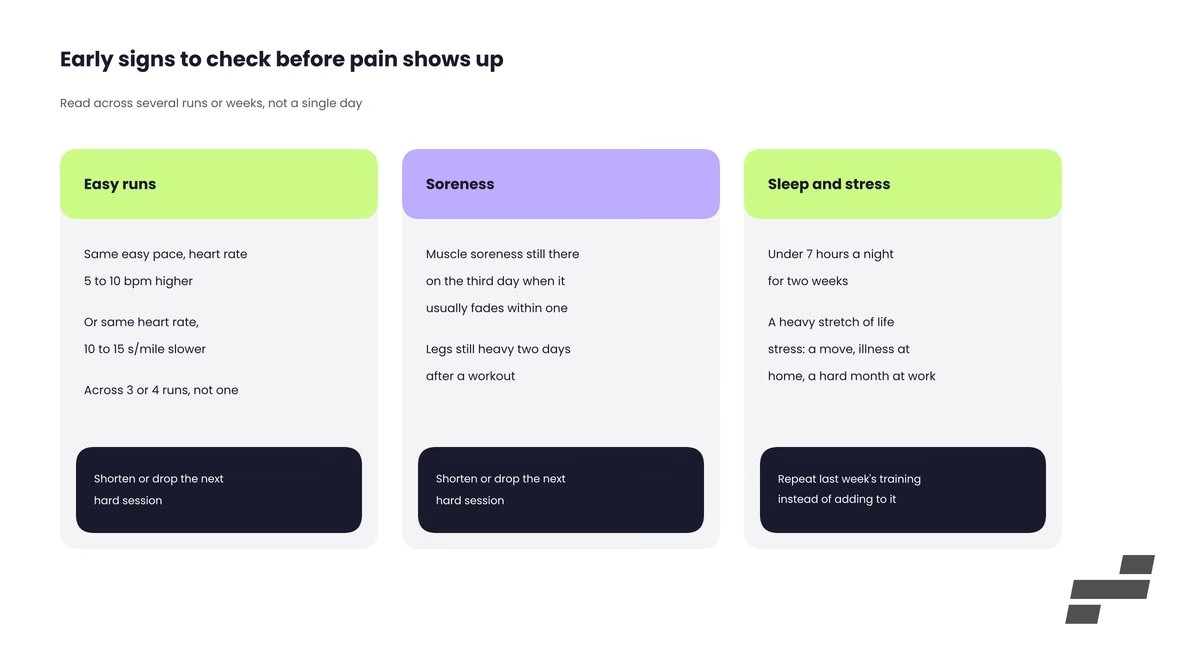
Most overuse injuries build over days or weeks before they hurt. During that stretch, the warning signs show up in three places you can check yourself: heart rate and pace on easy runs, how long soreness lasts, and your sleep and stress over the past couple of weeks.
Heart Rate and Pace on Easy Runs
Easy runs make the most useful running injury prevention gauge because you run them often and at a known effort. Compare like with like, on a similar route and in similar weather. Your usual easy pace may now take a heart rate 5 to 10 beats per minute higher, or the same heart rate may give a pace 10 to 15 seconds per mile (6 to 9 seconds per kilometer) slower. Across three or four runs rather than one, either shift means fatigue from the last few weeks hasn’t cleared. Legs that still feel heavy two days after a workout, when they would normally have recovered by then, point the same way.
Goldberg and colleagues (2025) followed 339 runners weekly for six months. Muscle soreness was higher in the two weeks before an injury was reported, and fatigue in the week before. So when three or four easy runs in a row show these signs, shorten or drop the next hard session rather than running it as planned.
The gauge only works if easy runs stay easy, though. Pace creeping up on easy days adds load of its own, and the guide to easy running covers how to keep those days at the right effort.
Sleep and Life Stress Across Weeks
Johnston and colleagues (2020) tracked 95 endurance athletes for a year. Sleeping under seven hours a day across a two-week window was linked to a 51% higher risk of a new injury, while sleeping more than seven hours was linked to lower risk. The study measured sleep across two-week windows, so the pattern to watch is a run of short nights rather than one bad night.
Life stress matters for running injury prevention in a similar way. Across sports, a meta-analysis by Ivarsson and colleagues (2017) found that negative life events and a strong stress response had the clearest links to injury among the psychological factors studied. That means a house move, a sick child or a heavy month at work can raise injury risk even when the training itself hasn’t changed.
So after two weeks of short sleep or high stress, repeat the previous week’s training instead of adding to it. Whether a single day’s run should become a rest day is a separate call, covered in when an easy day should become a rest day.
Load That Isn’t Mileage
Two 30-mile (48 km) weeks are not the same if one of them includes the first track session of the season or a hilly long run. The extra work goes into specific tissues, and the mileage total doesn’t show it.
Speed and Distance Rising Together
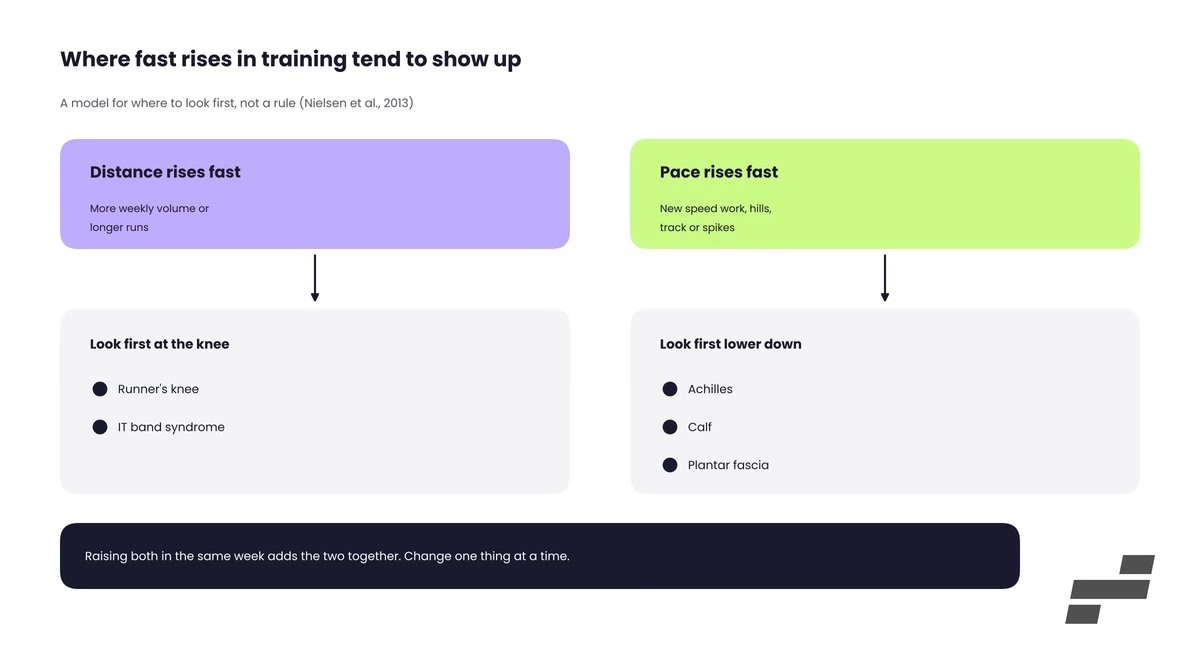
Speed and distance load the body in different places. Nielsen and colleagues (2013) proposed that fast rises in distance tend to show up at the knee, while fast rises in pace tend to show up lower down, at the Achilles, calf and plantar fascia. A later trial didn’t confirm that split cleanly, so it works best as a model for where to look first rather than a rule.
That trial, Run Clever (Ramskov and colleagues, 2018), had 447 runners build either the amount of fast running or their total volume over 16 weeks. Injury rates were similar in both groups. The authors also noted that small changes accounted for a considerable share of injuries, and that the interaction between training variables needs more attention. In other words, building either one carries risk, and building both in the same week adds the two together.
The most practical rule in running injury prevention is to change one thing at a time. In a week that adds a new kind of session, such as race-pace work, hills or the track, hold the long run and the weekly volume flat. Running Periodization covers load guardrails such as the 10% rule for the weeks where volume is the thing that moves.
New Shoes, Surfaces, Hills and the Track
Every new surface or piece of equipment shifts load onto a different structure. Uphill running loads the Achilles and calves, while downhill running loads the quads as they brake each step. Track bends load the two legs unevenly, and spikes move more of the work to the calves. Similarly, on trails the ankles and feet adjust to uneven ground with every step, which they rarely do on the road.
Shoes count too. Tenforde and colleagues (2023) described five runners who developed navicular bone stress injuries, a high-risk type of stress fracture in the midfoot, after switching to carbon-plated shoes. A case series can’t show the shoes caused it. Even so, it makes a sensible case for starting with strides and part of one session before wearing them for a full workout.
Variety can help as well. Malisoux and colleagues (2015) followed 264 recreational runners and found that those who rotated more than one pair of shoes had 39% lower injury risk. Because it was an observational study, rotation is a reasonable option rather than a requirement.
For running injury prevention, the approach to all of these is the same: one new element at a time, introduced gradually. That means hills once a week before twice, or new shoes for one run in three before every run. Calf strength is worth building before hills, speed or spikes arrive, since the calf and Achilles take most of that extra load.
Soreness or Pain? How to Prevent Running Injuries From Growing
Soreness is a normal response to training, spread across the muscles that did the work. Pain usually sits in one spot on one side, and it means one tendon, bone or joint is taking more load than it can currently handle. In running injury prevention, telling them apart is how you decide whether to keep the plan, change it or stop.
Physical therapists often use a pain-monitoring approach with runners coming back from tendon problems. In the Achilles trial by Silbernagel and colleagues (2007), patients kept running as long as pain stayed at or below 5 on a 0 to 10 scale. The pain also had to settle by the next morning and not build from week to week. They did as well as patients who stopped running for the first six weeks. That model was built for a diagnosed injury, however. For a healthy runner deciding what to do about a new ache, a stricter version fits better.
| Response | What it usually feels like | What to do |
| Keep | General soreness, often in both legs, that eases during the warm-up and is gone within 48 hours | Carry on with the plan |
| Change | One spot on one side, up to 3 out of 10, settled by the next morning | Remove the most recent change (a new session, shoes, route or extra distance) and hold for a week |
| Stop | Above 3 out of 10, building as the run goes on, worse the next morning, sharp, or a tender spot on a bone | Stop running that day, and get it assessed if it isn’t clearly better within a few days |
In the Change row, removing the latest change rather than resting completely lets the tissue settle while the rest of the training carries on. If the spot is no better after a week, treat it as a Stop. When it isn’t clear which row an ache belongs in, choose the more cautious one.
Common Running Injuries and What Usually Drives Them
The most common running injuries are Achilles tendinopathy, shin splints (medial tibial stress syndrome), runner’s knee (patellofemoral pain), plantar fasciitis and IT band syndrome. A systematic review by Kakouris and colleagues (2021) placed these five at or near the top of both new and ongoing injury counts, with the knee, ankle and lower leg the most often injured areas. All five are overuse injuries, so the same early signals and the same approach to running injury prevention apply to each of them.
Runner’s Knee
Runner’s knee is pain around or behind the kneecap, often worse on stairs, downhills or after sitting for a while. In the speed and distance model above, it sits on the distance side. Hip and glute strength work helps by controlling how the thigh moves under the knee as each foot lands.
IT Band Syndrome
IT band syndrome is pain on the outside of the knee that often starts at a predictable point in a run and builds from there. Like runner’s knee, it sits on the distance side of the model, and downhill running often aggravates it. The same hip work applies.
Shin Splints, Achilles Pain, Plantar Fasciitis and Stress Fractures
Shin splints cause pain along the inner edge of the shinbone and are especially common in newer runners and after a jump in training. Achilles pain and plantar fasciitis sit on the pace side of the model, so new speed work, hills and spikes are the first things to check. A stress fracture usually shows as pain at one point on a bone that gets worse with each run, and it goes straight to the Stop row. Bone stress injuries are also linked to not eating enough to cover training, so a look at fueling belongs alongside a look at the training.
Running Injury Prevention Habits That Support the Training

Managing load does most of the work in running injury prevention. The habits below raise how much load the body can handle, so the same training carries less risk.
Strength Training
Stronger calves, quads and hips handle more running before a tendon or joint becomes painful. The research on strength and running injuries explains why this holds for distance runners. For the practical side, strength training for runners covers how to fit it around a running week, starting with two short sessions.
Mobility and Stretching
Mobility work is worth the time when limited range gets in the way of a position you need, such as bending the ankle on steep hills or hip extension at faster paces. Stretching as general injury protection has weaker support, and the Cool-Down article sets out what the evidence says about stretching after runs. In practice, that means stretching for the range a runner actually lacks.
Foam Rolling
Foam rolling can ease how sore and stiff muscles feel for a short time, which makes it a handy part of a warm-up or a recovery day. It doesn’t change how much load a tendon or bone can tolerate, so in running injury prevention it works alongside load management rather than in place of it.
Balance and Ankle Stability
Running is a long series of single-leg landings, so single-leg control is part of running injury prevention on every run. Balance work trains the ankle and foot to react to uneven ground, which matters most for trail runners and anyone coming back from an ankle sprain. A few minutes of single-leg work before a run, progressed onto softer or unstable surfaces, fits into almost any week.
Shoes, Cross-Training and Form
Choose shoes that feel comfortable while running, and bring in new models gradually as described above. Cross-training adds aerobic work without the impact; in the same Malisoux study, more weekly time in other sports was linked to lower running injury risk. That makes a bike or pool session one of the easier ways to avoid running injuries during a heavy block. Running form is worth changing for a specific, persistent problem, ideally with a professional’s guidance. Even then, a form change is itself a change in load, so it follows the same one-change-at-a-time rule.
Reading These Signals Across a Group of Athletes
For a coach, the pace and heart rate signals come from each athlete’s synced activities, read against that athlete’s own usual easy runs. The rest of the early signals don’t show up in that data. Sleep, life stress, lingering soreness and a stiff spot in the morning reach the coach only when the athlete reports them.
EndoGusto’s daily wellness check-in covers that side. Each morning, athletes answer a short set of questions on 1 to 5 scales and log their hours of sleep. A coach then sees two weeks of short nights, or soreness that hasn’t cleared, as it builds rather than whenever the athlete happens to mention it.
The season plan is the other place to apply running injury prevention across a group. Before a block starts, mark the weeks where each athlete’s new elements arrive, such as a first track session, a hillier goal course or new race shoes. In EndoGusto, the Training Arc lays out the season week by week, and each week’s notes are a natural place to mark them. Spacing those changes across different weeks makes the one-change rule easier to follow. If a spot then flares up, it is clear which change caused it, and the athlete loses a session rather than a training block.

Catch the Early Signals Across Every Athlete
Suggested References
- Goldberg, M., Le Mat, Y., Metra, M., de Sousa, T., Edouard, P., Millet, G. Y., Pairot de Fontenay, B., and Debarnot, U. (2025). Poor sleep quality is associated with an increased risk of running-related injuries: A prospective study of 339 runners over six months. Scandinavian Journal of Medicine and Science in Sports, 35(11), e70164. PubMed
- Ivarsson, A., Johnson, U., Andersen, M. B., Tranaeus, U., Stenling, A., and Lindwall, M. (2017). Psychosocial factors and sport injuries: Meta-analyses for prediction and prevention. Sports Medicine, 47(2), 353–365. PubMed
- Johnston, R., et al. (2020). General health complaints and sleep associated with new injury within an endurance sporting population: A prospective study. Journal of Science and Medicine in Sport, 23(3), 252–257. Repository
- Kakouris, N., Yener, N., and Fong, D. T. P. (2021). A systematic review of running-related musculoskeletal injuries in runners. Journal of Sport and Health Science, 10(5), 513–522. DOI
- Malisoux, L., Ramesh, J., Mann, R., Seil, R., Urhausen, A., and Theisen, D. (2015). Can parallel use of different running shoes decrease running-related injury risk? Scandinavian Journal of Medicine and Science in Sports, 25(1), 110–115. PubMed
- Nielsen, R. O., et al. (2013). Classifying running-related injuries based upon etiology, with emphasis on volume and pace. International Journal of Sports Physical Therapy, 8(2), 172–179. PubMed
- Ramskov, D., Rasmussen, S., Sørensen, H., Parner, E. T., Lind, M., and Nielsen, R. O. (2018). Run Clever: No difference in risk of injury when comparing progression in running volume and running intensity in recreational runners. BMJ Open Sport and Exercise Medicine, 4(1), e000333. Article
- Saragiotto, B. T., Yamato, T. P., Hespanhol Junior, L. C., Rainbow, M. J., Davis, I. S., and Lopes, A. D. (2014). What are the main risk factors for running-related injuries? Sports Medicine, 44(8), 1153–1163. PubMed
- Silbernagel, K. G., Thomeé, R., Eriksson, B. I., and Karlsson, J. (2007). Continued sports activity, using a pain-monitoring model, during rehabilitation in patients with Achilles tendinopathy: A randomized controlled study. American Journal of Sports Medicine, 35(6), 897–906. DOI
- Tenforde, A., Hoenig, T., Saxena, A., and Hollander, K. (2023). Bone stress injuries in runners using carbon fiber plate footwear. Sports Medicine, 53(8), 1499–1505. DOI
- van Poppel, D., van der Worp, M., Slabbekoorn, A., et al. (2021). Risk factors for overuse injuries in short- and long-distance running: A systematic review. Journal of Sport and Health Science, 10(1), 14–28. PubMed