The Running Cool-Down Routine: What the Evidence Actually Supports

For most of the athletes a coach trains, the running cool-down routine is the last thing that is paid attention to and often the first thing to get cut. The session ends, the legs are done, and there is a job to get back to or a school pickup that started five minutes ago. So, the walk to the car gets counted as a cool-down, or it gets skipped outright. That instinct is not as wrong as it tends to feel.
When researchers went looking for the benefits a cool-down is supposed to deliver, most of them were not there. It does not prevent next-day soreness. It does not lower injury risk. It does not flush lactic acid out of the legs, partly because that is not how lactate works and partly because the legs are not where the soreness comes from. The athlete who skips it is not carrying yesterday’s run into today.
There is one job the cool-down does genuinely well. It is also the part almost nobody prescribes on purpose, because it sits underneath the stretching that gets all the attention. And after a couple of specific sessions, a long, thorough cool-down is the wrong call, and it quietly costs the athlete something they wanted.
This article sorts the running cool-down routine into what the evidence supports, what it does not, and what to prescribe after different sessions, including when to prescribe nothing at all. The aim is a cool-down you can defend, one a busy athlete will actually do, and a clear sense of what to keep when there are only three minutes to spare.
Key Takeaways for Coaches
- Why most of what a cool-down promises, it does not deliver, and which belief to drop first
- The blood-versus-muscle lactate distinction that ends the “flush it out” idea for good
- The one physiological job a cool-down does well, and why it hides under the stretching
- What post-run static stretching can and cannot deliver, settled by the meta-analysis
- The refueling trade-off that makes a thorough cool-down the wrong call after certain sessions
- A session-by-session template for what to prescribe, what to compress, and when to prescribe nothing
What a Running Cool-Down Routine Actually Does (and What It Doesn’t)
A cool-down is the stretch of low-intensity activity done right after the main effort of a session. The usual version pairs a few minutes of easy jogging or walking with some static stretching, and the usual reason given is recovery: clear the waste products, loosen the muscles, head off tomorrow’s soreness. That last part is where the trouble starts, because the recovery the cool-down gets credited with is mostly not the recovery it provides.
In 2018, Bas Van Hooren and Jonathan Peake published a review in Sports Medicine that pulled the scattered research on active cool-downs together and asked a plain question: what does a cool-down actually accomplish compared with simply stopping? The answer is worth sitting with. An active cool-down does not reliably improve same-day or next-day performance. It does not prevent injury. And it does not meaningfully reduce muscle soreness or speed the recovery of the markers that track muscle damage. The three benefits most often used to justify the cool-down are the three the evidence supports least.
If you coach experienced athletes, none of that will be a complete shock. The ones who skip the cool-down do not show up hurt or flat the next day at any higher rate than the ones who do it religiously. The research simply puts a reason behind something many coaches have already half-noticed. So before adding anything to a cool-down, it helps to be clear about what most of it is not doing. The parts that survive that cut are the ones worth a busy athlete’s minutes.
The Lactate Myth, Corrected
The most stubborn belief about cool-downs is that easy movement flushes lactic acid from the muscles, and that this is why the legs feel sore if you skip it. Two things are wrong with that.
First, the soreness blamed on lactic acid has nothing to do with it. Lactate clears from the bloodstream within an hour or so of finishing, long before next-day soreness arrives. Delayed soreness comes from microscopic mechanical damage to the muscle fibers and the inflammation that follows, not from acid sitting in the legs. The timelines do not even overlap.
Second, the cool-down’s effect on lactate is narrower than the myth suggests. Van Hooren and Peake found that an active cool-down does clear lactate from the blood faster than passive rest. However, it does not necessarily clear it faster from the muscle tissue itself, which is where it would have to matter. So the one true piece of the lactate story, faster blood clearance, points at a marker that was going to normalize on its own and was never causing the soreness anyway. The athlete who skips the cool-down is not dragging yesterday’s lactate into today’s run. That idea can be retired.
What It Genuinely Helps: Coming Down From the Effort
Here is the part that holds up. A hard run leaves the body in a sympathetically driven state: heart rate up, blood vessels open, blood pooling in the legs, the nervous system still running the program it ran during the effort. The return to baseline is not instant, and how it is managed matters.
Stop dead at the end of a hard effort and the blood being pushed through wide-open vessels in the legs suddenly has nowhere to go. Venous return drops, and the blood available to the brain drops with it. That is the lightheadedness, occasionally the near-faint, that some athletes get when they cross a line and stop walking immediately. A few minutes of easy movement keeps the muscle pump working and smooths that transition. Van Hooren and Peake found active cool-downs promote faster recovery of the cardiovascular and respiratory systems, and this is the mechanism behind it.
There is a related signal that coaches working with heart rate data already watch. How quickly heart rate falls in the first minute after stopping, and how heart rate variability returns over the minutes after, reflects parasympathetic reactivation, the nervous system shifting out of fight-or-flight and back toward rest. That shift is the real recovery process the cool-down supports. It is also the one almost no athlete is thinking about while they cool down, because their attention is on the stretching. The active ingredient is the easy movement that walks the system back down from the effort. Everything else is optional.
The One Part of the Cool-Down Worth Protecting

If the active ingredient is the easy movement, then the part of the cool-down worth protecting is also the simplest to prescribe: a few minutes of easy running that slides into a walk. Five to ten minutes covers it. The effort should drop continuously, from whatever the session finished at down to a relaxed jog, then to a walk where the athlete could hold a conversation without thinking about it. The point is the gradual descent, not the distance.
This also answers the time problem directly. When an athlete has three minutes rather than fifteen, this is the part to keep. The easy jog to walk is doing the physiological work of bringing the cardiovascular and nervous systems down from the effort. The stretching, as the next section gets into, returns far less than the time it takes. So a compressed cool-down is not a watered-down version of the real thing. It is the real thing with the low-value add-ons stripped off.
The descent matters more after some efforts than others, and the line is how high the session drove things to begin with. A track session of 400-meter reps leaves heart rate near maximum and the sympathetic system fully switched on. Cutting from that straight to standing still is the scenario that produces the gray-at-the-edges feeling, and occasionally puts someone on the ground at the trackside. A few minutes of jogging between the last rep and stopping is not a nicety there. It is the difference between a controlled return and a system left to crash on its own. After an easy run that never left a conversational effort, there is almost nothing to descend from, and the run was its own cool-down.
There is a practical reason to coach the walk specifically, not just the jog. Athletes treat the moment they stop running as the end, yet stopping running is not the same as stopping. The legs still need the muscle pump working for another minute or two while heart rate settles. An athlete who jogs to a halt and drops onto the curb has cut the cool-down off right where it was still doing something. Walking until breathing is unremarkable and heart rate is clearly down is the actual finish line.
Coaching tip: Give athletes a signal to finish on, not a number on the clock. “Walk until you could hold a conversation comfortably and your breathing is something you have stopped noticing” lands better than “cool down for five minutes.” The fit twenty-five-year-old hits it three minutes after a tempo. The masters athlete after a hard interval set might need eight. The body reaching baseline is the target. The minutes are only an estimate of how long that usually takes.
For the athlete chasing a number, the cool-down jog has a quiet second use: it is a free readout. How fast heart rate falls in that first minute of easy jogging, and whether it settles or stays stubbornly high, is a usable signal about how hard the session really was and how recovered the athlete came into it. A cool-down heart rate that will not come down the way it usually does is worth a note in the log. It often shows up before the athlete reports feeling run-down.
Stretching and Foam Rolling: What They Actually Return
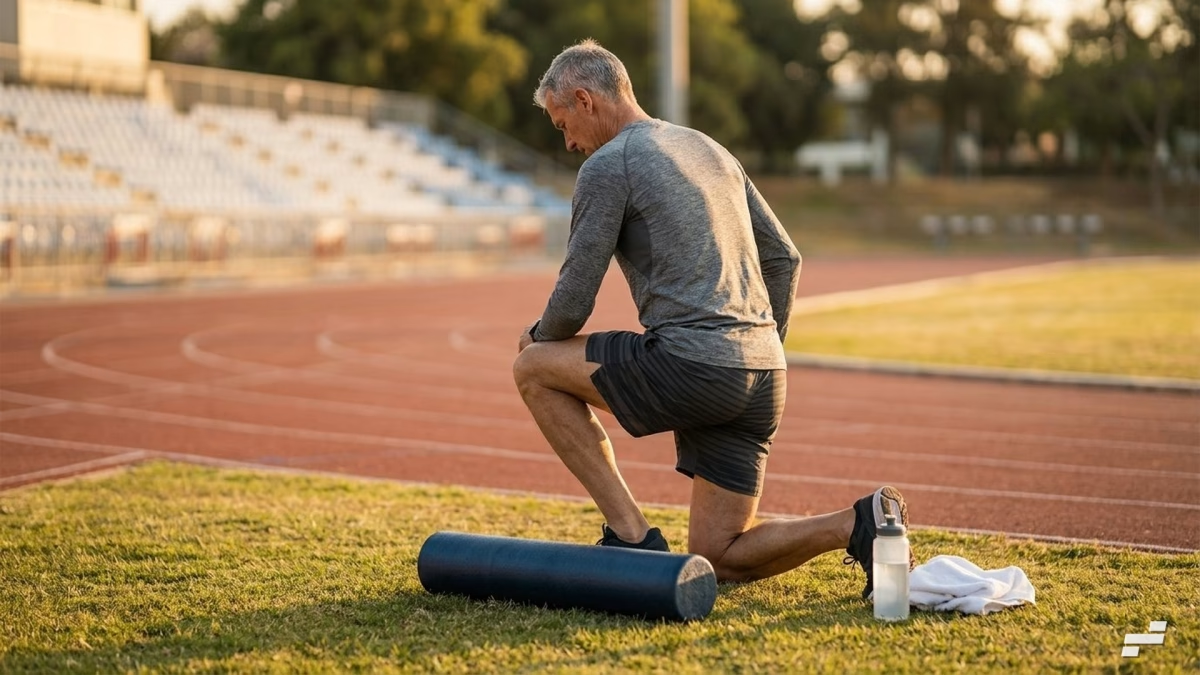
This is the part of the cool-down that gets the airtime: the stretches, the foam roller, the mobility circuit. It is also where the gap between effort spent and benefit returned is widest. None of it is harmful in normal doses. Most of it simply returns less than its place in the routine implies, and a coach who knows the real return can spend an athlete’s time more effectively.
The table below sorts the common running cool-down exercises by what the evidence supports, so the rest of this section can explain the reasoning instead of just asserting it.
| Cool-down component | What it’s believed to do | What the evidence supports |
| Easy jog to walk | Ease the transition, aid recovery | Genuine: faster cardiovascular and autonomic return to baseline |
| Static stretching | Prevent soreness, prevent injury | Little to none for soreness or injury; modest short-term range-of-motion gain |
| Foam rolling | Reduce soreness, speed recovery | Small reduction in perceived soreness; low cost, reasonable to include |
| Ice baths / cold immersion | Speed recovery | Speeds acute recovery, but can blunt the training adaptation (see next section) |
Static Stretching After Running
Static stretching is the default cool-down activity, and the post-run window is actually a sensible time to do it: the muscles are warm, so they lengthen more easily and the work feels productive. The problem is what coaches expect it to deliver. A 2021 meta-analysis of randomized trials on post-exercise stretching found it does not meaningfully reduce delayed-onset muscle soreness, and its effect on short-term recovery of strength and range of motion is small. The held hamstring stretch is not heading off tomorrow’s stiffness, however much it feels like it should.
That does not make it pointless. If an athlete has a genuine mobility restriction, a tight hip flexor that’s altering their stride, an ankle that won’t dorsiflex through its range, then the warm post-run window is a good time to work on it, and consistent stretching there can hold or improve that range over weeks. The distinction worth teaching: stretch after running to maintain or improve mobility you actually need, not to prevent a soreness it won’t prevent. Prescribed for the right reason, it stays in the routine. Prescribed as injury insurance, it’s selling a guarantee the evidence won’t back.
Foam Rolling and Soft-Tissue Work
Foam rolling sits in a more favorable spot, mostly because it is cheap to include. The research points to a small but real reduction in perceived muscle soreness when athletes roll after hard sessions, without interfering with anything else. It will not transform recovery, and an athlete who rolls religiously is not buying much over one who does not. However, for an athlete who finds it useful and is going to do it anyway, a couple of minutes per major muscle group after a hard session is a low-cost, low-risk addition. The honest framing for the squad is that it is optional comfort with a modest payoff, not a recovery essential. So rank it accordingly when time is short: the easy jog comes first, the rolling comes only if there is time left.
When a Cool-Down Helps Most, and When to Skip It
The right cool-down is not one routine applied to every session. It is a response to what the session just did to the body, and sessions differ enormously. The warm-up question is how far the body is from the demand it’s about to meet. The cool-down question is the mirror image: how far the effort just taken has pushed the body from baseline. A session that barely left baseline has barely anything to come down from. A session that drove heart rate to its ceiling and emptied the tank needs the descent managed on purpose.
That gives a simple rule for the active portion. The harder and more intense the session, the more the cool-down earns its place. After a track session, a hard tempo, or a race effort, the few minutes of easy jogging matter, both for the cardiovascular descent and to avoid the stop-dead lightheadedness. After an easy run or a recovery run, there is almost nothing to manage, and the run already finished at cool-down pace. A formal cool-down on an easy day is a solution to a problem the day did not create. Tell the athlete to walk the last few minutes and call it done.
This is also the honest answer for the athlete who is simply out of time. When the choice is a compressed cool-down or none at all, the session itself decides. After the hard stuff, protect the jog to walk and drop everything else. After the easy stuff, there is nothing to protect, and walking to the car is a complete cool-down. The athlete is not cutting a corner. They are matching the cool-down to the work, which is what it should have been doing all along.
Race day is its own case, and a crowded one. After a 5K or 10K, where the athlete redlined and then stopped hard at the line, a cool-down jog is genuinely useful, assuming the legs can give it. After a marathon, the math flips. The athlete has been running for hours, glycogen is gone, and the muscle damage is already done. A cool-down jog there only adds fatigue to a system with nothing left to gain from it. Walk, refuel, get warm. The cool-down jog that suits a 10K is the wrong prescription for the marathon finisher.
The Refueling Trade-Off Worth Weighing
Here is the consideration that turns a long cool-down from harmless into counterproductive. After a glycogen-depleting session, the body’s priority is refueling, and the muscles are primed to take carbohydrate back up in the window right after the effort. A long, energetic cool-down keeps burning the very fuel the athlete needs to start replacing. Van Hooren and Peake note that an extended active cool-down can interfere with muscle glycogen resynthesis. For an athlete training again inside a day, that is a real cost. The fifteen-minute “recovery” jog can leave them less recovered for tomorrow, not more.
The Ice Bath Challenge
Cold immersion carries a sharper version of the same trade-off. An ice bath does speed acute recovery, which is why it is tempting in a heavy training block or between rounds of competition. However, regularly using cold-water immersion after training has been shown to blunt the long-term adaptations the training was meant to produce, dampening some of the muscle-building signaling the session’s stress was supposed to trigger. The cold bath that helps an athlete feel fresh tomorrow can quietly cost them the adaptation they trained for over the block. There is a place for it in-season, when freshness for the next race outranks long-term gain. In a build phase, when adaptation is the entire point, routine ice baths work against the goal. The question is not whether it aids recovery. It is what you are trading for that recovery, and whether you want to make that trade right now.
Building the Running Cool-Down Into the Plan

Knowing what the cool-down does is one thing. Getting it prescribed correctly across a squad, and actually done, is another. A coach is not advising one athlete who will weigh the options carefully. A coach is prescribing across a group, for sessions of wildly different intensity, to athletes who will quietly drop whatever is not spelled out.
The fix is to attach the cool-down to the session rather than leave it as a standing instruction. “Cool down afterward” gets read as anything from a thorough fifteen minutes to nothing at all, and it usually drifts toward nothing once the athlete is tired and the car is right there. A cool-down written into the session, with the same specificity as the main set, gets done. Here is a template scaled by session type, built on everything above.
| Session type | Active portion | Add-ons worth specifying | Skip |
| Easy / recovery run | None needed; walk the last few minutes | None | Formal cool-down, stretching circuit |
| Tempo / threshold | 5–8 min easy jog to walk | Optional mobility on a real restriction | Long stretching as “recovery” |
| Intervals / track | 8–10 min easy jog to walk, descend fully | Foam rolling if time; mobility if needed | Stopping dead after the last rep |
| 5K–10K race | 8–10 min easy jog once legs allow | Light mobility | Skipping it; this is where it counts |
| Marathon | Walk only, refuel, get warm | None | Cool-down jog on emptied legs |
The pattern across the table follows the physiology. The active portion scales with how hard the session drove the system. The stretching is demoted to a conditional add-on rather than the centerpiece. And two sessions get an explicit instruction to do less. That last column matters as much as the first. Telling an athlete what to skip is what keeps the cool-down from quietly inflating back into a fifteen-minute routine the moment nobody is watching.
The compliance problem is worth naming directly, because it is where the prescription lives or dies. The cool-down is the easiest part of the session to skip and the part with the least immediate consequence for skipping it, which is exactly why it gets skipped. Nobody runs visibly worse tomorrow because they did not jog for six minutes today. So the move is not to oversell it, because athletes can tell when they are being oversold. The move is to make the prescription small enough and specific enough that there is nothing to argue with. Eight minutes of easy jogging after the track session, written next to the reps, is harder to ignore than a vague principle about the value of cooling down.
Coach the Running Cool-Down You Can Defend
The cool-down came down to most of us as a fifteen-minute package, and a good deal of the package does not hold up. The stretching is not preventing tomorrow’s soreness. Nothing in the routine is flushing lactic acid, because that was never the problem. The injury-prevention claim has no evidence behind it. Asking athletes to spend fifteen minutes on a return that mostly is not there is a hard sell, and athletes can feel the difference, which is part of why the cool-down is the first thing they drop.
What survives the cut is smaller and easier to defend. The easy jog that walks the cardiovascular and nervous systems down from a hard effort is doing real work, especially after the sessions that drove things hardest. Mobility work earns its place when there is an actual restriction to address. Foam rolling is fine if an athlete likes it. And after some sessions, the easy day, the marathon, the right cool-down is to do less, refuel, and let the body get on with the adaptation it just earned.
The traps are specific, and they are easy to inherit without noticing. There is the stretching circuit kept on as injury insurance, holding its place in the routine long after the evidence stopped supporting it. There is the athlete who sprints the last rep, stops dead, and goes gray at the trackside because the walk was never coached. There is the fifteen-minute jog and the ice bath added to every hard session in a build phase, quietly eating the adaptations the block was built to produce. In each case the answer is not more cool-down. It is the right cool-down, matched to what the session actually did.
That is the version worth coaching: short, specific, scaled to the session, and honest about its limits. It is also the version athletes will actually do, partly because you are not asking them to take anything on faith, and partly because it respects the time they do not have.

Coach every session, start to finish
Suggested References
- Van Hooren, B., & Peake, J. M. (2018). Do We Need a Cool-Down After Exercise? A Narrative Review of the Psychophysiological Effects and the Effects on Performance, Injuries and the Long-Term Adaptive Response. Sports Medicine, 48(7), 1575–1595. https://pubmed.ncbi.nlm.nih.gov/29663142/
- Afonso, J., Clemente, F. M., Nakamura, F. Y., et al. (2021). The Effectiveness of Post-exercise Stretching in Short-Term and Delayed Recovery of Strength, Range of Motion and Delayed Onset Muscle Soreness: A Systematic Review and Meta-Analysis of Randomized Controlled Trials. Frontiers in Physiology, 12, 677581. https://www.frontiersin.org/journals/physiology/articles/10.3389/fphys.2021.677581/full
- Michael, S., Graham, K. S., & Davis, G. M. (2017). Cardiac Autonomic Responses during Exercise and Post-exercise Recovery Using Heart Rate Variability and Systolic Time Intervals: A Review. Frontiers in Physiology, 8, 301. https://pmc.ncbi.nlm.nih.gov/articles/PMC5447093/