Couch to 10K Plan: Beginner Progression to 10K

Choosing a 10K as a first race is ambitious, and most people who choose it have a reason. Often there is history: indoor soccer on Thursday nights until a few years ago, a couple of seasons of lacrosse at college, years of a sport that involved plenty of running without ever being called running. Sometimes a 5K has already happened, for a charity or with people from work, and it turned out to be more manageable than expected. Sometimes 10 kilometers simply sounds like a distance worth training for.
The ambition is usually accurate, and the fitness that’s been earned through those other sports is real. What twelve weeks have to build is the part that fitness does not cover. Those sports were played in bursts, with the running broken up by stoppages, substitutions and halftime. A 10K takes most first-timers somewhere between 70 and 90 minutes of moving forward, and every minute of it lands on the same bones, tendons and joints. Breathing and the heart often cope with that sooner than expected. Being able to absorb that much time on your feet is what takes the twelve weeks.
The training comes to roughly three hours a week for three months, most of it slower than feels dignified. Three sessions a week, at least one rest day between them, and every session run at an effort that still allows a full sentence out loud. The first six weeks turn intermittent jogging into half an hour of continuous running. The last six stretch that toward the time a 10K takes.
Key Takeaways for Coaches
- Twelve weeks, three sessions a week. The first six build continuous running out of run/walk intervals. The last six build the duration to carry it 10 kilometers.
- Every session is run at conversational effort. That control matters more than any number in the schedule.
- Sessions are prescribed in minutes rather than kilometers, so a slow day costs nothing extra. Week 10’s long run is the one that gets measured by distance, as a dress rehearsal for the race.
- The twelve weeks are fixed, because the race date is. A hard or missed week gets repeated and the build absorbs it, so you arrive at race day a little less far along instead of risking injury or fatigue by jumping ahead.
- The race is longer than any training session, so it is run to a planned run/walk structure that gets rehearsed in week 10 rather than improvised on the day.
- Pain that changes your stride, or that is still there the next morning, is a different signal from ordinary fatigue and calls for a drop back rather than a repeated week.
The 12-Week Couch to 10K Plan
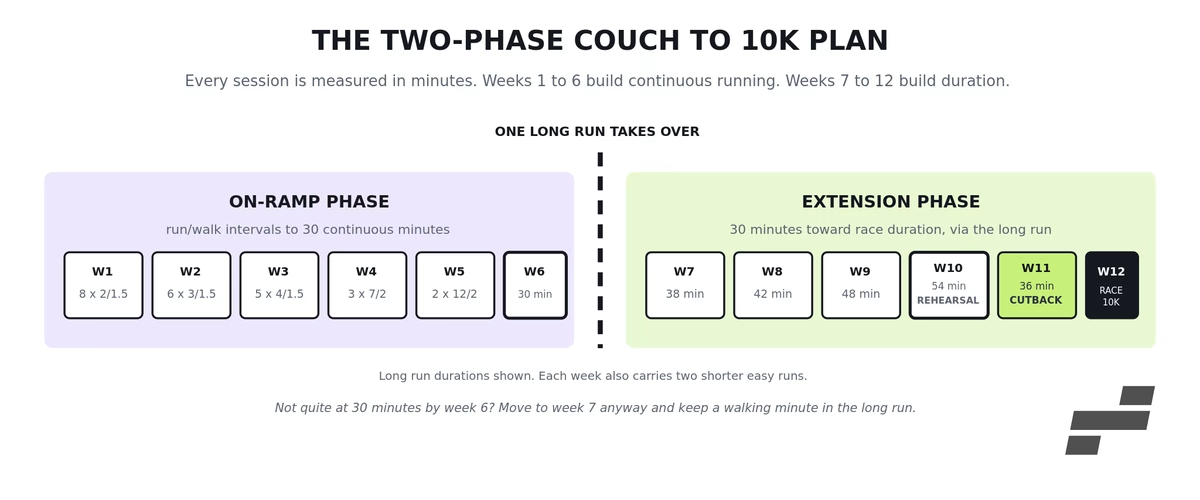
A couch to 10K plan is a twelve-week program that takes a near-beginner from short run/walk intervals to finishing a 10K race, training three times a week. The first six weeks turn intermittent jogging into an unbroken 30-minute run by lengthening the run segments faster than they shorten the walk breaks, which is the same run/walk method our couch to 5K plan spreads across nine weeks. The last six take that half hour and stretch it toward the time a 10K will take, built around one long run that grows each week while the other two sessions hold steady.
Every session opens with five minutes of brisk walking and closes the same way, with at least one rest day between sessions. The distances in brackets are what those minutes come to at around 7:30 per kilometer, or roughly 12 minutes per mile, which is where most new runners settle.
| Week | Session 1 | Session 2 | Session 3 | Phase |
| 1 | 8 × (2 min run / 90 sec walk) | 8 × (2 min run / 90 sec walk) | 8 × (2 min run / 90 sec walk) | On-ramp |
| 2 | 6 × (3 min run / 90 sec walk) | 6 × (3 min run / 90 sec walk) | 6 × (3 min run / 90 sec walk) | On-ramp |
| 3 | 5 × (4 min run / 90 sec walk) | 5 × (4 min run / 90 sec walk) | 4 × (5 min run / 2 min walk) | On-ramp |
| 4 | 3 × (7 min run / 2 min walk) | 3 × (7 min run / 2 min walk) | 2 × (10 min run / 2 min walk) | On-ramp |
| 5 | 2 × (12 min run / 2 min walk) | 2 × (12 min run / 2 min walk) | 20 min continuous | On-ramp |
| 6 | 22 min continuous | 26 min continuous | 30 min continuous | On-ramp ends |
| Week | Session 1 | Session 2 | Long run | Phase |
| 7 | 22 min easy (~3 km / 1.8 mi) | 22 min easy (~3 km / 1.8 mi) | 38 min (~5 km / 3.1 mi) | Extension begins |
| 8 | 22 min easy (~3 km / 1.8 mi) | 26 min easy (~3.5 km / 2.2 mi) | 42 min (~5.5 km / 3.5 mi) | Extension |
| 9 | 22 min easy (~3 km / 1.8 mi) | 28 min easy (~3.7 km / 2.3 mi) | 48 min (~6.4 km / 4 mi) | Extension |
| 10 | 22 min easy (~3 km / 1.8 mi) | 30 min easy (~4 km / 2.5 mi) | 54 min dress rehearsal, run 9 min / walk 1 min | Peak |
| 11 | 22 min easy (~3 km / 1.8 mi) | 22 min easy (~3 km / 1.8 mi) | 36 min (~4.8 km / 3 mi) | Cutback week |
| 12 | 26 min easy (~3.5 km / 2.2 mi) | 20 min easy (~2.7 km / 1.7 mi) | Race day: 10K | Race week |
Week 7 is written for a runner who has reached about half an hour of continuous running, and most people get there on schedule. Anyone who is not quite there should still move into week 7 and break the long run with a walking minute wherever it is needed, for as many weeks as it takes.
How Hard Each Session Should Feel
Every session in this plan is run at conversational effort, meaning you can speak a full sentence out loud without gasping between the words. If that is not possible, the pace is wrong, whatever the watch says. That single control governs all twelve weeks, and it keeps governing long afterward, since easy running stays the bulk of a trained runner’s plan for the same reasons it makes up all of this one.
Minutes rather than kilometers is deliberate. Thirty-eight minutes is thirty-eight minutes whether it covers five kilometers or four and a half, so a heavy-legged day still delivers its full dose and nothing extra. A distance target behaves the opposite way. On a tired day it simply takes longer, and every extra minute is load the schedule never planned for, arriving on the day the body was least able to take it. A number to complete also pulls at the pace, which is how easy runs drift from conversational to labored without anyone deciding to run harder.
The Long Run Carries the Second Half
From week 7, one session each week is longer than the other two and it carries the second half. The long run is where the body meets durations it has not held before, where fueling turns into a practical question rather than a theoretical one, and where the demand of race day gets rehearsed at something close to its real length. The two shorter runs keep the week’s rhythm without competing with it, which gives a priority rule for a week that has to lose a session: it loses a short one. Our article on the long run covers how that session behaves once a runner has a few years behind them.
The Week 10 Dress Rehearsal
One session needs a distance on it, and that is the last long run before the race. That run is 54 minutes in week 10: 9 minutes of running and 1 minute of walking from the start, on a measured route or with a watch that records what it covers.
Most runners at this stage come back with something in the region of 6 to 7 kilometers, and that number is what makes race day predictable. It says roughly how long 10 kilometers will take at an effort already held for the best part of an hour, and it turns the run/walk structure from an idea into something the legs have done. It is run on tired legs on purpose, four weeks into a build, which is the state the finishing kilometers of the race will find you in.
Why the Last Two Weeks Come Down
Weekly running time in the second half moves from 82 minutes in week 7 to 90, then 98, then 106 in week 10. Each rise stays under 10 percent on the week before it. Nielsen and colleagues (2014) found that novice runners who increased how much they ran each week sharply got injured more often than those who built up gradually, so 10 percent works as a ceiling to hold to in the weeks when everything feels easy and it is tempting to add more.
After week 10 the load comes down and stays down: 80 minutes in week 11, then 46 before the race itself.
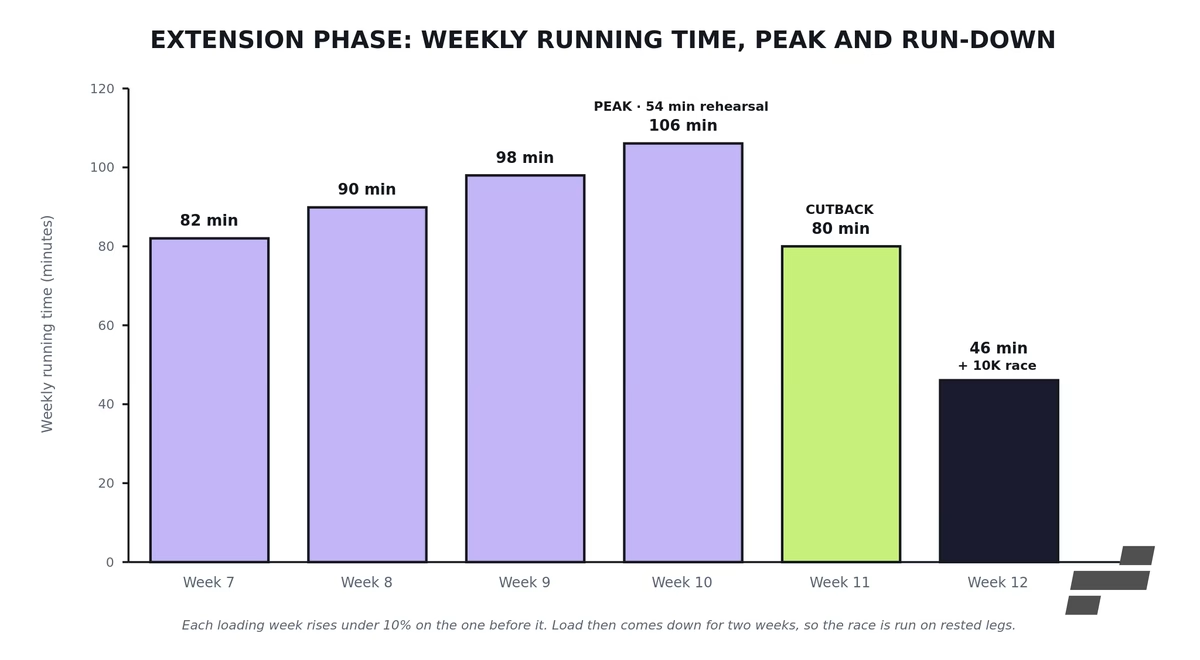
Week 11 can feel like losing ground. There is less running in it than in week 10, at the point when most runners feel they are finally getting somewhere, and a week out from a race the urge to top up is strong. Nothing useful can be added in seven days. What can be added is fatigue, and it will still be there on race morning. Aerobic fitness improves on a weekly timescale and reports back constantly, which is why it feels like the thing to chase. Bone and tendon remodel over months and say very little until they say it all at once. Week 11 and race week are where four weeks of loading get absorbed rather than added to.
When Life Gets in the Way
When there is a choice between staying on schedule and staying cautious, cautious wins. Arriving at race day a little behind the plan costs a few more walking minutes. Arriving hurt, or worn down from catching up, can cost the race.
One missed session is the simplest case. Move it to another day in the same week, keeping a rest day before the long run, and carry on. If the week has no room for it, let one of the shorter runs go rather than the long run.
A week with two or more missed sessions, or one that felt too hard, gets repeated before moving on. Too hard means the long run turned into a grind, or the talk test kept failing in the back half of sessions. Weeks 10 to 12, the rehearsal, the cutback and race week, stay tied to the race date, so a repeated week comes out of the weeks before them.
That leaves one rule to follow for the rest of the plan: a long run is never more than about five minutes longer than the last one you completed comfortably. Repeat week 8, for example, and the week 10 rehearsal becomes about 47 minutes instead of 54, with a little more walking on race day to match. Nothing is lost by taking that route, and any week can be run again.
Pain is different, and it is the one case where the date gives way. Pain that changes your stride while you are running, or that is still there the next morning, is not a repeat-the-week signal. Drop back to the previous week’s durations for two weeks, and if the pain survives the drop back, the next appointment is with a clinician rather than the schedule.
After a stretch with no running at all, come back below where you stopped. One to two weeks off means picking up at the week before the last one completed. After more than two weeks off, keep the race date and lower what you expect from it. Fitness comes back fast, often within a session or two, so a returning runner feels ready for far more than their legs can take. Go back to whatever long run you can finish comfortably and build from there with the five-minute rule, and plan on more walking in the race.
How to Race Your First 10K
The longest run in this plan is 54 minutes, and the race will take 70 to 90. That gap is deliberate. Training all the way to race duration would need two or three more weeks of loading on a body already close to the edge of what it can absorb in three months. Race day supplies the difference on its own: tapered legs, a start line, other people moving at the same time, and an hour of adrenaline.
Plan the Walk Breaks Before the Start
A break taken on a schedule does a different job from a break taken when the legs give out. A structure that works for most first-timers is 9 minutes of running and 1 minute of walking, from the very first kilometer, including the ones where the walk feels unnecessary. Those early breaks do the real work. They protect the last stretch, which is the part beyond anything the plan trained.
Week 10’s long run is written the same way for that reason. A pacing structure used for the first time on race day is a guess. Used once in training, it becomes something the body recognizes: how quickly the legs come back inside that minute, how hard it is to start running again afterward, and how little ground the walk actually costs. The last one surprises most people, since a brisk walk at that stage of a race is not much slower than the shuffle it replaces.
Not every twelve weeks goes to plan, and a race entered back in week 1 is still worth running off an interrupted build. What changes is the ratio. Five minutes running and one minute walking, held from the start, will carry a runner who got as far as week 9 through 10 kilometers without the last third coming apart. Setting that before the gun is what makes it work. Deciding it at kilometer six does not.
Effort in Thirds
Split the race into thirds by feel rather than by pace. The first third should feel embarrassingly easy, easy enough to be slightly uncomfortable while other people stream past. The middle third should feel comfortable and businesslike. Only the final third is allowed to feel like work. Any effort that feels honest at kilometer two is too fast, and kilometer eight is where the runner finds out.
Drinking and Fueling Past the Hour
For an effort lasting more than an hour, drink at the aid stations from the first one onward rather than waiting for thirst. Take in something small and carbohydrate-based at around the 40-minute mark. Jeukendrup (2014) describes measurable benefit from modest carbohydrate intake at efforts of this duration, and the practical point for a first 10K is the timing: the signal that you needed something arrives well after the moment when taking it would have helped.
A gel, a few chews or a sports drink all work, and the one that works best is the one already tried on a long run. Race day is a poor place to discover that a particular gel does not agree with you. For anyone who wants to be more deliberate about it, our nutrition partner NooMinds builds intake plans around an athlete’s own tolerance and session duration, which is worth setting up well before the distances get long enough for fueling to decide the outcome.
After the Finish Line
Twelve weeks of consistent training leave a runner holding three things that outlast the medal: an aerobic base, a weekly rhythm that has survived weather, work and a couple of bad Mondays, and a long run habit. All three transfer to whatever comes next.
Three routes open up from there, depending on appetite. Running a second 10K off the same fitness usually takes several minutes off the time on experience alone, because the first one was run without knowing what the distance feels like, and our 10K race pacing strategy is where that starts. Taking the speed route means a 5K block built for racing rather than finishing, which is a different kind of training and a good use of a winter. Letting the long run keep growing points toward a half marathon later in the year.
Every schedule, this one included, is written for an average body. It cannot see that your left knee is stiff in the mornings, that March has three weeks of travel in it, or that week 4 flattened you while week 9 felt easy. Those are the things that decide how a block of training actually goes, and reading them is what a coach does. If this 10K turns into a half marathon, or the training has to fit around something complicated, that is the point to find someone who can adjust the week in front of you instead of the week that was printed twelve weeks ago. All of it comes down to the same job: getting one specific person from where they are to where they want to be.

Find a Coach for What Comes After Your First 10K
Suggested References
- Videbæk, S., Bueno, A.M., Nielsen, R.O., & Rasmussen, S. (2015). Incidence of Running-Related Injuries Per 1000 h of running in Different Types of Runners: A Systematic Review and Meta-Analysis. Sports Medicine, 45(7), 1017–1026. doi.org/10.1007/s40279-015-0333-8
- Nielsen, R.Ø., Parner, E.T., Nohr, E.A., Sørensen, H., Lind, M., & Rasmussen, S. (2014). Excessive Progression in Weekly Running Distance and Risk of Running-Related Injuries: An Association Which Varies According to Type of Injury. Journal of Orthopaedic & Sports Physical Therapy, 44(10), 739–747. doi.org/10.2519/jospt.2014.5164
- Jeukendrup, A. (2014). A Step Towards Personalized Sports Nutrition: Carbohydrate Intake During Exercise. Sports Medicine, 44(Suppl 1), S25–S33. doi.org/10.1007/s40279-014-0148-z