Tempo Runs for Runners: How to Train at Threshold Pace

The most productive tempo run workout is usually the one that feels slightly too easy. This isn’t just an intuitive coaching “vibe”—it is rooted in the strict physiological principles of the Norwegian Method, which emphasizes controlled intensity to maximize volume. Lactate threshold is a precise metabolic zone; training even slightly above it produces a different adaptation than training at it.
An athlete who finishes every tempo session feeling wrecked has likely transitioned into “no-man’s land,” that is running too fast for threshold adaptation but too slow for VO2max development. When executed correctly, threshold running should leave you feeling “pleasantly taxed,” not exhausted.
The concept isn’t complicated, but the execution of it can be. Things to work through include which formats to use and when, how the prescription changes for a 5K athlete versus a marathoner, where tempo fits in the weekly structure without undermining the long run or the interval session, and how to tell the difference between a tempo block that’s working and one that’s just producing fatigue.
This article covers all of it: the physiology behind threshold training, the three tempo run workout formats and when to schedule them, race-distance-specific programming, and how to diagnose the most common reasons the adaptation stops showing up.
Key Takeaways
- Why running your tempo run workout too fast produces hard sessions with almost none of the threshold adaptation you’re after
- The three tempo formats (sustained, cruise intervals, and progressive) and which one belongs at each stage of a training block
- How the correct tempo running workout looks completely different for a 5K specialist versus a marathon athlete, even at the same fitness levels
- The 48-hour sequencing rule that determines whether your athlete arrives at threshold ready to adapt or just ready to survive
- Four signs your athlete’s tempo training isn’t working, and the specific adjustment that fixes each one
What a Tempo Run Workout Actually Is
A tempo run workout is a sustained effort at lactate threshold pace: the fastest speed at which your body clears lactate as quickly as it produces it. In exercise physiology, this is often referred to as the Maximal Lactate Steady State (MLSS). Run any faster and lactate accumulates, fatigue accelerates, and the session becomes a different physiological stimulus. The session typically lasts 20 to 40 minutes at that effort, either as one continuous block or broken into structured repetitions. That’s the whole definition.
What makes it tricky is that threshold pace isn’t a fixed number. It shifts as fitness develops, and it varies meaningfully between athletes at the same training volume. A runner targeting 19:00 for 5K and a runner targeting 23:00 might both be doing “tempo runs,” but their threshold paces are separated by more than a minute per mile (40 seconds per kilometer).
How to Identify Threshold Pace Without a Lab
Three methods work in practice, and using two of them together is more reliable than either alone.
By feel. Threshold effort is comfortably hard. Conversation is reduced to fragments, three or four words at most. If your athlete can speak in full sentences, they’re below threshold. If they can barely speak at all, they’re above it.
By heart rate. Research on the maximal lactate steady state in trained runners puts threshold at an average of 89 percent of maximum heart rate, with individual variation running from 85 to 92 percent (Hafen & Vehrs, 2018). Use this range as a ceiling check, particularly in heat or altitude when pace targets become unreliable.
By race pace. In Daniels’ Running Formula, Jack Daniels puts threshold pace at approximately 25 to 30 seconds per mile (15 to 19 seconds per kilometer) slower than current 5K race pace. The further an athlete is from a recent race effort, the less reliable this anchor becomes. An athlete whose last 5K was three months ago and who has been training consistently can trust it. An athlete using a time from last season probably can’t.
What Your Body Is Actually Adapting To
Understanding why threshold training works helps coaches prescribe it more precisely and explain to athletes why the pace targets matter.
Two adaptations drive the improvement. First, consistent training at threshold increases mitochondrial mass in the working muscles and upregulates the expression of oxidative enzymes, including citrate synthase and cytochrome oxidase. More mitochondria means the muscles can oxidize lactate faster, processing it as fuel rather than letting it accumulate (Emhoff et al., 2013). Second, endurance training shifts the distribution of lactate dehydrogenase (LDH) toward its H-isoenzyme form, which favors lactate oxidation. In practical terms, the body gets better at converting lactate back into a usable energy source while still running at effort.
The combined result is that the same pace produces less lactate accumulation over time. Threshold pace, as a result, drifts faster as the training block progresses.
This is the clearest way to see whether the training is working. An athlete who enters a block running their tempo run at 7:30 per mile (4:40 per kilometer) and exits it running the same heart rate at 7:12 per mile (4:28 per kilometer) has measurably raised their threshold. The pace changed. The effort didn’t. That gap is the adaptation.
It also explains why running tempo too fast undermines the process. An athlete consistently above threshold is producing lactate faster than these clearance mechanisms can handle. They’re accumulating fatigue, not building capacity. The session is harder, but the physiological signal is different, and so is the outcome.
Three Tempo Run Workout Formats, Three Different Tools
Most runners think of the tempo run as one thing: go out and run hard for twenty minutes. In practice, there are three distinct formats, and each serves a different purpose within a training block. Using only one of them across an entire season is like having three tools in a toolbox and only ever reaching for the same one.
The Sustained Tempo Run
This is the classic format: one continuous block at threshold pace, typically between 20 and 40 minutes. Daniels’ Running Formula recommends capping sustained tempos at 40 minutes. Beyond that point, the effort required to maintain threshold pace starts taxing the system in ways that resemble a race effort more than a training stimulus, and the recovery cost stops being worth it.
The sustained tempo is best used mid-to-late in a training block, once the athlete has already demonstrated they can hold threshold for 20 continuous minutes without pace drift. It builds confidence alongside fitness. An athlete who has run 35 minutes at threshold knows what that effort feels like when it counts.
Cruise Intervals and Broken Tempo
Repetitions at threshold pace separated by 60 to 90 seconds of easy jogging. The recovery isn’t there to make the session easier. It’s there to extend the total time at threshold beyond what a single sustained effort can deliver. A session of 5 × 8 minutes at threshold with 90-second recoveries produces 40 minutes of threshold stimulus that most athletes couldn’t sustain continuously. The accumulated stress is comparable; the in-session fatigue is not.
This format is the better starting point early in a block, or when an athlete is returning from time off. It also allows the coach to run slightly more total threshold volume per session than a sustained tempo permits, because the brief recoveries let lactate stabilize between efforts.
Progressive Tempo Runs
The least discussed of the three formats, and one of the most useful. A progressive tempo starts 10 to 15 seconds per mile (6 to 9 seconds per kilometer) below threshold and builds to threshold pace by the final third of the run. The entire run counts as quality work, not just the final portion.
Two situations call for it specifically. First, athletes who consistently overshoot threshold pace in the opening minutes of a sustained tempo, feel fine for ten minutes, and then fall apart. The progressive format forces the pacing discipline that prevents that early-mile mistake. Second, athletes in the early base phase who don’t yet have the aerobic development to sustain full threshold pace for 20 minutes. Starting below threshold and building toward it provides the training signal without the failure that comes from asking an underprepared athlete to hold a pace they can’t yet sustain.
Each of these formats produces threshold adaptation. However, the format that fits the athlete’s current training phase and fitness level determines whether that adaptation actually shows up.

Tempo Training Running by Race Distance
Threshold pace is the same physiological concept for every runner, but what that means for session structure changes significantly depending on the race being targeted. A 5K specialist and a marathon athlete training at the same threshold pace are doing fundamentally different things with that stimulus.
5K and 10K Athletes
For shorter race distances, threshold pace sits close to race pace. A 5K is run well above threshold; a 10K is run slightly above it. The goal of tempo training for these athletes isn’t to simulate race conditions. It’s to raise the threshold ceiling so that race pace feels less like maximum effort on the day.
For a runner targeting 18:30 for 5K, threshold pace lands at approximately 6:25 per mile (4:00 per kilometer), around 27 seconds per mile (17 seconds per kilometer) slower than their race pace. The format that serves this athlete best is cruise intervals, not sustained tempos. Accumulating 30 to 40 minutes of threshold work in broken efforts, for example 5 × 6 minutes with 60-90 second recoveries, builds the LT ceiling without the muscular fatigue that a long sustained tempo produces. That fatigue matters more here, because 5K and 10K athletes also carry a significant interval load in the same training week.
Two tempo sessions per week is manageable for this group in the build phase, provided the second session is shorter and the formats are varied. Running the same sustained format twice a week at this distance group tends to produce accumulated fatigue rather than progressive adaptation.
For more detail on how this applies to race day execution, see our 10K Race Pacing Strategy guide.
Half Marathon and Marathon Athletes
The relationship between threshold pace and race pace flips for longer events. Half marathon pace sits very close to threshold for well-trained athletes. Marathon pace sits well below it. For both groups, the goal shifts from LT ceiling work to accumulating volume at or near threshold, which raises the entire aerobic floor.
Sustained tempos grow in priority here. A 3:30 marathon athlete’s threshold sits around 7:45 per mile (4:49 per kilometer). Marathon pace for this athlete is closer to 8:00 per mile (4:58 per kilometer). The tempo sessions aren’t rehearsing race effort. They’re raising the aerobic ceiling so that 8:00 pace on tired legs at mile 20 still feels manageable. Consistent threshold work across a training block is what creates that margin.
Progressive tempos work particularly well in the final four to six weeks before a half marathon. An athlete who starts 12 to 15 seconds per mile (7 to 9 seconds per kilometer) below threshold and builds across a 35-minute run is practicing exactly the pacing discipline they’ll need in the first half of their race, where going out even slightly too hard is the most common execution error.
For half marathon race-day application of this, see our How to Pace a Half Marathon: Build Your Race Plan.
Where Tempo Runs Live in the Weekly Structure
The adaptation from a tempo run workout depends as much on what surrounds it in the week as on the session itself. An athlete who hits threshold on tired legs gets a hard effort. They don’t necessarily get a threshold adaptation.
The core rule is straightforward: the athlete needs to arrive at a tempo session with enough glycogen to actually reach and hold threshold. That means placing tempo at least 48 hours after the previous quality session and at least 48 hours before the next one. A long run the day before a tempo isn’t just uncomfortable; it actively compromises the session’s physiological value.
For a runner training five days a week, the structure that holds up best across a block looks like this: a track or tempo on Tuesday, intervals session on Friday, long run on Sunday. That spacing gives 48 hours of recovery on each side of the threshold session. When shifting things around it is important not to compress the quality efforts, which compounds across a block faster than most coaches expect.
How Often Is Enough
During a base phase, one tempo session per week is sufficient for most runners. The aerobic volume is doing the primary work at this stage, and threshold training is supporting it, not leading it.
In the build phase, athletes running higher weekly mileage can absorb a second weekly tempo session, provided the formats are different. A sustained 30-minute tempo on Tuesday and a shorter cruise interval session later in the week targets the same system with enough variation in session structure to avoid accumulated fatigue. Repeating the same format twice a week at high intensity is one of the surer ways to turn a productive training block into an overreaching one.
Coaching tip: If your athlete consistently reports that tempo feels much harder than it should and the scheduling has enough cushion between quality efforts, then the threshold pace has likely been estimated as too fast.
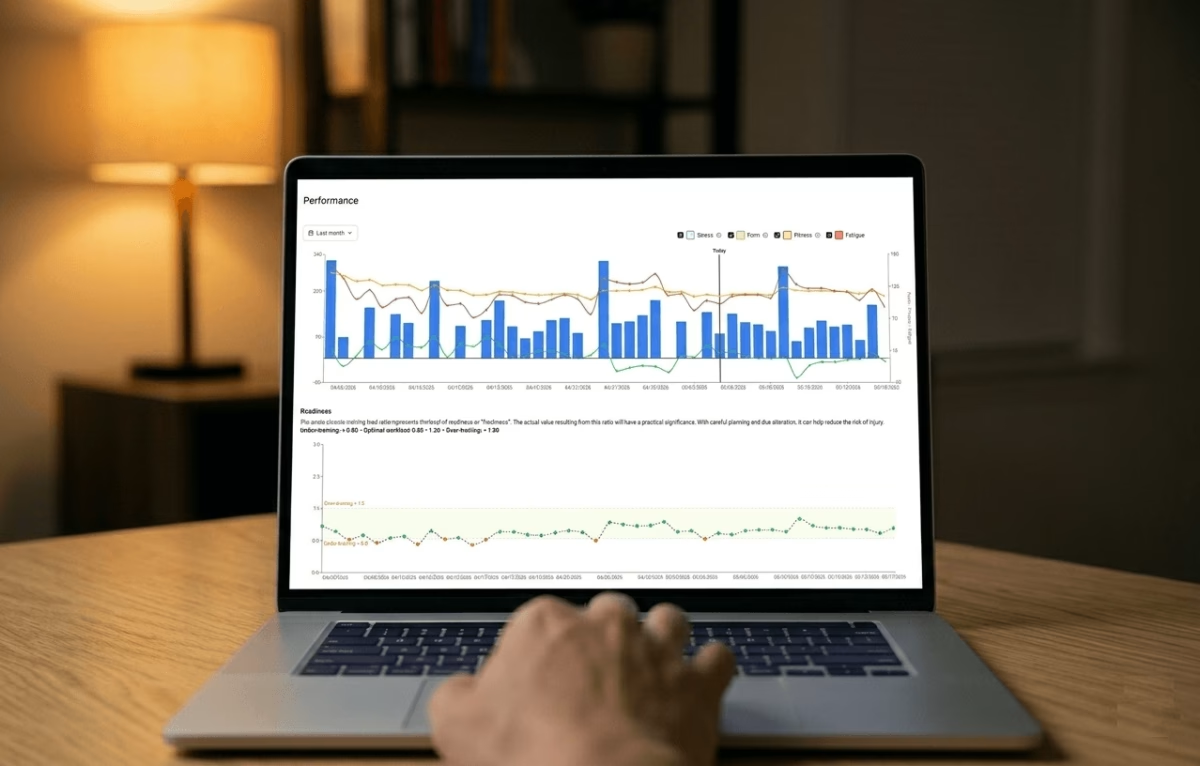
When the Tempo Run Workout Isn’t Working
Four failure modes account for the majority of cases where consistent tempo training produces hard sessions but no measurable threshold improvement. Each one has a different fix.
Running It Too Fast
This is the most common problem, and the hardest to catch from the log alone. If an athlete’s tempo splits are consistently faster than threshold by more than 8 to 10 seconds per mile (5 to 6 seconds per kilometer), they’re producing a different physiological stress than the one the session is designed for. The effort above threshold accumulates lactate faster than the clearance mechanisms can handle, the session tips into something closer to race effort, and the recovery cost rises without the corresponding LT adaptation.
The tell is in the second half of the sssion. An athlete running too fast feels strong through the first 12 to 15 minutes, then either falls apart or has to work visibly harder to hold pace. A well-executed threshold session should feel controlled throughout. If the back half looks ragged in the data, the front half was too fast.
An easy approach is to bring back the pace assignment by a few seconds and to anchor the session to heart rate rather than pace alone.
No Threshold Progression After Six to Eight Weeks
Threshold pace should drift faster as a training block progresses. If an athlete has run consistent weekly tempos for six to eight weeks and the pace at the same heart rate hasn’t moved, examining total weekly volume might be the key. LT adaptations require an aerobic base large enough to support them. An athlete running 25 miles (40 kilometers) per week has a ceiling on threshold response that additional tempo sessions won’t overcome. The fix isn’t more quality work; it’s more easy mileage.
Canceling Tempo When the Athlete Is Tired
Coaches and athletes frequently cancel tempo sessions when fatigue shows up. Sometimes that’s the right call. Often it isn’t. A slightly fatigued threshold run still produces a real training signal.
The question worth asking before pulling the session: is the fatigue systemic, things like illness, disrupted sleep, declining HRV trend, or is it normal accumulated training load from a hard week? Those are different situations with different answers. Systemic fatigue warrants rest. Normal training load usually doesn’t, and the athlete who skips every tempo that doesn’t feel perfect will finish the block undertrained at threshold.
No Warm-Up
An athlete who starts a tempo session at threshold pace from the first step spends the opening 10 to 15 minutes just bringing the physiology to the right place. Cardiac output is still rising, muscle temperature is still climbing, and the metabolic systems needed to sustain threshold pace haven’t fully engaged. In practical terms, a 25-minute tempo with no warm-up might deliver 10 to 12 minutes of actual threshold stimulus.
A genuine 10 to 15 minute easy warm-up before every threshold session isn’t optional. It’s the difference between a session that does what it’s supposed to do and one that looks complete in the log but isn’t.
Getting Threshold Pace Right is the Point
Threshold training is one of the few areas of running physiology where getting the details right makes a bigger difference than working harder. An athlete who has been doing tempo runs for six months at the wrong intensity hasn’t been building their lactate threshold. They’ve been practicing something that looks like threshold training from the outside.
The formats, the pacing, the placement in the weekly structure, the warm-up that most athletes skip: none of these are minor details. Together they determine whether the adaptation actually happens. Coaches who understand what threshold training does and doesn’t do are the ones whose athletes show up to race day with a fitness ceiling that’s measurably higher than it was sixteen weeks earlier. That gap doesn’t come from working harder. It comes from working at the right intensity, in the right format, at the right point in the week.
Retest threshold pace every six to eight weeks. When it moves, update the targets. When it doesn’t, look at the mileage base before adding more quality work.
Tempo Training Is Easier to Track When Your Athletes Are in One Place
EndoGusto gives coaches a single view across their full roster: session data, training load, and athlete feedback. When a Thursday tempo isn’t producing the adaptation you expected, the answer is usually in the data from the 48 hours before it.

Build Smarter Threshold Training With EndoGusto
Suggested References
- Hafen, P.S., & Vehrs, P.R. (2018). Sex-related differences in the maximal lactate steady state. Sports, 6(4), 154. https://www.ncbi.nlm.nih.gov/pmc/articles/PMC6316329/
- Emhoff, C.A., Messonnier, L.A., Horning, M.A., Fattor, J.A., Carlson, T.J., & Brooks, G.A. (2013). Lactate kinetics at the lactate threshold in trained and untrained men. Journal of Applied Physiology, 114(11), 1497–1507. https://pmc.ncbi.nlm.nih.gov/articles/PMC9094885/
- Daniels, J. (2014). Daniels’ Running Formula (3rd ed.). Human Kinetics.