Predict Marathon Finish Time: Tools and Methods

A new athlete shows up to the first session of a marathon build with a number. She ran 1:48 at a spring half marathon, typed it into three different websites that predict marathon finish time, and every marathon finish time predictor gave her the same output: 3:44. She wants to build the block around it.
The coach’s first question shouldn’t be whether the formula is correct. It almost certainly is, mathematically. The question is whether the athlete in front of them has the training history to support what the formula assumes. A 3:44 marathon from a 1:48 half is a reasonable projection for a runner who has spent months averaging 60-plus kilometers per week with consistent quality sessions and well-structured long runs. For a runner coming off 35-kilometer weeks who hasn’t yet built that aerobic foundation, the same number is a ceiling she doesn’t have the base to reach.
The calculator doesn’t know the difference. It sees one race result and extrapolates. That’s all it can do. The coach sees the training log, the weekly volume trend, the marathon pace sessions, and the trajectory of the build. That’s the information that turns a formula output into a goal worth committing to, or a number that needs adjusting before the athlete builds 16 weeks of pacing and effort around something the preparation doesn’t support.
This is the marathon’s particular problem with prediction tools. At shorter distances, the gap between the formula’s assumptions and the athlete’s actual preparation stays small enough to be irrelevant. At 42 kilometers, it becomes the whole story. This article covers how race-based predictions work and where their limits show up at the marathon specifically. It also covers training-based methods that most online marathon finish time predictors ignore entirely. Then it walks through how to combine multiple inputs into a realistic range, and when in the build to commit to a final goal.
Key Takeaways
- Why a calculator can produce a mathematically correct number that a coach should still question, and what the formula measures versus what it assumes about the athlete’s preparation
- Why the half marathon is the strongest single race input for marathon prediction, and why the standard Riegel multiplier consistently underestimates how much recreational runners slow at 42 kilometers
- What Yasso 800s actually tell you, why they overestimate marathon time for speed-focused runners, and how to use them as one calibration point rather than a standalone prediction
- How to read the spread between three inputs (race result, Yasso session, and marathon pace workout data) to build a prediction range that reflects the athlete’s actual preparation
- Why committing to a goal at the start of the build is the most common marathon goal-setting mistake, and the three-step timeline that produces a more reliable target
Why the Marathon Is the Hardest Distance to Predict
Prediction error at the 5K is usually a minute or two. At the 10K, maybe three. At the marathon, recreational runners routinely finish eight, twelve, even twenty minutes off their predicted time. That gap isn’t a flaw in the math. It reflects what the marathon actually tests that shorter distances don’t.
Up to the half marathon, performance is driven primarily by aerobic capacity and running economy. Both transfer well across distances. A runner’s VO2max and stride efficiency set a ceiling that holds from 5K through 21 kilometers reliably enough that a single race result can anchor a useful prediction. Standard formulas, including Riegel’s and Daniels’ VDOT system, were built on this relationship. For a deeper look at how those tools work across all distances, our general race time prediction guide covers both methods in detail.
At the marathon, a third factor takes over: the ability to sustain pace when glycogen stores are depleted and muscular fatigue has accumulated past anything the shorter distances produce. That capacity is built almost entirely through training volume and long-run specificity. It doesn’t show up in a 5K result. It doesn’t fully show up in a half marathon either. Two runners with the same aerobic ceiling can arrive at kilometer 30 in completely different physiological states, depending on whether their training built the specific endurance the marathon’s final third requires.
This is why population-based prediction models lose accuracy at the marathon for a meaningful share of runners. The models capture the average relationship between fitness and marathon performance across a broad sample. However, individual training profiles diverge from that average far more at 42 kilometers than at any other standard distance. The further a runner’s weekly volume and long-run history sit from the dataset’s center, the wider the prediction error becomes.
That doesn’t make prediction tools useless. It makes the choice of method, and the quality of the inputs, more consequential at the marathon than anywhere else.
The Half Marathon: Your Most Reliable Race Input
The single most useful input for predicting marathon finish time from a race result is a recent half marathon. Not a 10K. Not a 5K. The half marathon.
The reason is physiological specificity. When coaches try to predict marathon finish time from a race result, the half marathon gives you the closest approximation of what 42 kilometers actually demands. A 5K measures aerobic ceiling and short-duration speed. A 10K adds a lactate threshold component. The half marathon tests both and introduces something much closer to actual marathon physiology: sustained output over 90 minutes or more, with the glycogen demands and muscular loading that come with it. A runner who held goal pace through 21 kilometers has demonstrated more of what the marathon requires than a runner who ran a fast 10K three weeks ago.
The research supports this. Vickers and Vertosick’s 2016 analysis of 2,303 recreational endurance runners, published in BMC Sports Science, Medicine and Rehabilitation, found that incorporating weekly training mileage alongside race results produced significantly more accurate marathon predictions than race-based formulas alone. Critically, Riegel’s formula was well-calibrated up to the half marathon but consistently overestimated what recreational runners could do at 42 kilometers.
What the Numbers Look Like in Practice
Riegel’s formula applied to a half marathon produces a marathon estimate of roughly 2.08 times the half marathon time. For recreational runners without very high training volume, 2.11 to 2.15 is a more realistic multiplier. The spread matters. Present it as a range, not a single number.
Take an athlete who ran 1:52 at a spring half marathon. Riegel gives 3:53. Applying a 2.13 multiplier gives 3:58. For a runner averaging 52 kilometers per week through a consistent build, the honest planning window is 3:56 to 4:01, not a point estimate. That range is the foundation for the training block: session paces, long run targets, and the race-day goal all get anchored to it.
The runner who knows their half marathon time but doesn’t know their training volume well enough to apply the right multiplier is better served by the wider range than by a precise number that may not hold at kilometer 33.
When There’s No Recent Half Marathon
If your athlete doesn’t have a half marathon result from the past three months, or if their most recent one was run under unusual conditions, race-based prediction becomes less reliable. That isn’t a dead end. It’s a signal to lean harder on training-based methods, which the next sections cover. A tune-up race in the early build, even at 10K, gives you something to work with, but the prediction error widens. A runner with a 48:00 10K gets a Riegel output of 3:40 for the marathon. For someone without a strong history of sustained volume, the honest range is closer to 3:51 to 3:58 once you apply the 5 to 8 percent adjustment that recreational training profiles typically require. A half marathon six to eight weeks before the target race narrows that uncertainty considerably. If neither race input is available, workout data becomes the primary signal, and the prediction range widens accordingly.
Coaching tip: Treat any race-based marathon prediction as a ceiling, not a target. If you’re working from a shorter-distance result, apply a 5 to 8 percent upward adjustment before using it for planning. Use Riegel as a first reference point and a cross-check against training data, not as the final word. If your training-based estimate and the Riegel output are close, that convergence means something. If they’re 12 minutes apart, that gap is worth investigating before committing to a goal.
Three Training-Based Methods Coaches Use

Race results give you a snapshot of fitness on a specific day. Workout data gives you something different: a picture of what the athlete is actually building toward. For coaches who want to predict marathon finish time with any real accuracy, that picture often carries more weight than a single race time, because the workouts are happening in the context of marathon-specific preparation.
These three methods don’t replace race-based inputs. They fill in what race results can’t see.
Yasso 800s
Bart Yasso’s method has been in coaching circulation for decades, and it persists because it’s simple and often surprisingly close. Run 10 × 800 meters with equal recovery. Take your average 800-meter time in minutes and seconds and convert it directly to a marathon prediction in hours and minutes. A runner averaging 3:45 per 800 is predicted to run a 3:45 marathon.
The reason it works at all is that 800-meter repeats sit close to VO2max effort, making them a rough proxy for aerobic ceiling. In practice, the method tends to align best for runners with consistent high mileage and a solid long-run history. The more endurance the athlete has built underneath their speed, the closer the Yasso output sits to actual marathon performance.
Where it breaks down is exactly where marathon prediction matters most. Yasso 800s measure speed and aerobic capacity. They measure almost nothing about the endurance base that determines what happens past kilometer 30. A runner who has done strong speed work but limited long-run volume can post an impressive Yasso session and still fall apart in the final quarter of the race. The workout tells you about the ceiling. It says nothing about whether the foundation can support reaching it.
Use Yasso 800s as one calibration point, not a standalone prediction. If the Yasso result aligns with your race-based estimate, that agreement adds confidence. If it’s significantly faster, treat it as an indicator of aerobic potential the athlete hasn’t yet built the endurance to access on race day.
Marathon Pace Workout Data
If your athlete has completed marathon pace tempo blocks during the build, those workouts are often more predictive than any calculator. A 16-kilometer run at goal marathon pace, completed with stable heart rate and consistent splits, is a direct demonstration of the specific physiological demand the race will place on that runner. A race result at a shorter distance, by contrast, is an indirect inference.
The signals to track across marathon pace workouts are heart rate drift, pace consistency in the final third of the session, and RPE at the target pace. A runner sustaining goal pace through 16 kilometers with steady heart rate and controlled effort is on track. A runner whose pace falls 8 to 10 seconds per kilometer in the final 4 kilometers of the same session is showing you a ceiling the current training load hasn’t cleared yet.
This method is also the most useful tool for athletes who don’t have a recent half marathon result. Three or four marathon pace sessions across the build, tracked carefully, give you enough data to anchor a realistic goal range even without a race input.
Long Run Pace as a Calibration Signal
This is the least precise of the three training-based methods, but it works as a useful floor check when other data is limited. A runner completing long runs of 26 to 30 kilometers at 3-7% slower than their predicted marathon pace, without significant fade in the final 6 kilometers, is demonstrating that the aerobic base can support the distance. A runner who needs to slow considerably more than that, or who fades noticeably in the final stretch, is carrying a prediction their current long-run capacity doesn’t yet support.
The key word is fade. A long run completed at an even effort throughout tells you one thing. A long run that starts at the right relative pace and slows progressively through the back half tells you something different. The absolute pace matters less than what the pace costs the athlete across the full duration.
Long run data doesn’t give you a specific finish time. What it gives you is a confidence check on the estimates your other methods have produced. If the long runs are confirming the range, you can trust it more. If they’re contradicting it, the range needs to move.
Predicting Marathon Finish Time From Multiple Inputs
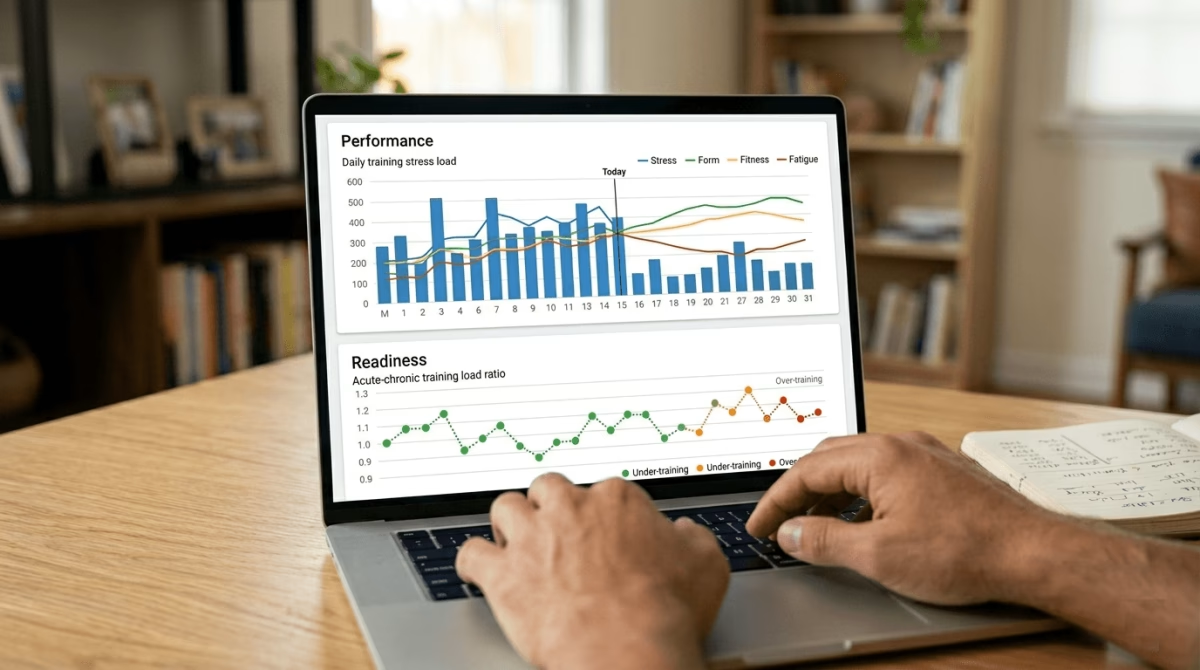
A single input gives you a number. Multiple inputs give you a range. When coaches need to predict marathon finish time reliably, the range is almost always more useful than any single output.
The goal isn’t to average the outputs and land on a single figure. It’s to read what the spread between inputs is actually telling you about the athlete’s current state. When inputs converge, you have a well-grounded target. When they diverge, the gap is information worth acting on before committing to a race-day goal.
Here’s a practical protocol using three data points: a race result, a Yasso session, and marathon pace workout data.
Take an athlete with a 1:46 half marathon from eight weeks ago. Applying the 2.11 to 2.15 multiplier gives a planning window of 3:43 to 3:47. Riegel gives 3:41. Already there’s a spread worth noting. Now add a Yasso session: she averaged 3:28 per 800 across 10 reps. That converts to a 3:28 marathon. Finally, look at her marathon pace workouts. She’s been sustaining goal pace comfortably through 14 kilometers but fading noticeably in the final 2 kilometers of 16-kilometer sessions, dropping 5 to 8 seconds per kilometer in that closing stretch.
Read those three inputs together. The half marathon says 3:43 to 3:47. Riegel says 3:41. Yasso says 3:28. The marathon pace workouts are showing a ceiling at roughly 14 kilometers of sustained effort at goal pace. The Yasso number is almost certainly reflecting her aerobic speed, not her current marathon endurance. The honest working target is 3:45 to 3:49, anchored to the conservative end of the half marathon range and confirmed by what the marathon pace sessions are revealing about her endurance ceiling.
Present that range to the athlete. A runner who goes into a marathon targeting 3:28 because a track session said so, when her marathon pace workouts are flagging a limitation at 14 kilometers, is heading for a difficult final 10.
Convergence works the other way too. If the half marathon, Yasso, and marathon pace data all point to the same window, you can commit to that range with real confidence and build the block accordingly. For more on how to structure that build once the goal is set, the marathon pacing strategy guide covers goal pace anchoring and session design in detail.
The Variables That Blow Up Even Accurate Predictions
A well-calibrated prediction range can still miss. Not because the method was wrong, but because certain variables sit entirely outside what any formula or workout can see. Even the best approach to predict marathon finish time can’t account for everything. At the marathon, three variables stand out.
Training Volume and Specificity
This is the biggest variable, and it’s invisible to every prediction tool that takes only a race time as input. Two athletes with identical half marathon times can finish 20 minutes apart at the marathon if one spent 14 weeks averaging 65 kilometers per week with well-structured long runs and the other patched together 35-kilometer weeks around work and travel.
Before you commit to a goal range, look honestly at whether the athlete’s actual training load over the past 12 weeks is consistent with what the prediction assumes. If it isn’t, the range needs to shift, regardless of what the calculator says.
Taper Quality
A well-executed taper doesn’t add fitness. It allows the fitness already built to show up fully on race day. A botched taper, whether from too much volume in the final two weeks, a minor illness, disrupted sleep, or travel stress, can suppress performance by 5 to 10 minutes even when the underlying preparation is solid.
This cuts both ways. An athlete who tapers well often runs closer to the optimistic end of their prediction range. One who tapers poorly can fall well short of the conservative end.
Race-Day Conditions
Heat, wind, and course profile can each shift actual finish time significantly beyond any prediction baseline. These adjustments should be built into the plan before race week, not improvised after the gun goes off. A hilly course or a warm forecast doesn’t change the athlete’s fitness. It changes how much of that fitness translates to pace on the day.
When in the Build to Commit to a Goal Time
Many coaches and most athletes set a marathon goal at the start of the build and treat it as fixed. That’s backwards. The early weeks of a marathon block are when you have the least data. Committing to a hard number at week sixteen, based on a single race result fed through a tool that claims to predict marathon finish time, and then building fourteen weeks of training around it is the most common goal-setting mistake in training for a marathon.
A more reliable approach moves in three steps.
In the first four weeks, set a provisional range based on whatever race data is available. Train to the midpoint of that range. Don’t communicate a specific goal to the athlete yet. Use this phase to observe how they’re absorbing the training load and how their easy pace feels relative to their predicted fitness level.
Around weeks ten to eight out from the race, the first marathon pace workouts and any tune-up race results give you real calibration data. This is when the range narrows. If the marathon pace sessions are confirming the provisional target, tighten the window. If they’re flagging a ceiling, revise down before the athlete has emotionally committed to a number that the training isn’t supporting.
By weeks four to three out, commit to a final goal. The long runs are done. The marathon pace data is in. The taper is beginning. This is the right moment for a specific number, because now the prediction is built on fourteen weeks of evidence rather than a snapshot from before the build started.
The athlete who arrives at race week with a goal that has been tested and updated across the build is in a fundamentally different position from the one who has been chasing the same number since week one. Every method used to predict marathon finish time, from Riegel to Yasso to marathon pace workouts, gets better when it’s fed fresh data as the build progresses. The prediction isn’t a verdict delivered before the work starts. It’s a working hypothesis that the training either confirms or revises.
From Prediction to Race Plan with EndoGusto
The gap between a predicted time and a realistic race goal is coaching. EndoGusto gives you the training log visibility to close that gap: weekly volume trends, session-level data across your roster, and the context to know whether an athlete’s goal matches what the preparation actually supports.

Turn Your Prediction Into a Training Plan
Suggested References
- Vickers, A.J., & Vertosick, E.A. (2016). An empirical study of race times in recreational endurance runners. BMC Sports Science, Medicine and Rehabilitation, 8(1), 26. https://doi.org/10.1186/s13102-016-0052-y