Triathlon Distances: What Each Format Actually Demands From Coaches

Intro
Triathlon distances are the first variable every coach encounters and the one most often treated as a formality. Sprint, Olympic, half, and full. Most coaches can recite the numbers. Thinking carefully about what those numbers actually change in training is another task altogether.
The difference between a sprint triathlon and a full-distance race is not just duration. It is a different set of constraints on intensity, recovery, fueling, load progression, and injury risk. An athlete who thrives at Olympic distance may struggle at sprint, not because they lack fitness, but because the training problem is fundamentally different. A coach who applies the same planning logic across all four formats will eventually watch an athlete underperform without understanding why.
This article walks through each of the standard triathlon distances from a coaching perspective. It examines what each format typically demands in terms of training emphasis, common mistakes, and practical planning decisions. It is written for coaches who already work with triathletes, as well as those building a conceptual framework before stepping into multisport coaching.
Key Takeaways for Coaches
- Sprint triathlon distances punish technical weakness more than fitness gaps, making skill work a year-round priority.
- Olympic distance is where poor pacing habits become visible, and where coaches can most easily diagnose execution problems.
- Long-distance formats shift the limiting factor from intensity to durability, fueling tolerance, and structural resilience.
- Recovery cost does not scale linearly with distance. Sprint racing can be more disruptive to a training week than coaches expect.
- Triathlon distances should guide training priorities, not define athlete identity or dictate a mandatory progression path.
- The comparison table in this article maps how intensity, volume, fueling, and recovery shift across all four formats.
What Are the Standard Triathlon Distances?
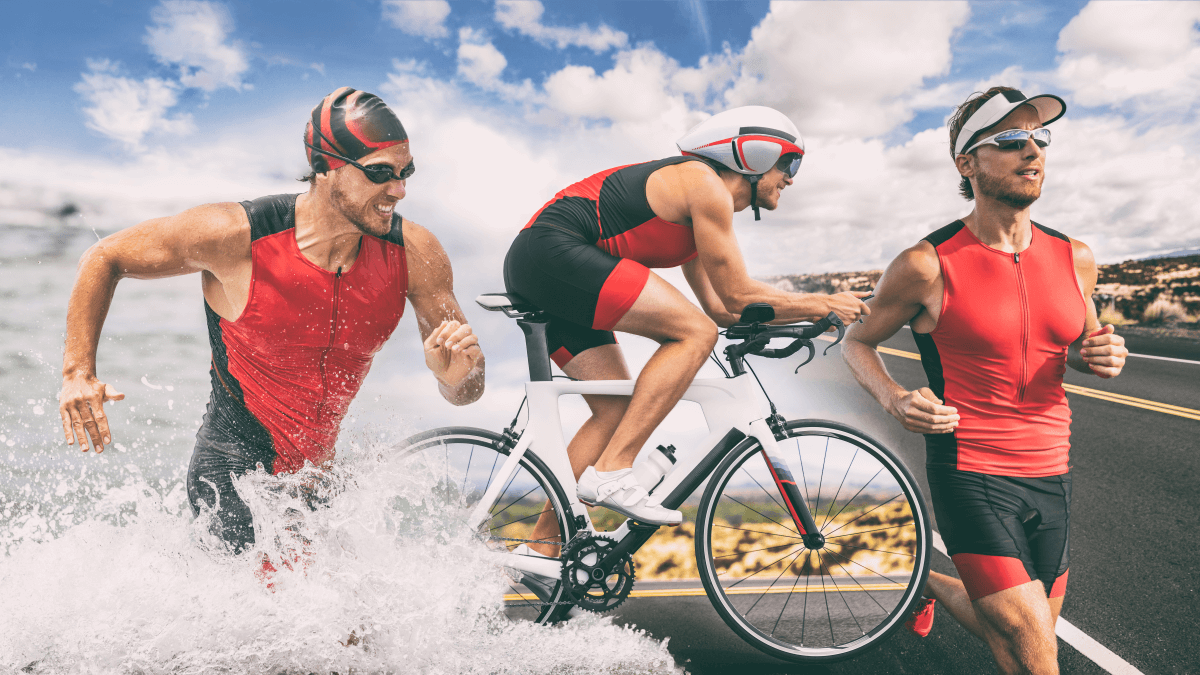
Triathlon consists of swimming, cycling, and running completed consecutively. The sport organizes itself around four primary distance formats, each recognized by World Triathlon and used globally in both amateur and professional competition.
| Format | Swim | Bike | Run | Typical Duration |
| Sprint | 750m | 20 km | 5 km | 60-90 min |
| Olympic | 1.5 km | 40 km | 10 km | 2-3 hrs |
| Half (70.3) | 1.9 km | 90 km | 21.1 km | 4-6 hrs |
| Full | 3.8 km | 180 km | 42.2 km | 8-12+ hrs |
These formats are not a ladder. They are distinct training problems. Each one shifts the balance between intensity, volume, durability, and recovery in ways that should change how a coach writes a training plan. The sections below examine each format individually, then compare them side by side.
Sprint Triathlon Distances (and Coaching Implications)
What Sprint Distance Looks Like in Practice
A sprint triathlon covers 750 meters of swimming, 20 kilometers of cycling, and 5 kilometers of running. Most age-group athletes finish between 60 and 90 minutes, though competitive racers can dip under an hour. That duration places the event squarely in high-end aerobic territory: too long for a pure anaerobic effort, too short for conservative pacing to work.
For coaches, the practical consequence is clear. Sprint distance demands the ability to sustain work near threshold across three disciplines with minimal recovery between them. An athlete who swims 750 meters at 80% of maximum heart rate, then mounts a bike and holds 85% for twenty minutes, then tries to run 5 km at tempo pace is managing a very different physiological challenge than one who paces a four-hour half distance.
Intensity tolerance becomes a key limiter
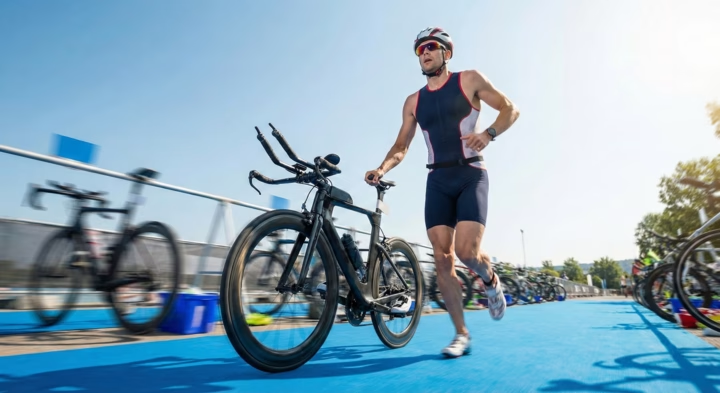
In longer triathlon distances, aerobic base and durability tend to be the primary limiters. At sprint distance, however, intensity tolerance takes over. The athlete who can absorb hard efforts across all three legs and recover between them will outperform someone with a larger aerobic engine but poor high-end capacity.
Consider two athletes with similar training backgrounds. Athlete A averages 4:45/km on a fresh 5 km run. Athlete B averages 4:30. In a standalone race, that gap is significant. Off a hard bike, though, the picture changes. If Athlete A transitions smoothly and holds 4:55, while Athlete B loses coordination and drifts to 5:15, the faster runner finishes behind. Sprint triathlon rewards the athlete who can access their fitness under fatigue, not the one with the best standalone numbers.
Technical Skill Pays Outsized Returns
Because the total race is short, small technical gains have a larger proportional impact. A swimmer who improves their catch by ten percent over 750 meters might save thirty seconds, which is a meaningful margin in a race decided by minutes. Similarly, a clean T1 transition that saves twenty seconds is worth more in a sixty-minute event than in a ten-hour one.
From a coaching standpoint, this means sprint preparation should include more drill work, more transition rehearsal, and more attention to bike handling. These investments compete directly with physiological training for limited training hours, so coaches need to make deliberate choices about where time is best spent.
Recovery Cost Can Be Deceptive
Although sprint distances are shorter, the relative intensity can create a surprisingly high recovery cost—Sprint races are short, but the relative intensity creates a recovery footprint that surprises many coaches. An athlete who races a sprint at 90% effort may need two to three days of reduced training before returning to quality work. Stacking a hard Tuesday interval session after a Sunday sprint race is a common scheduling error that leads to flat training weeks.
The mistake is treating sprint races as low-cost training opportunities. In practice, the neuromuscular and metabolic stress of an all-out sixty-minute effort can disrupt a training block almost as much as a longer, slower race. Coaches should plan for this, especially during race-dense periods in the spring and summer calendar.
Sprint Distance Is Not Only for Beginners
Sprint triathlon is often marketed as an entry point, but competitive sprint racing is genuinely demanding. For advanced athletes, sprint preparation develops speed, intensity tolerance, and race execution skills that transfer to longer formats. For newer athletes, it offers a chance to learn triathlon logistics without the volume demands of longer preparation. In either case, coaches should treat sprint distance as a specific format worth training for, not a stepping stone to be rushed through.
Planning training across triathlon distances?
Olympic Triathlon Distances (and Coaching Implications)
What Olympic Distance Looks Like in Practice
The Olympic format doubles the sprint distances: 1.5 kilometers of swimming, 40 kilometers of cycling, and 10 kilometers of running. Race duration typically falls between two and three hours for age-group athletes. That extra time changes the nature of the challenge in ways that are not immediately obvious.
At two-plus hours, the event is long enough for pacing errors to compound. An athlete who goes out fifteen seconds per kilometer too fast on the swim will arrive on the bike with an elevated heart rate and accelerated glycogen depletion. Unlike a sprint, where the remaining race is short enough to absorb that mistake, an Olympic-distance race gives the error time to grow. By kilometer thirty on the bike, the athlete is working harder than planned. By kilometer seven of the run, they are walking.
Pacing Discipline as the Central Coaching Challenge
Sprint triathlon forgives minor pacing mistakes because the race ends before the consequences fully arrive. Olympic distance does not. For coaches, this makes the format an excellent diagnostic tool. If an athlete consistently reports strong bike legs followed by difficult runs, the problem is almost certainly the bike, not the run.
Training for Olympic distance should therefore include pacing rehearsals: sessions where the athlete practices holding a target intensity that feels slightly conservative in the first half and sustainable in the second. Brick sessions of forty minutes on the bike at race effort followed by fifteen to twenty minutes of running are particularly useful. The goal is not to simulate the full race but to teach the athlete what disciplined output feels like when their body wants to push harder.
Durability Across Disciplines Matters More Than Peak Output
At Olympic distance, the cumulative effect of three disciplines becomes more apparent than at sprint. An athlete may have strong standalone 10 km run fitness, but after a 1.5 km swim and a 40 km bike, that fitness is filtered through fatigue. What matters is not peak capacity but how much of it remains accessible after two hours of sustained effort.
Coaches should prioritize training that develops durability under accumulated load. Longer aerobic sessions, combined bike-run workouts, and progressive long rides with moderate intensity all contribute to this quality. Isolated high-intensity intervals still have a place, but they should serve the goal of sustaining output over time rather than producing short peaks.
Training Balance Becomes More Sensitive
In sprint triathlon, a coach can sometimes get away with heavily emphasizing one discipline. At Olympic distance, imbalance punishes athletes more clearly. Overinvesting in the bike at the expense of run volume, for instance, produces an athlete who posts strong cycling numbers but cannot run effectively afterward.
From a practical planning standpoint, Olympic-distance preparation requires more careful distribution of training stress across all three sports. Coaches should track not just total weekly volume but the split between disciplines, and adjust when one sport begins to dominate at the expense of the others.
Recovery Cost Increases Without Maximal Intensity
Olympic-distance racing feels less explosive than sprint racing, which leads some coaches to underestimate its recovery cost. The total time under load is substantially longer, however, and the stress on connective tissues, particularly in the run, is higher. An athlete who races an Olympic-distance event on Sunday may need a lighter training week than expected, especially if the run was hilly or conditions were warm.
Coaches should account for this in block planning. Back-to-back Olympic-distance races separated by two weeks, for example, require genuine recovery management in between, not just lighter training on Monday and Tuesday.
Long-Distance Triathlon (Half & Full)
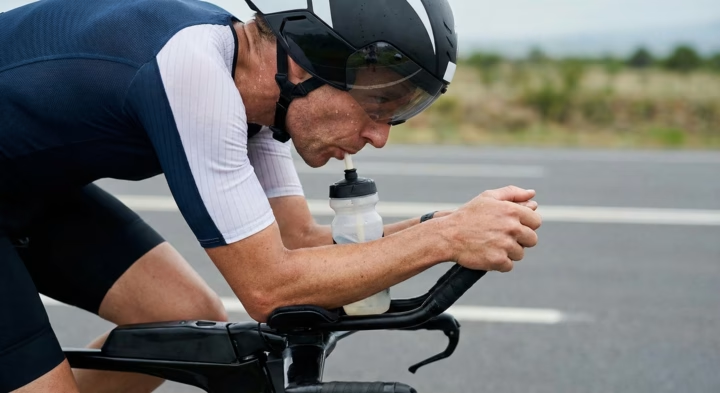
Long-distance triathlon fundamentally changes the coaching problem. Half-distance racing (1.9 km swim, 90 km bike, 21.1 km run) and full-distance racing (3.8 km swim, 180 km bike, 42.2 km run) introduce variables that barely exist in shorter formats. The 70.3 format in particular has distinct coaching demands that are covered in depth in our companion article on 70.3 triathlon distances. This section focuses on the broader coaching principles that apply across both long-distance formats.
Durability and Fatigue Resistance Outweigh Peak Performance
In a sprint triathlon, the athlete with the highest threshold power usually wins. In a full-distance race, the athlete who can maintain 65% of their threshold for ten hours usually wins. These are fundamentally different qualities, and they respond to different training stimuli.
Long-distance preparation prioritizes muscular endurance, structural resilience, and the ability to sustain submaximal workloads for extended periods. An athlete with a 300-watt FTP who can only hold 180 watts after five hours on the bike will be outperformed by one with a 260-watt FTP who can hold 175 watts at hour eight. Peak numbers matter far less than what remains available late in the race.
Fueling Tolerance Becomes a Performance Constraint
Sprint and Olympic racing allow athletes to get by on endogenous carbohydrate stores. Long-distance racing does not. Athletes racing four to twelve hours require structured fueling, typically 60-90 grams of carbohydrate per hour on the bike, and the ability to absorb that intake without gastrointestinal distress.
Fueling tolerance is a trainable adaptation, not a fixed trait. Coaches should integrate fueling rehearsals into long training sessions at least eight weeks before a target race. Athletes who attempt race-day nutrition for the first time on race day are, in effect, rolling the dice on an outcome they could have controlled. Gut training, progressive carbohydrate loading during rides, and testing specific products at race intensity are all coaching responsibilities, not afterthoughts.
Volume Management Becomes Critical
Long-distance preparation demands higher weekly training hours, but volume without structure creates more problems than it solves. An athlete logging fourteen hours of moderate, unstructured riding and running accumulates fatigue without targeted adaptation. Meanwhile, an athlete logging eleven well-sequenced hours, with clear intensity targets and protected recovery days, arrives at the start line both fitter and fresher.
Coaches must also monitor the interaction between volume and injury risk. Connective tissue adapts more slowly than the cardiovascular system. An athlete whose heart rate data suggests readiness for a 22 kilometer run may have Achilles tendons that disagree. Progressive overload, adequate recovery between long efforts, and consistent attention to orthopedic warning signs protect athletes from the breakdown that is common in long-distance preparation.
Recovery Timelines Extend Substantially
After a full-distance race, complete physiological recovery can take four to eight weeks. Even after key training sessions, such as a four-hour bike ride with tempo blocks, recovery windows extend well beyond what shorter-distance athletes require. Coaches should plan for longer recovery periods between hard efforts, slower return to quality work after races, and greater cumulative fatigue across training blocks.
This demands patience from both coach and athlete. The feedback loop in long-distance training is slower. Fitness gains take longer to materialize, and the temptation to add volume or intensity when progress feels stalled is one of the most common coaching errors in this format.
Comparing Triathlon Distances: What Changes for Training?
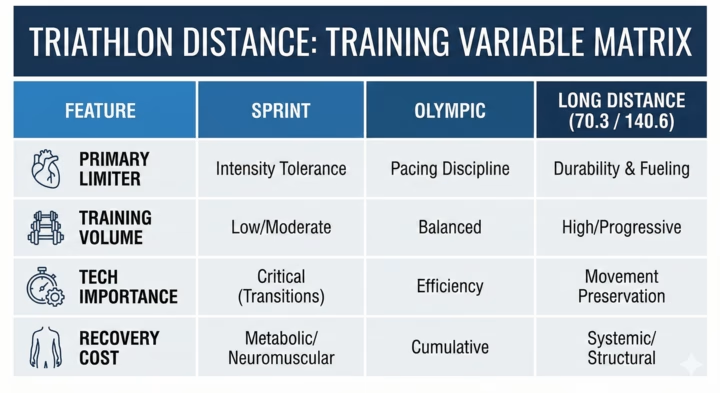
Triathlon distances are often presented as a simple progression from short to long. In practice, each format shifts the training problem in multiple directions at once. The table below maps how key variables change across formats.
| Variable | Sprint | Olympic | Half | Full |
| Intensity Role | Primary Limiter | Important but must be paced | Sustained sub-threshold | Supportive only |
| Volume Demand | Low | Moderate | High | Very high |
| Key Limiter | Intensity tolerance | Pacing discipline | Durability + fueling | Fatigue resistance |
| Fueling Need | Minimal | Optional (moderate) | Mandatory | Critical |
| Recovery Cost | High (intensity-driven) | Moderate-high | High (volume-driven) | Very high |
| Technical Impact | Outsized | Significant | Compounds over hours | Compounds over hours |
The Question Is Not Which Distance Is Harder
Coaches are better served by asking how the training problem changes rather than which format is harder. A sprint triathlon is not easier than a full distance. It is a different kind of difficult. The athlete who wins a competitive sprint has trained intensity tolerance, technical execution, and fast recovery between disciplines. The athlete who finishes a full distance well has trained durability, fueling tolerance, and emotional patience. Both require serious, distance-specific preparation.
Intensity Distribution Shifts, Not Just Volume
As race distance increases, the role of intensity changes in kind, not just in degree. Sprint training includes meaningful exposure to threshold and supra-threshold work. Olympic training balances threshold with longer aerobic development. Long-distance training makes intensity a supporting tool rather than the main stimulus.
Coaches who apply sprint-style intensity distribution to long-distance athletes produce fast, fragile performers. Conversely, coaches who prescribe only slow aerobic work for sprint athletes produce durable runners who lack the top-end capacity to race competitively. Matching intensity structure to target distance is one of the most consequential planning decisions a coach makes.
Recovery Dynamics Are Distance-Specific
Shorter does not always mean less recovery. Sprint racing generates high neuromuscular and metabolic stress concentrated into a brief effort. The recovery pattern is sharp: the athlete feels terrible for a day or two and then bounces back quickly. Long-distance racing, in contrast, generates deep structural and systemic fatigue that resolves slowly over weeks.
Olympic distance sits in between, producing a blend of intensity-driven and volume-driven fatigue. Coaches should plan recovery protocols that match the fatigue profile of each format rather than applying a one-size-fits-all approach
How Coaches Should Use Distance When Planning Training
Understanding triathlon distances is only useful if it changes how training is planned. Distance should function as a constraint that shapes decisions, not as a label that triggers a template.
Use Distance to Define Priorities, Not Identity
One of the most common coaching errors is allowing distance to define what an athlete is rather than what they need. A sprint-focused athlete may still require significant aerobic development. A long-distance athlete may still benefit from structured threshold work. Distance guides emphasis; it should not exclude any training element entirely.
An athlete preparing for a sprint triathlon, for example, still needs a solid aerobic base. Without it, their ability to recover between hard efforts across three disciplines is compromised. Similarly, a full-distance athlete who never trains above 75% of threshold arrives at race day without the neuromuscular sharpness to hold target watts when conditions get difficult.
Let Distance Inform Load Progression
The rate at which training load can safely increase depends on target distance. Sprint preparation allows relatively fast load progression because the total training stress is lower and feedback cycles are short. An athlete can attempt a sprint race, evaluate performance, adjust training, and race again within four to six weeks.
Long-distance preparation, in contrast, requires longer build phases, more conservative load increases, and greater patience. Attempting to compress a twenty-week full-distance build into twelve weeks, a common request from athletes, usually produces undertrained or injured athletes rather than faster ones. Coaches should use distance to set realistic timelines and manage expectations accordingly.
Adjust Expectations Around Adaptation Speed
Shorter triathlon distances produce faster observable results. An athlete training for a sprint triathlon may see meaningful improvements in four to six weeks. An athlete preparing for a full-distance race may train for twelve weeks before any benchmark session reflects the underlying fitness gains.
This mismatch between effort and visible progress is a leading cause of athlete frustration in long-distance preparation. Coaches who explain this dynamic upfront, and who use intermediate markers such as heart rate efficiency on the bike or pace-to-perceived-exertion ratios on the run, keep athletes engaged and confident through the long middle of a training block.
Avoid Treating Distance as a Linear Progression
Moving from sprint to Olympic to half to full is often presented as a natural path. For many athletes, however, it is neither natural nor necessary. Some athletes are biomechanically and temperamentally suited to shorter formats. Others thrive at long distance from relatively early in their triathlon careers.
Performance development does not require increasing distance. An athlete who races sprint triathlons for three seasons, progressively improving execution and intensity tolerance, is developing just as meaningfully as one who moves from sprint to Olympic to half distance in the same period. Coaches should match distance to the individual, not to a generic progression model.

Applying Distance-Based Training in Practice
Each triathlon distance creates a different training problem, and coaches need tools that reflect those differences. Sprint preparation organized around key intensity sessions has different monitoring needs than a full-distance build structured around progressive long rides and fueling rehearsals.
EndoGusto supports coaches by providing a structured environment to plan, monitor, and adjust training load across swim, bike, and run within one integrated system. By visualizing discipline-specific stress and progression over time, coaches can make informed decisions about load distribution, recovery timing, and intensity balance, regardless of whether the athlete is preparing for a sixty-minute sprint or a twelve-hour full distance.