Running Cadence Training: How to Use Step Rate Without Chasing 180
In 1984, a coach sat in the stands at the Los Angeles Olympics with a notebook and started counting steps. Jack Daniels watched elite distance runners come through, tallied their turnover, and noticed that nearly all of them were landing at least 180 times a minute. He wrote it down. Four decades later, that single tally has hardened into a rule, printed on watch faces and built into training software that flags anything under 174 as a problem to fix.
The number itself was never wrong. What happened to it was. An observation about elite athletes racing at the front of an Olympic final became a target handed to every runner on every easy jog, a setting to dial in rather than a readout of what the body is already doing. Running cadence training works better when you read step rate as a signal, not a number to chase.
That distinction changes how you coach it. Cadence isn’t a control you set directly. It settles wherever pace, strength, mobility, and fatigue leave it, which means the useful question is rarely “how do I get this runner to 180.” It’s “what is this runner’s cadence telling me, and which input do I change to move it.” This article covers how to read step rate, when raising it actually helps, when to leave it alone, and the drills and training that shift it for real. The watch can show you the number. What you do with it is the coaching.
Key Takeaways for Coaches
- Cadence is an output of pace, strength, and fatigue, so the most reliable way to change it is to change those inputs rather than drill the number on its own.
- The 180 figure came from elite runners racing in 1984, which makes it a landmark for the fast end of the pace range, not a target for easy running.
- Cadence scales with pace, so the same runner is correctly quicker on a tempo than on a recovery jog, and one fixed target ignores that.
- A roughly 5 to 10 percent increase from a runner’s own baseline is where the injury-load research actually sits, not a jump to an absolute number.
- Raising cadence shifts load off the knee and onto the calf and Achilles, so a runner’s injury history decides whether the change is worth making.
- Reading cadence trends across a training file, the drift late in a long run, the collapse on downhills, the slow decoupling from pace, tells you more than any single average.
What Running Cadence Actually Measures
Running cadence is the number of steps you take per minute, counting both feet. It’s also called step rate. A watch reports it automatically; you can also count one foot’s strikes for 30 seconds and multiply by four. Most recreational runners land somewhere between 155 and 180 steps per minute, and the right figure for any individual depends on their height, speed, and mechanics.
A step is one footfall to the next, left to right. A stride is a full cycle, left to left, so your stride rate is exactly half your step rate. Cadence is almost always reported as steps per minute, but the two terms get swapped often enough that a 90 and a 180 can describe the same runner. When you read a number off a file, know which one the device is counting. At EndoGusto, we display cadence as steps per minute.
The reason cadence matters at all comes down to one equation. Your pace is cadence multiplied by stride length, nothing else. To run a given speed, you cover so much ground per step and take so many steps per minute, and those two numbers have to produce the pace. That means there are only two levers. You can land more often, or you can travel farther each time you land.
That equation is also why cadence can’t be judged in isolation. A runner at 165 steps per minute might be perfectly efficient or badly overstriding, and the number alone won’t tell you which. What settles it is the other lever: how far the stride is reaching, and whether the foot is landing under the body or out in front of it. Cadence is one half of a pair, and it only makes sense read alongside the other half.
Why 180 Steps Per Minute Became the Rule
A number that described one situation got applied to every situation. Daniels counted around 46 runners, and all but one were at 180 or above. Every one of them was racing, most over 5K and 10K distances, at paces far quicker than anything a recreational runner holds on a Tuesday morning. The 180 figure was a floor for elite athletes running fast, not an average for everyone running easy. Somewhere along the way the floor became a target, and the racing context fell off entirely.
Two things get lost in that translation. The first is pace. Those elite runners weren’t at 180 all the time; they were at 180 while racing. Drop the same athletes to an easy recovery pace and their cadence drops with it. A number measured at the fast end of the range tells you almost nothing about where a runner should be at the slow end.
The second is body size, and this is where the rule breaks down most clearly. When Burns and colleagues tracked cadence in 100-kilometer ultramarathon runners, height turned out to be the strongest physical predictor of step rate, ahead of speed, training volume, and experience. Taller runners have longer levers. A longer leg covers more ground per swing, so it naturally turns over less often at the same pace. Push a 6’2″ runner to hit 180 on an easy run and you’ll usually get a choppy, stuttering stride that costs more energy than it saves. The number didn’t fit, because the body didn’t fit the number.
None of this makes 180 useless. For a runner who’s shuffling along at 150 with a long, reaching stride, nudging toward a quicker turnover is sound advice, and 180 sits in the right neighborhood as a rough ceiling to aim under. The figure works as a landmark for one part of the pace and body-size range. It stops working the moment it’s treated as a single correct answer for runners of every height moving at every speed.
Cadence Is an Output, Not a Dial
Your body already picks a cadence, and it doesn’t pick randomly. Left alone, runners settle into a step rate that costs them the least energy for the pace they’re holding. Cavanagh and Williams (1982) showed this directly: when they had runners shift their stride frequency away from the one they’d chosen on their own, oxygen consumption went up in nearly every direction they moved it. The self-selected rate was the efficient one. The body had already solved the problem.
That finding has a sharp coaching consequence. When you set a metronome 12 steps a minute above what a runner naturally does and ask them to hold it with nothing else changed, you’re not making them more efficient. You’re often making them less efficient, raising their heart rate to sustain a turnover their body didn’t choose. The number on the watch goes up. The cost of running goes up with it. That’s not an improvement, it’s a tax.
So if the number isn’t the thing you set, what is? Cadence moves when the inputs underneath it move. Run faster and it rises on its own, because at a quicker pace the efficient solution shifts toward more frequent, shorter steps. Build strength in the hips and glutes and a runner can produce force faster, which lifts turnover without any conscious effort. Open up stiff ankles and a restricted stride frees into a quicker one. Let fatigue accumulate late in a long run and cadence usually sags as the muscles that drive turnover give out. In every case the step rate is reporting on something else.
This is why “improve your cadence” is the wrong instruction and “improve the thing that’s holding your cadence down” is the right one. The two produce different training. The first sends a runner out with a metronome to grind toward a number. The second asks what’s actually capping their turnover, then trains that, and lets the cadence follow. One treats the readout as the target. The other treats it as the diagnostic it really is.
Not every runner has something holding their cadence down. Some are already turning over efficiently for their body and their pace. Before you train cadence at all, you have to know which runner is in front of you.
When Cadence Work Actually Helps (and When to Leave It Alone)

Cadence training pays off for some runners and does nothing for others. The work of coaching it well is mostly the work of telling those groups apart before you hand anyone a metronome. Three patterns cover most of what you’ll see, and each one points to a different decision.
The Overstrider
This is the runner cadence work was made for. The step rate sits low, often down around 150 to 160 at an easy pace, and it’s low because the stride is reaching too far in front of the body. The foot lands ahead of the hips with the leg extended, which acts like a brake on every step and sends impact straight up through a relatively straight knee. Quicker, shorter steps pull the landing back underneath the runner, and the braking eases.
The injury case here is well supported. Heiderscheit and colleagues (2011) had 45 runners adjust their step rate above and below their preferred rate and measured what happened at the joints. A modest increase of around 5 to 10 percent meaningfully cut the energy absorbed at the knee and the load through the hip. For a runner whose low cadence is producing a long, braking stride, that’s a direct path to lessen the load that drives knee pain and shin trouble. The cadence change is worth making because of what it does to the stride, not because of the number itself.
The Already-Efficient Runner
Plenty of runners show up turning over just fine. A runner cruising at 172 on an easy run with the foot landing cleanly under the body doesn’t have a cadence problem to solve. Pushing them toward 180 because a watch flagged 172 as low adds cost and choppiness in exchange for nothing. Their body has already found its efficient rate for that pace, and the right coaching move is to leave it alone and spend the attention somewhere it matters. A metric being lower than a famous number is not the same as a metric being wrong.
The Strength- or Mobility-Limited Runner
The third runner has a low cadence that’s real but not fixable with turnover cues, because the turnover isn’t the actual limit. Weak hips and glutes mean force comes out slowly, so the leg can’t recycle fast enough to support a quicker step. Stiff ankles or hips cap how the stride moves, and the body compensates with a slower, longer reach. Put this runner on a metronome and they’ll fight it the whole run, because you’re asking for an output their current strength and range can’t produce. The fix is upstream. Train the hips and the ankle mobility, and the cadence rises on its own once the limit is gone.
The practical takeaway across all three: cadence is a starting question, not an answer. A low number tells you to look closer, not to immediately train it upward. What you find when you look closer, a braking overstride, an already-efficient stride, or a strength limit wearing a cadence disguise, is what decides whether you touch it at all.
How to Improve Running Cadence Without Forcing a Number
Once you’ve decided a runner clearly needs more turnover, running cadence training becomes a question of method: how to get it without buying the choppy, expensive stride from earlier. The answer is to work from the runner’s own baseline and change it in small steps, not to point them at 180 and hope.
Start From the Baseline, Then Move 5 to 10 Percent
Measure before you change anything. Have the runner do an easy run at a normal, comfortable pace and read the cadence off the watch, or count one foot’s strikes for 30 seconds and multiply by four. That number is the starting point, and it’s specific to this runner at this pace. A target only means something relative to it.
From there, aim for a 5 to 10 percent increase, not a fixed destination. A runner at 158 is working toward roughly 166 to 174, not 180. This matters because the injury-load research was built on percentage shifts from a preferred rate, not on absolute numbers. A 5 to 10 percent nudge is enough to pull the foot back under the body and ease the braking, while staying close enough to the efficient rate that the energy cost barely moves. Jump straight to a number 20 steps above baseline and you get the tax, not the benefit.
One detail worth holding onto: most of the supporting work was done on treadmills at steady speeds, and real running happens on changing ground at changing paces. A 2021 study by Musgjerd and colleagues tested cadence increases outdoors and found the impact-force reductions held up in a real-world setting, which is reassuring for coaches prescribing this to runners training on roads and trails rather than in a lab.
Use Sound Cues, But Briefly
A metronome or a beat-matched playlist is the simplest way to feel a new turnover. Set the metronome to the target step rate and the runner’s feet tend to fall into the rhythm without conscious effort, an effect called auditory-motor entrainment: the motor system locks onto a steady external beat. A consistent click works better than music for this, because the tempo never drifts the way a song does.
The mistake is running with it the whole time. Better to use it in short blocks, a few minutes at a time inside an easy run, so the runner learns the feel and then tries to hold it without the cue. The goal is for the new turnover to become the body’s default, which only happens when the runner practices producing it themselves. A metronome running for sixty straight minutes trains dependence on the metronome. Short, repeated exposures train the cadence.
Cadence Running Drills and Exercises That Build Turnover

The drills side of running cadence training is narrow but useful. A handful of exercises target turnover specifically, either by letting a runner feel a faster cadence safely or by building the strength and range that let cadence rise on its own. These work best as additions to a runner’s week, not replacements for running. For how drills earn their place in a session and actually transfer to the run, Running Drills That Carry Into the Run covers the broader picture. What follows here stays specific to cadence.
Downhill Strides and Short-Step Pickups
A gentle downhill does the work for you. Running down a slight grade, the slope pulls the legs into a quicker turnover than the runner would produce on the flat, so they get to feel a higher cadence without consciously forcing it. Keep it gentle, a slope shallow enough that the runner stays controlled and isn’t braking down it, and keep the reps short, 20 to 30 seconds. The point is the sensation of quick, light feet, not a hard effort.
Short-step pickups work on flat ground and need no equipment. The runner deliberately takes faster, shorter steps for 20 or 30 seconds, lands lightly under the body, then jogs easily to recover. These cadence running drills aren’t about speed; they’re about rehearsing a turnover and a foot strike, then letting the body remember the feel. A few reps at the end of an easy run is plenty. Done regularly, they build a quicker default without a metronome.
Strength and Mobility, the Real Lever
For a lot of runners, the thing capping cadence isn’t the cadence, it’s what’s underneath it. Two categories of running cadence exercises address that directly.
For force production, hip and glute strength lets the leg drive and recover faster, which is what a quicker turnover physically requires. Single-leg work like step-ups, split squats, and hip thrusts builds the drive. Calf and foot strength, through heel raises and hops, supports the faster ground contact that a higher cadence asks for, which also matters because raising cadence shifts load toward the calf and Achilles. A runner with injury history in those areas should build the tissue before leaning on the turnover.
For range, stiff ankles and hips force a slower, longer reach. Ankle mobility work and hip flexor and hip extension drills open up the room a quicker stride needs. When the limit is range rather than effort, this is what lets the cadence climb on its own. You’re not training the number. You’re improving what held it down.
Reading Cadence in the Training File
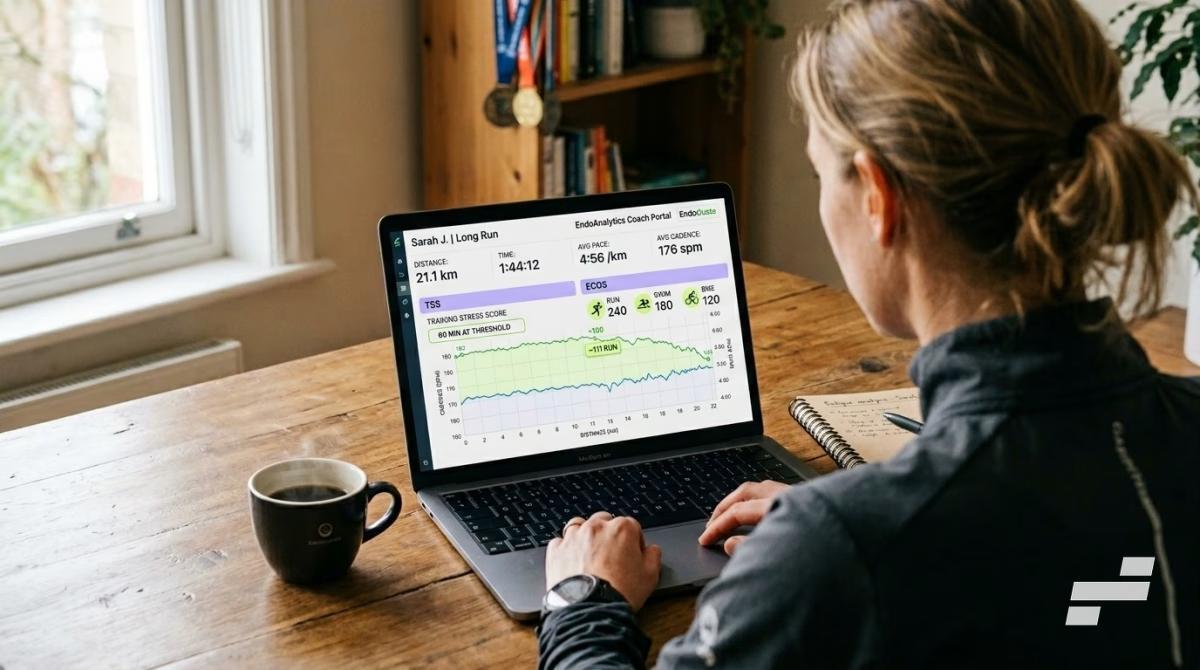
A single cadence average hides almost everything useful. The number that matters is how step rate behaves across a run, because the pattern is where the diagnosis lives. Three patterns come up often enough to watch for, and each one points somewhere specific.
The first is cadence drifting down late in a long run. Early on the runner holds, say, 170, and by the final few kilometers they’re at 162 at the same pace or slower. That sag is the muscles that drive turnover starting to fatigue, and it usually shows in the file before the runner reports the legs feeling heavy. It’s an early read on durability, the quality long run training is built to develop. A runner whose cadence falls apart at kilometer 24 of 28 is telling you their strength endurance runs out before the distance does, which is a training target, not a race-day surprise to discover later.
The second is cadence collapsing on downhills. If step rate drops sharply every time the elevation does, the runner is braking down the hills, reaching the foot out front to control the descent instead of turning over and flowing down it. That’s overstriding showing up exactly where it costs the most, since downhill braking loads the knee hardest. It’s also one of the more coachable patterns, because quicker, lighter steps on the descent fix it directly.
The third is the slow one, and the one easiest to miss: pace held steady while cadence quietly drifts down over weeks. The runner is maintaining their times, so nothing looks wrong, but they’re holding pace by lengthening the stride rather than keeping turnover up. That’s creeping overstride, and it tends to surface as a niggle long before it surfaces in the splits. Catching it in the file is the whole advantage of watching the trend instead of the average.
Coaching tip: When a runner reports a new ache but their paces look fine, pull up cadence over the last several weeks before anything else. A turnover that’s quietly drifted down while pace held steady is often the mechanical story behind an injury that otherwise looks like it came from nowhere.
The table below maps the common patterns to what’s likely behind them and what to do next.
| What the cadence pattern shows | Likely cause | Coaching response |
| Drops late in a long run, same pace | Turnover muscles fatiguing; strength-endurance limit | Build strength endurance; treat as a durability target, not race-day luck |
| Collapses on downhills | Braking overstride controlling the descent | Cue quick, light steps downhill; practice flowing descents |
| Pace steady, cadence drifting down over weeks | Creeping overstride, stride lengthening to hold pace | Reintroduce short-step pickups; recheck before a niggle becomes an injury |
| Spikes well above baseline, heart rate climbs with it | Forced turnover above the efficient rate | Back off the target; let cadence settle nearer the self-selected rate |
Building Cadence Into a Training Plan
Running cadence training belongs on easy days. The instinct is to attach it to hard sessions, but a runner doing intervals already has pace, effort, and form to manage, and adding a turnover target to that load means something gets dropped. Easy runs have the spare attention. A few short pickups or a couple of metronome blocks inside a relaxed aerobic run is enough, and it leaves the quality sessions to do their own job.
Give the change time, and be honest about how much. A new cadence starts to feel less alien within about two to four weeks of consistent, low-key practice. Feeling natural is not the same as being automatic, though. For a new turnover to hold up under fatigue at the end of a long run or a race, when it matters most, it needs a full training block of reinforcement, not a fortnight. Treat the early comfort as the first sign it’s working, not the finish line.
The runners who change their cadence for good are rarely the ones who chased the number hardest. They’re the ones who trained the limit underneath it and let the turnover follow, then practiced the new feel often enough on easy days that it stopped being a thing they had to think about.
The Number Is a Signal, Not a Target
Two runners can show the same cadence on a watch and need opposite things from their coach. One is overstriding into a braking, knee-loading pattern and has a lot to gain from quicker steps. The other is already efficient for their height and pace, and the same intervention would only cost them. The average on the file doesn’t separate them. Reading what the number is reporting on does.
That’s the shift worth making with running cadence training. Step rate isn’t a dial you turn up toward a famous number. It’s one of the clearest signals a runner’s body sends about pace, strength, mobility, and fatigue, and a coach who reads it that way makes a sharper call than one chasing 180 for everybody.
Tracking your athletes’ runs through EndoGusto lets you see how turnover holds up across a long run, behaves on the descents, and shifts over a training block, so you catch the drift while there’s still time to do something about it.

See What Your Athletes’ Cadence Is Really Telling You
Suggested References
- Heiderscheit, B.C., Chumanov, E.S., Michalski, M.P., Wille, C.M., & Ryan, M.B. (2011). Effects of step rate manipulation on joint mechanics during running. Medicine & Science in Sports & Exercise, 43(2), 296-302. https://pmc.ncbi.nlm.nih.gov/articles/PMC3022995/
- Cavanagh, P.R., & Williams, K.R. (1982). The effect of stride length variation on oxygen uptake during distance running. Medicine & Science in Sports & Exercise, 14(1), 30-35. https://pubmed.ncbi.nlm.nih.gov/7154893/
- Musgjerd, T., Anason, J., Rutherford, D., & Kernozek, T.W. (2021). Effect of increasing running cadence on peak impact force in an outdoor environment. International Journal of Sports Physical Therapy, 16(4), 1076-1083. https://pmc.ncbi.nlm.nih.gov/articles/PMC8329321/
- Burns, G.T., Zendler, J.M., & Zernicke, R.F. (2019). Step frequency patterns of elite ultramarathon runners during a 100-km road race. https://pmc.ncbi.nlm.nih.gov/articles/PMC6028232/